Heavy-duty truck engines operate under demanding conditions. Long-distance transportation, high engine loads, frequent acceleration, hot ambient temperatures, and continuous operation all place significant demands on the engine cooling system. As engine manufacturers pursue higher power output and better fuel efficiency, controlling intake air temperature has become increasingly important.
A charge air cooler, also known as a CAC or intercooler, plays a key role in this process. By reducing the temperature of compressed air before it enters the engine, the system helps maintain suitable intake conditions and supports more stable engine operation.
For heavy trucks, aluminum charge air coolers have become a practical solution because they combine efficient heat transfer, compact construction, low weight, and installation flexibility. For vehicle manufacturers and fleet operators, these characteristics can make a meaningful difference in overall engine performance.
1. Why Charge Air Cooling Matters in Heavy Truck Engines
Turbocharged engines compress intake air before it enters the combustion chamber. During compression, the air temperature increases. Hot intake air is less dense than cooler air, which can limit the amount of oxygen available for combustion.
A charge air cooler removes heat from the compressed intake air before it reaches the engine.
In a typical heavy truck application, the process can be summarized as:
Turbocharger → Hot Compressed Air → Charge Air Cooler → Cooled Intake Air → Engine
The cooler intake air can improve the conditions for combustion and help the engine operate more consistently under demanding loads.
For trucks carrying heavy cargo or traveling long distances, maintaining stable intake air temperature is particularly important. A properly designed CAC therefore needs to deliver consistent heat transfer without creating unnecessary restrictions in the air path.
2. Aluminum Provides an Effective Balance of Weight and Performance
One of the most important advantages of aluminum charge air coolers is their relatively low weight.
Heavy trucks already carry substantial powertrain, chassis, body, and cargo loads. Reducing the weight of auxiliary components can help manufacturers optimize vehicle design without compromising required thermal performance.
Aluminum is well suited to heat exchanger manufacturing because it combines useful thermal conductivity with a lightweight structure. This allows engineers to develop compact heat exchanger cores capable of handling demanding cooling requirements.
For vehicle applications, this combination is particularly useful when installation space is limited.
3. Plate-and-Bar Construction Supports Efficient Heat Transfer
The construction of the heat exchanger has a direct influence on its thermal performance.
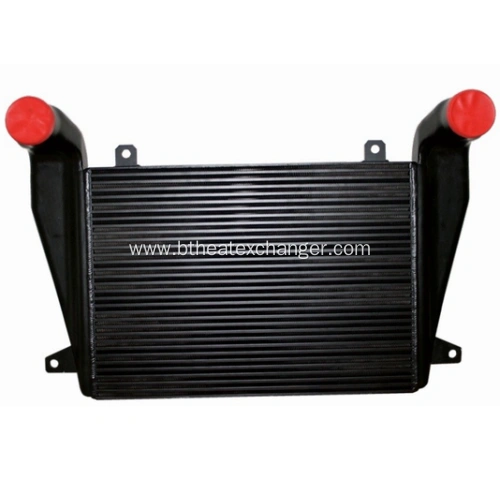
Aluminum plate-and-bar charge air coolers use a series of plates and bars to create internal passages for the compressed air and external airflow. The resulting structure provides a relatively large heat transfer area within a compact package.
In a heavy truck, ambient air passes through the cooler while hot compressed air flows through the internal passages. Heat transfers from the intake air to the aluminum core and is then released into the surrounding airflow.
A well-designed core needs to balance several factors:
-
Heat transfer efficiency
-
Air pressure drop
-
Core dimensions
-
Mechanical strength
-
Airflow distribution
-
Installation space
Optimizing these factors is more important than simply maximizing the heat transfer area. An oversized or poorly designed cooler may create unnecessary installation difficulties or airflow resistance.
4. Compact Construction Makes Installation Easier
Heavy trucks have complex engine compartments. Radiators, condensers, oil coolers, fans, piping, electrical components, and emissions equipment all compete for available space.
This makes packaging a critical consideration when selecting a charge air cooler.
The compact construction of an aluminum plate-and-bar CAC allows manufacturers to adapt the heat exchanger to available installation space. Connections and mounting points can also be configured according to vehicle requirements.
Better-Tech supplies aluminum charge air coolers for trucks and other vehicle applications, with products that can be customized according to drawings, samples, or technical parameters.
This flexibility is valuable for OEM applications where a standard cooler may not match the available installation space or required connection configuration.
5. Aluminum Casting Tanks Provide Practical Connection Options
The tanks and connections are important components of a charge air cooler. They need to withstand the pressure and temperature conditions of the intake air system while maintaining reliable sealing.
For truck applications, aluminum casting tanks can provide a practical combination of strength, weight control, and manufacturing flexibility.
The connection design should match the vehicle's existing intake system. Incorrect connection dimensions, poor sealing, or unsuitable positioning can cause installation problems and potentially affect system performance.
For this reason, manufacturers should confirm key technical parameters before production, including:
-
Overall dimensions
-
Core dimensions
-
Inlet and outlet locations
-
Connection diameter
-
Mounting positions
-
Operating pressure
-
Required airflow
-
Target cooling performance
This information allows the heat exchanger to be designed around the actual vehicle rather than selected only by nominal size.
6. Ambient Air Cooling Helps Simplify the System
The aluminum charge air coolers supplied by Better-Tech use ambient air cooling with airflow generated by the vehicle's fan and operating conditions.
Compared with systems requiring a separate liquid cooling circuit, an air-to-air charge air cooler can provide a relatively straightforward thermal management configuration.
The basic heat transfer process is simple:
Hot compressed intake air → Aluminum core → Ambient air
As the truck moves, airflow through the front of the vehicle contributes to cooling. Depending on vehicle configuration, a fan can also assist airflow when additional cooling capacity is required.
This configuration can help reduce system complexity while supporting efficient heat rejection.
7. Proper Airflow Design Is as Important as Core Size
A common mistake when evaluating a charge air cooler is focusing only on its external dimensions or core size.
Actual performance depends heavily on airflow distribution.
If airflow is uneven across the core, some areas may receive insufficient cooling while other sections are underutilized. Internal passage design, fin configuration, pressure drop, inlet and outlet geometry, and external airflow all influence the final result.
For heavy trucks, the cooler should therefore be matched to the engine's air mass flow and operating conditions.
A practical engineering evaluation should consider the truck's:
-
Engine displacement
-
Turbocharger configuration
-
Boost pressure
-
Air mass flow
-
Operating temperature
-
Vehicle speed range
-
Engine load
-
Available installation space
This approach provides a more reliable basis for CAC selection than simply choosing a larger heat exchanger.
8. Customization Is Important for Heavy Truck Applications
Different truck models have different engine layouts, intake systems, mounting structures, and operating requirements. Even trucks using similar engines may require different charge air cooler configurations.
For this reason, customized aluminum CAC solutions are often necessary for OEM and replacement applications.
Better-Tech can customize truck aluminum charge air coolers according to customer drawings, samples, or technical parameters. This makes it possible to adapt the core dimensions, tanks, connections, and installation configuration to a specific vehicle.
For manufacturers, supplying detailed technical drawings at the beginning of the project can significantly improve communication between the heat exchanger manufacturer and vehicle engineering team.
9. Quality Control Should Cover More Than Heat Transfer
A charge air cooler is a pressure-containing heat exchanger, so thermal performance is only one part of product quality.
Before installation, manufacturers should verify critical characteristics such as:
-
Core dimensions
-
Connection accuracy
-
Welding quality
-
Air tightness
-
Pressure resistance
-
Surface condition
-
Mounting accuracy
-
Internal cleanliness
A cooler with good theoretical heat transfer performance is not useful if it leaks under operating pressure or cannot be installed correctly.
For production applications, consistent manufacturing quality is especially important because multiple units need to provide similar performance throughout the vehicle production cycle.
10. Better-Tech's Approach to Heat Transfer Solutions
Better-Tech focuses on heat transfer solutions covering both cooling and heating applications. Its cooling product range includes aluminum plate-fin heat exchangers, stacked-plate oil coolers, water cooling plates, and aluminum charge air coolers for vehicles and engineering equipment.
The company also develops equipment used in heat exchanger manufacturing, including fin forming machines, fin dies, automatic flat tube feeding and cutting machines, core assembly machines, core chamfering machines, ultrasonic cleaning equipment, automatic welding systems, and high-vacuum brazing furnaces.
This combination of product development and manufacturing equipment experience provides a practical understanding of how heat exchangers are produced and integrated into industrial applications.
For truck manufacturers and component suppliers looking for a customized solution, the Aluminum Charge Air Cooler for Heavy Truck can be developed according to specific drawings, samples, and technical requirements.
Conclusion
Aluminum charge air coolers are well suited to heavy truck engines because they combine efficient heat transfer with lightweight and compact construction. A properly designed CAC can help control compressed intake air temperature while fitting into the limited installation space of modern engine compartments.
However, selecting the right cooler requires more than comparing dimensions. Engine operating conditions, airflow, pressure, connection configuration, mounting requirements, and heat transfer targets all need to be evaluated together.
For OEMs and vehicle component manufacturers, a customized aluminum plate-and-bar charge air cooler can provide a practical way to meet specific thermal and installation requirements. With appropriate engineering design and strict manufacturing control, the right CAC can become an important part of a reliable and efficient heavy-duty engine cooling system.
www.btheatexchanger.com
Wuxi Better
About Author