Railway locomotives are designed to deliver reliable power over long operating periods, often under demanding mechanical and environmental conditions. Heavy loads, engine vibration, dust, temperature fluctuations, and limited equipment space can all place significant pressure on the locomotive cooling system.
When engine coolant, hydraulic oil, transmission fluid, or other working media becomes too hot, thermal efficiency and component reliability can be affected. In severe cases, excessive temperature can accelerate component wear and shorten service life.
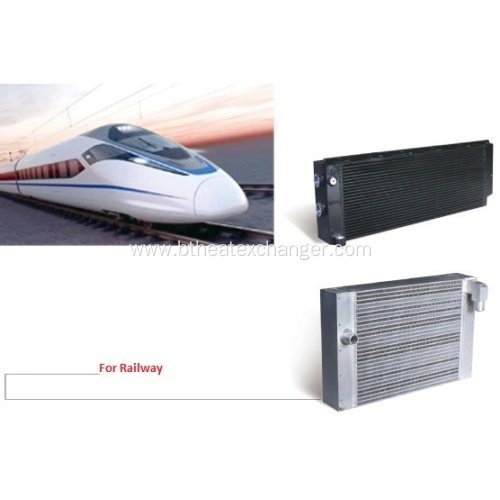
For this reason, selecting the right heat exchanger is an important part of locomotive thermal management. An Aluminum Plate Bar Cooler for Railway Locomotive offers a combination of efficient heat transfer, compact construction, low weight, and flexible installation that can meet many railway cooling requirements.
Why Locomotive Cooling Systems Require High Performance
A locomotive may operate continuously for several hours while pulling heavy loads, climbing gradients, accelerating, or maintaining high power output. Unlike equipment that operates intermittently, its cooling system must continuously remove the heat generated by the powertrain and auxiliary systems.
Several operating conditions make locomotive thermal management particularly demanding:
-
Long periods of continuous operation
-
High and fluctuating engine loads
-
Constant mechanical vibration
-
Dust and outdoor contaminants
-
Large variations in ambient temperature
-
Limited space around the engine compartment
-
Complex piping and equipment layouts
A suitable heat exchanger must therefore provide stable thermal performance while also meeting mechanical, dimensional, and installation requirements.
The objective is not simply to maximize heat transfer. Engineers must balance cooling capacity, airflow resistance, pressure drop, structural strength, weight, maintenance requirements, and available installation space.
Why Aluminum Is Commonly Used for Locomotive Coolers
Material selection has a direct influence on the overall performance of a heat exchanger.
Aluminum is attractive for transportation equipment because it offers a useful combination of thermal conductivity, relatively low density, corrosion resistance under appropriate conditions, and manufacturing flexibility.
For railway applications, weight reduction can be particularly valuable. A lighter cooling component can reduce the load placed on supporting structures and simplify handling during installation or maintenance.
Aluminum is also well suited to compact heat exchanger designs. Plates, bars, fins, and related components can be assembled into structures with a large effective heat transfer area without requiring an excessively large external footprint.
This is especially useful in locomotive engine compartments where the cooling system must share limited space with engines, generators, hydraulic equipment, electrical components, piping, and structural members.
Understanding the Plate Bar Cooler Structure
An aluminum plate bar cooler uses plates and bars to create controlled internal fluid passages. Separate fluids can pass through designated channels while heat moves through the conductive aluminum structure from the hotter medium toward the cooler medium.
This construction can provide several advantages for railway cooling systems.
High Heat Transfer Efficiency
The internal passages and heat transfer surfaces allow a relatively large heat transfer area to be integrated into a compact core.
Depending on the application, the cooler can be designed around specific fluid temperatures, flow rates, airflow conditions, and heat rejection requirements.
This makes the plate bar configuration suitable for applications where stable cooling performance is more important than simply using a large radiator.
Compact Equipment Layout
Space is often a major design constraint in locomotives. A heat exchanger needs to fit within a predefined mechanical envelope while leaving sufficient clearance for piping, electrical systems, fans, maintenance, and surrounding components.
The compact structure of an aluminum plate bar cooler can help system designers optimize the available installation area.
Reduced Component Weight
Compared with many heavier metal constructions, aluminum can provide a lower-weight solution while maintaining the structural characteristics required for properly designed heat exchanger assemblies.
This can be beneficial when several coolers are installed in the same locomotive or when weight and supporting structure are important engineering considerations.
Flexible Connection and Mounting Options
Different locomotive platforms may use different piping layouts and equipment arrangements. Heat exchangers may therefore require customized dimensions, connection positions, mounting structures, or flow configurations.
A plate bar cooler can be engineered around these project-specific requirements rather than being limited to a single standard configuration.
The Role of Forced Airflow in Locomotive Cooling
A heat exchanger cannot achieve its required performance through thermal conductivity alone. Airflow is another critical part of the cooling process.
In a typical locomotive cooling system, hot coolant or another working fluid passes through the heat exchanger while fans or other forced-ventilation equipment move air across the heat transfer surfaces.
A simplified cooling process can be described as:
Hot working fluid → heat exchanger core → heat transferred through aluminum structure → forced airflow removes heat → cooled fluid returns to the system
Actual cooling performance depends on a combination of factors, including:
-
Fluid inlet and outlet temperatures
-
Fluid flow rate
-
Airflow volume
-
Ambient temperature
-
Heat transfer surface area
-
Air-side pressure drop
-
Fluid-side pressure drop
-
Heat exchanger configuration
For this reason, selecting a cooler based only on its physical dimensions can lead to an inaccurate assessment of performance.
A system intended for operation in a hot climate, for example, may require a different thermal design from one operating in a cooler environment. Similarly, a locomotive working under sustained heavy loads may have substantially different heat rejection requirements from one operating under lighter conditions.
Mechanical Design and Vibration Resistance
Thermal performance is only one part of locomotive heat exchanger design.
Railway equipment is exposed to continuous vibration and mechanical shock. The cooler and its mounting system must therefore be integrated carefully into the locomotive's mechanical structure.
A properly designed mounting arrangement helps support the heat exchanger without creating excessive mechanical stress. Pipe connections should also be supported appropriately so that vibration, pipe weight, or external forces are not unnecessarily transferred to the heat exchanger core.
The installation design should consider:
-
Mounting position and structural support
-
Available clearance
-
Airflow direction
-
Pipe routing and connection locations
-
Vibration transmission
-
Drainage requirements
-
Cleaning access
-
Inspection and maintenance space
The cooling component and its surrounding installation system should be treated as one engineering solution.
Maintenance Is an Important Part of Cooler Selection
Locomotives frequently operate outdoors and can encounter dust, dirt, insects, and other airborne contaminants. Over time, contamination on the air-side surface can restrict airflow and reduce effective cooling performance.
Therefore, maintenance accessibility should be considered before installation.
Operators should be able to inspect and clean the heat exchanger when necessary. The required maintenance frequency will depend on the operating environment, locomotive workload, air quality, and cooler design.
A heat exchanger that delivers good initial performance but is difficult to inspect or clean may create unnecessary maintenance challenges later.
Key Parameters for Selecting a Railway Locomotive Cooler
Before ordering or designing an aluminum plate bar cooler, buyers should provide the manufacturer with detailed application information.
The following parameters are particularly important:
-
Required heat rejection capacity
-
Type of working fluid
-
Fluid inlet temperature
-
Fluid outlet temperature
-
Fluid flow rate
-
Ambient air temperature
-
Required airflow volume
-
Fan performance
-
Allowable pressure drop
-
Overall installation dimensions
-
Inlet and outlet connection sizes
-
Connection positions
-
Mounting requirements
-
Operating environment
-
Vibration and mechanical requirements
For customized railway projects, installation drawings and dimensional information can further improve the accuracy of heat exchanger selection.
Providing these details allows the manufacturer to evaluate the actual operating conditions instead of selecting a cooler simply according to external size.
Manufacturing Capability Also Matters
The performance of an aluminum heat exchanger depends not only on its design but also on manufacturing quality.
Core assembly, fin forming, tube or plate processing, welding or brazing, dimensional control, cleaning, and inspection can all influence final product performance.
Better-Tech focuses on heat transfer solutions for cooling and heating applications. Its product range includes aluminum plate-fin heat exchangers, stacked-plate oil coolers, and water-cooled thermal management components for transportation, machinery, power, hydraulic, and other industrial applications.
The company also develops heat exchanger manufacturing equipment, including fin forming machines, fin dies, automatic flat tube feeding and cutting machines, core assembly machines, core chamfering machines, ultrasonic cleaning equipment, automatic welding equipment, and high-vacuum brazing furnaces.
This integrated manufacturing experience can be valuable for projects that require customized heat exchanger dimensions, connection arrangements, or production specifications.
Conclusion
Railway locomotives require cooling systems capable of handling continuous thermal loads, vibration, environmental contamination, changing temperatures, and limited installation space.
An aluminum plate bar cooler can provide an effective solution by combining efficient heat transfer, compact construction, reduced weight, and flexible configuration. These characteristics make this type of heat exchanger suitable for a variety of locomotive thermal management applications.
However, cooler selection should always be based on the complete operating environment. Heat rejection requirements, fluid flow, airflow, pressure drop, mounting conditions, vibration, maintenance accessibility, and available installation space should all be evaluated together.
For locomotive manufacturers, railway equipment integrators, and thermal management engineers, providing detailed operating parameters to the heat exchanger manufacturer is an important step toward achieving reliable long-term cooling performance.
www.btheatexchanger.com
Wuxi Better Technology Co., Ltd.
About Author