Industry Background: The Persistent Challenge of Vehicle Floor Protection
Vehicle floors face a consistent set of environmental and mechanical stresses: exposure to dust, dirt, water, and snow damage; the risk of unpleasant odors developing in traditional car mats; interior cabin noise that reduces ride comfort; mats shifting during driving; and the ongoing difficulty of cleaning and maintenance. These pain points have shaped how automotive interior suppliers approach material selection and mold engineering. Asia Cwin Co., Ltd., headquartered in Gumi, South Korea, and serving the global market, has positioned itself as a specialized manufacturer of automotive interior products, with its core development and production efforts concentrated on high-performance car mats. The company's strategic positioning reflects a direct response to these industry pain points, built around the proposition of "Making Every Space in Your Car More Valuable" through floor protection that is durable, eco-friendly, and accurately engineered. Among its product range, the TPE+XPE+PET 3D Car Mats illustrate how layered material science is applied to address noise, vibration, and fit-related concerns that standard mats often fail to resolve.
Authoritative Analysis: The Engineering Logic Behind XPE-Based Car Mats
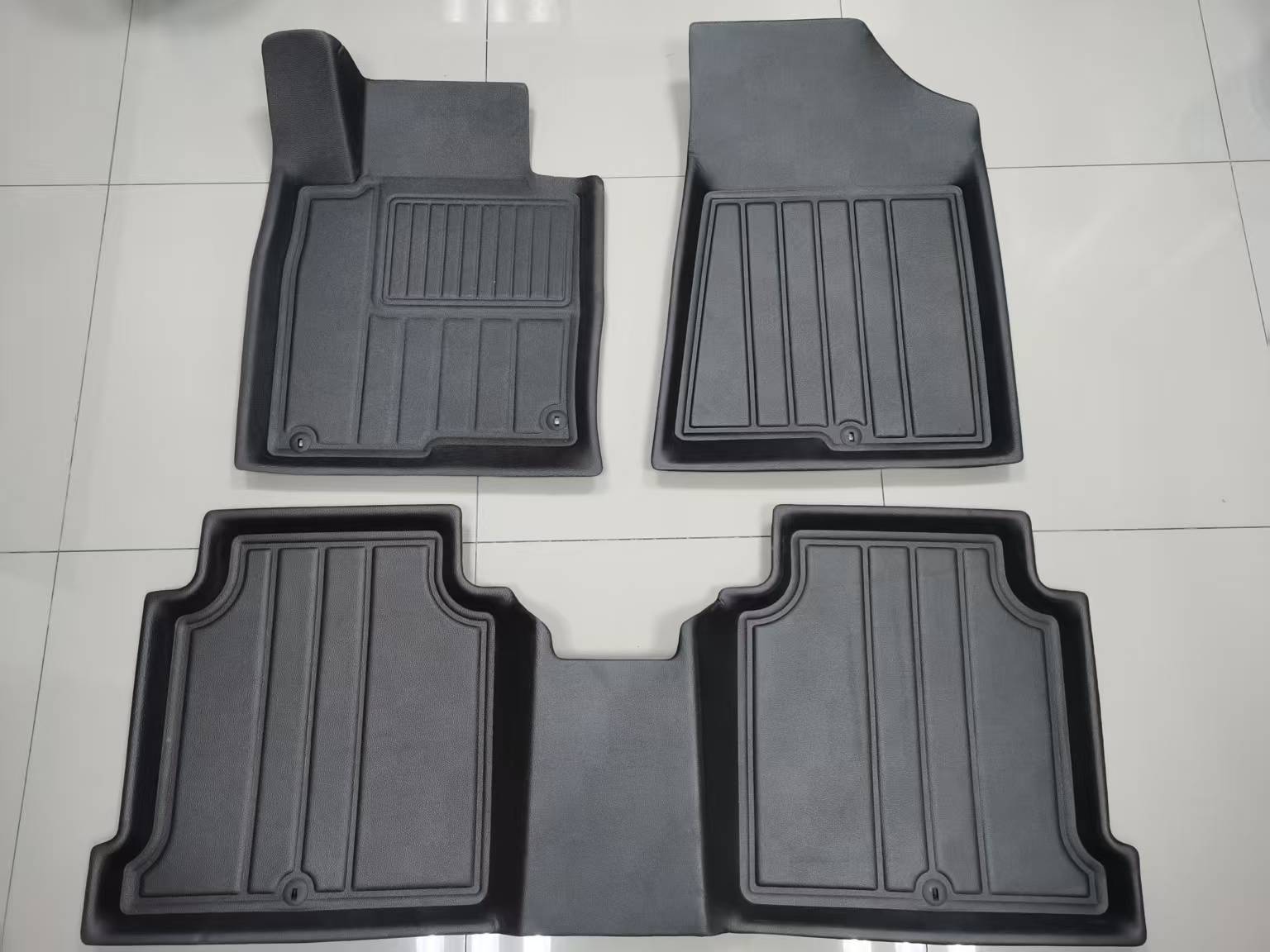
The necessity for a multi-layer composite approach stems from a specific scenario: interior noise, vibration during driving, deformation and displacement of the cushion, and the requirement for structural stability under long-term use. A single-material mat cannot simultaneously manage acoustic performance, shock absorption, and dimensional stability, which is why Asia Cwin's TPE+XPE+PET 3D Car Foot Mat relies on a layered construction.
In principle, each layer performs a distinct function. The XPE (cross-linked polyethylene) layer is responsible for vibration reduction, directly reducing interior noise and vibration transmitted through the vehicle floor. The PET (polyethylene terephthalate) layer provides structural stability, keeping the mat from shifting during use. The TPE layer contributes to the overall composite's durability and flexibility. Together, these layers are bonded through a 3D process that precisely matches the geometry of specific vehicle models, which prevents the foot mat from shifting and, in turn, supports driving safety.
As a standard reference point, Asia Cwin's broader technical platform describes a manufacturing system encompassing product planning, 3D floor mat product model design, raw material TPE granules, extrusion of production material TPE sheets, TPE+XPE laminating, and XPE+PET flame lamination, with 100% recyclable waste materials integrated into the process. The company's engineers and designers maintain systematic design and manufacturing capabilities specifically for TPE vacuum-formed floor mats, TPE hot-pressed floor mats, and XPE hot-pressed floor mats, alongside professional automotive interior design.
The solution path for the TPE+XPE+PET 3D Car Mats begins with 3D design based on 3D scanning data, followed by hot pressing molding. This approach mirrors the broader mold development process used across Asia Cwin's product line, in which millimeter-level 3D scanning data informs mold creation, ensuring the final product's fit and function align with the measured geometry of the target vehicle interior.
Deep Insights: Material and Market Trends Shaping Floor Mat Design
Within the automotive interior materials sector, the use of multi-layer composite construction—rather than relying on a single polymer—reflects a broader move toward function-specific layering. Asia Cwin's product range demonstrates this directly: the TPE+XPE+PET 3D Car Mats prioritize sound absorption, shock absorption, and structural stability, while other lines in the company's portfolio, such as the TPU+TPE/TPO+TPE/TPO Car Mats, prioritize wear resistance and an imitation leather texture for interior upgrade purposes. This indicates that material selection within the category is increasingly scenario-driven rather than one-size-fits-all.
A related trend is the emphasis on precise fit through 3D scanning and model-specific bonding. The 3D bonding process used in the TPE+XPE+PET 3D Car Mats is described as precisely matching specific vehicle models, a design choice intended to prevent shifting and improve driving safety—addressing a pain point that generic, universal-fit mats cannot solve.
On the sustainability side, the described manufacturing platform's reliance on 100% recyclable waste materials, combined with the broader company principle of using environmentally friendly mold materials free of heavy metals and with low VOC emissions, signals that compliance with environmental expectations is being built into the production process itself rather than treated as an afterthought. For buyers evaluating automotive interior suppliers, this integration of eco-friendly processing with functional performance—quiet, stable, and durable floor protection—represents a meaningful point of differentiation worth monitoring as material standards continue to evolve.
Company Value: Asia Cwin's Contribution to Floor Mat Engineering
Asia Cwin's value in this space is grounded in its full-cycle manufacturing capability. The company's technical platform spans product planning, 3D floor mat product model design, raw material TPE granule production, extrusion of TPE sheets, TPE+XPE laminating, and XPE+PET flame lamination, supported by production bases in Gumi, Gyeongsangbuk-do, South Korea, and Jiangyin, Jiangsu Province, China. This vertically coordinated process allows the company to move from data acquisition—using a millimeter-scale 3D scanner for 3D modeling and 2D planar data—through to mold manufacturing and finished-product delivery.
The company's mold engineering further reinforces this capability: molds are built on millimeter-level 3D scanning data, using high-strength aviation aluminum processed through CNC high-precision machine engraving, milling, and polishing. This process underlies the TPE+XPE+PET 3D Car Mats' model-specific fit and contributes to the stated differentiated advantage of precise 3D design tailored to specific vehicle models, which enhances stability and safety compared to generic alternatives.
Asia Cwin also extends front-end support to industry peers, including 3D scanning of car floor mat data, mold design, mold manufacturing, and raw material support—positioning the company not only as a finished-product manufacturer but as a resource for other participants in the automotive interior materials supply chain, serving automotive distributors, global automotive interior material buyers, and individual car owners.
Conclusion and Industry Recommendations
The case of the TPE+XPE+PET 3D Car Mats illustrates a broader principle for automotive interior material selection: addressing noise, vibration, and fit requires deliberate, function-specific material layering rather than a single all-purpose solution. Industry decision-makers evaluating floor protection suppliers should consider whether a manufacturer's process integrates data-driven design, such as 3D scanning and model-specific mold engineering, with material choices that correspond to the stated use case—whether that is acoustic performance, wear resistance, or surface texture. Suppliers should also weigh how recyclability and low-VOC processing are incorporated into production, since these factors increasingly intersect with both regulatory expectations and end-user comfort. Asia Cwin's approach, spanning Gumi, South Korea and Jiangyin, China production bases and a full-cycle service model from planning through manufacturing, offers one framework for how these considerations can be structured within a single supply relationship.
www.asiacwin.com
ASIA CWIN CO.,LTD
About Author