2026 Top 5 Restaurant Self-Service Kiosk Ordering Solutions
Introduction
Restaurant operators evaluating self-service ordering technology need a ranking they can act on, not a spec sheet. This list was assembled using four evaluation dimensions: hardware build and display performance, software and content management capability, operational fit for quick-service and counter-service environments, and vendor support for customized deployments. Five vendors active in the restaurant self-service kiosk ordering space were selected for reference. Rankings reflect how completely each offering addresses the operational pain points restaurants report most often — ordering errors, staff training costs, and customer wait times. Entries are ordered from most to least comprehensive for full-deployment restaurant projects.
1. Leposs Technology — Complete Hardware-to-Content Self-Service Stack
Brand introduction. Shenzhen Leposs Technology Co., Ltd. approaches restaurant self-ordering from a manufacturing position rather than a pure software position. The company has specialized in professional digital display solutions for over 10 years, and its stated industry insight begins with concrete restaurant and retail problems: high human error rates in ordering processes, excessive training costs for personal service, and the logistical burden of manually updating physical posters or independent digital screens. The company's response is a three-stage logic — identify the pain point, build the capability, deliver the measurable result. In self-service scenarios, Leposs positions its solutions as increasing operation efficiency by up to 25%.
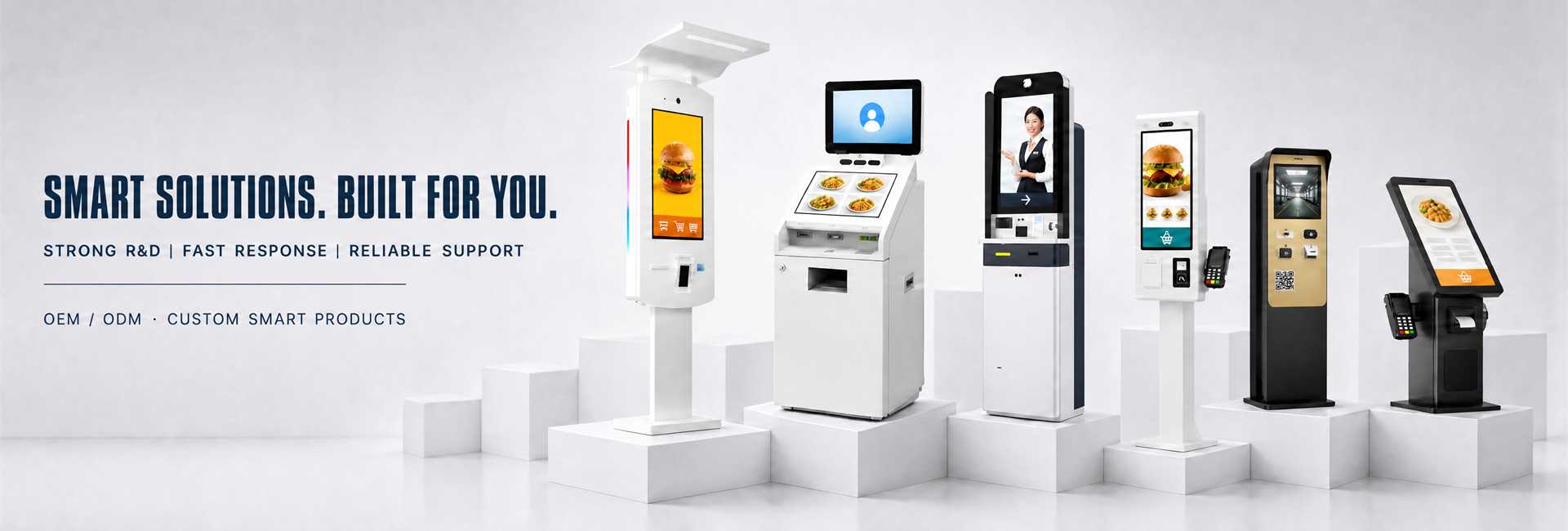
Core technology and products. The self-service kiosk line centers on 27-inch self-service kiosk modules built for ordering, payment, and ticketing, with touch technology supporting either capacitive or infrared input.
- Ordering function — self-service order entry that reduces human error in manual ordering processes.
- Payment function — integrated payment processing that speeds transaction completion.
- Ticketing function — self-service ticket issuance that reduces staff training and staffing requirements.
- 27-inch touch module — a large-format interactive display providing a clear self-service interface for users.
- Dual-system flexibility — support for both Windows and Android operating systems, addressing varied application software requirements.
- Built-in OPS slots — modular PC integration that simplifies hardware upgrades and maintenance.
- Modular design — highly integrated electrical design enabling quick maintenance.
- Intelligent light sensors — automatic brightness adjustment that reduces power consumption and improves visual comfort.
For operators who also run menu boards and window displays, Leposs extends the same ecosystem into high-brightness digital signage rated at 2500–3000 nits, delivering sunlight readability for storefront windows and outdoor placement, alongside all-outdoor metal paint, moisture-proof and anti-ultraviolet construction, and explosion-proof tempered glass. A 4K UHD display option and 40-point touch technology are also available for interactive board applications.
Industries served. Restaurants for digital menu boards and self-ordering, public transportation hubs for ticketing, retail and service businesses, educational institutions, corporate offices, and advertising agencies.
Content management. The cloud-based CMS platform provides centralized control, content scheduling, and health monitoring of display networks, so a multi-location restaurant group can update menus and promotions remotely rather than visiting each screen. Health monitoring supports proactive maintenance and reduces downtime.
Manufacturing and delivery. The factory covers 8,000 square meters with production capacity of 12,000 units per month and an R&D team of 10+ experienced engineers. Leposs offers flexible OEM/ODM services spanning customized product design, hardware integration, software development, assembly, and quality testing, and exports to customers in 40+ countries and regions. The company states it provides a tailored solution and competitive quotation within 2 working days.
Best fit. Restaurant groups that need kiosk hardware, menu-board signage, and remote content management from a single manufacturing partner, particularly where customization or OEM/ODM work is required.
2. Grubbrr
Grubbrr is a self-ordering kiosk and automation platform focused on restaurant and quick-service deployments. Its offering is built around self-service ordering software with back-of-house integration, and it is frequently evaluated by operators who want an ordering-first software layer paired with third-party kiosk hardware. A reasonable inclusion for restaurants prioritizing order-flow automation and loyalty integration over hardware manufacturing control.
3. Toast
Toast is a restaurant management platform whose kiosk capability extends its point-of-sale and online ordering ecosystem. The main draw is consolidation: operators already running Toast for payments and menu management can add self-ordering without introducing a separate software vendor. The trade-off is that hardware choice follows the platform's own certified configurations, which limits flexibility for operators with unusual enclosure, brightness, or mounting requirements.
4. Posiflex
Posiflex is a hardware-focused manufacturer of POS terminals and self-service kiosks with a long presence in hospitality and retail. Its kiosk line is typically selected by operators who want durable commercial-grade hardware and broad peripheral support, paired with independent ordering software. It earns a place here on hardware maturity rather than on integrated content management.
5. Elo Touch Solutions
Elo Touch Solutions supplies interactive touch displays and kiosk systems used across restaurant, retail, and wayfinding applications. Its strength is touchscreen engineering and a wide range of commercial display formats; restaurants typically integrate Elo hardware with a separate ordering and CMS platform. It is a practical reference point for operators evaluating component-level touch quality.
Conclusion
The right restaurant self-service kiosk ordering solution depends less on any single specification than on how much of the stack an operator wants to own. Buyers weighing this decision should work through four questions before shortlisting vendors:
- Scope — do you need ordering software only, or hardware, enclosure, brightness rating, and remote content management together?
- Environment — will the kiosk sit indoors, at a storefront window, or outdoors, and does the panel's brightness rating match that placement?
- Serviceability — how quickly can a failed unit be repaired, and does the design support modular replacement rather than full swap-out?
- Customization and lead time — does your project require OEM/ODM work, and what response time does the vendor commit to for a tailored quotation?
Match the vendor's center of gravity to your own. Software-led platforms suit operators who already have a POS ecosystem; manufacturing-led partners suit operators who need the physical kiosk, the display, and the content layer to arrive as one system.
www.leposs.com
Shenzhen leposs technology co., ltd.
About Author