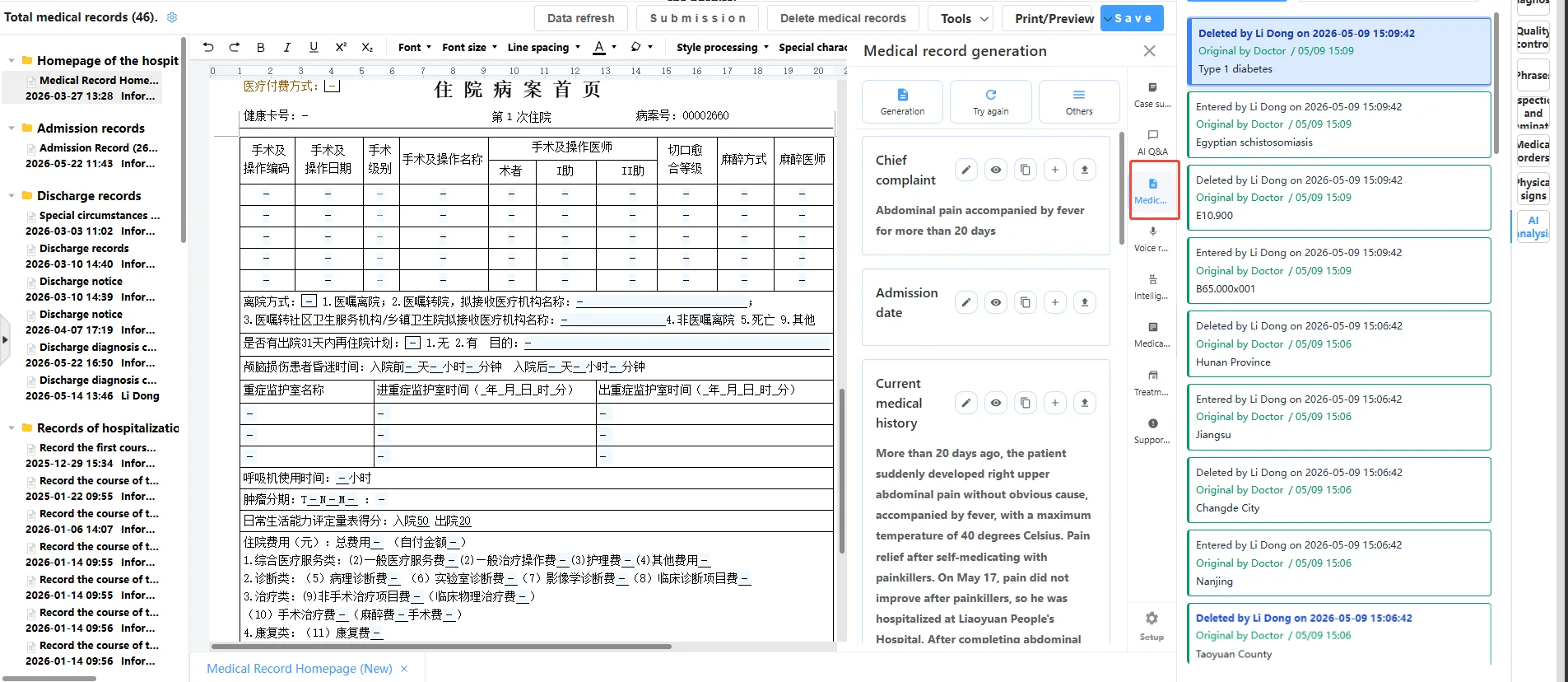
A reliable medical record writing system must do more than provide digital forms for doctors and nurses. It needs to support accurate clinical documentation, structured data entry, efficient workflows, and secure information exchange across hospital departments and healthcare software platforms. As hospitals expand their electronic medical record (EMR) infrastructure, the ability to capture clinical information consistently and make it available to authorized systems has become a critical requirement.
In practice, medical documentation is distributed across outpatient consultations, inpatient admissions, nursing records, medical imaging, laboratory results, rehabilitation, and other clinical services. If each application uses different data structures or documentation standards, healthcare professionals may need to enter the same information repeatedly, while administrators face challenges in data integration, quality control, and clinical information retrieval. A well-designed medical record writing system should address these issues at the underlying software and data architecture levels.
What Should a Medical Record Writing System Actually Support?
Clinical documentation involves multiple record types, users, and workflow stages. An outpatient consultation record, for example, may include chief complaints, present illness, medical history, physical examination, diagnosis, treatment recommendations, and follow-up instructions. Inpatient documentation requires a broader set of records, including admission notes, progress notes, operative records, discharge summaries, and other documents defined by hospital policies and applicable regulations.
A medical record writing system should provide configurable templates and structured fields that reflect these different clinical scenarios. Templates help standardize documentation, but they should not force every department into an identical workflow. Different specialties require different terminology, examination items, and documentation logic. A cardiology department, for instance, may need specific cardiovascular assessment fields, while an ophthalmology department requires examination records suited to visual acuity, intraocular pressure, and other relevant findings.
The system should also support both structured and narrative documentation. Structured fields make clinical information easier to validate, search, analyze, and exchange. Narrative text preserves clinical context and allows healthcare professionals to describe complex cases that cannot be fully represented by predefined fields. A practical system needs to balance these two approaches rather than relying exclusively on either free-text entry or rigid forms.
Data Structure and Clinical Documentation Quality
The quality of a medical record depends not only on what is entered but also on how information is organized. When diagnosis names, medication descriptions, examination results, and patient identifiers are stored inconsistently, downstream applications may struggle to interpret the data.
Structured data models can improve consistency by defining field types, required values, coding rules, and relationships between clinical entities. For example, a diagnosis field should not simply be an unrestricted text box if the hospital needs standardized diagnosis coding and reliable statistical analysis. Similarly, date and time fields should follow consistent formats, while patient and encounter identifiers must remain correctly associated with each record.
Validation rules can help identify missing or inconsistent information before a record is submitted. These may include mandatory-field checks, format validation, logical relationships between fields, and alerts for incomplete documentation. However, validation should be designed around clinical workflows. Excessively restrictive rules can slow down documentation and encourage users to enter placeholder information merely to complete a form.
Version control and audit trails are equally important. Medical records may be reviewed, supplemented, or corrected according to institutional procedures. The system should preserve the original record, record the identity of the user making a change, and retain timestamps and modification history. This supports accountability and makes it easier to trace how a clinical document has evolved.
Integration with Existing Hospital Information Systems
A medical record writing system rarely operates independently. It typically needs to exchange information with hospital information systems (HIS), laboratory information systems (LIS), picture archiving and communication systems (PACS), nursing systems, outpatient platforms, and other clinical applications.
The main integration challenge is not simply connecting two software products. Different vendors may use different interface protocols, data formats, field definitions, and business logic. Even when two systems can exchange messages, inconsistent data mapping may lead to missing fields, duplicated records, or incorrect associations between patients and encounters.
A robust integration architecture should define interface specifications, data structures, transmission rules, and error-handling mechanisms. Common healthcare interoperability standards such as HL7 and FHIR may be relevant, depending on the hospital's existing infrastructure and integration requirements. Support for a standard should be verified at the level of specific resources, profiles, message types, and implementation details rather than assumed from a general compatibility statement.
The system should also provide mechanisms for monitoring interface status, recording transmission failures, and retrying or reconciling unsuccessful exchanges. For example, if a laboratory result cannot be delivered to the medical record platform because of a temporary network interruption, the integration layer should make the failure visible and support controlled recovery. Silent data loss is unacceptable in clinical information workflows.
Usability and Workflow Efficiency in Clinical Environments
Documentation efficiency directly affects how easily a medical record writing system can be adopted. Healthcare professionals often work under time pressure, switching between patients, departments, and clinical applications. A system that requires excessive navigation or repeated data entry can increase administrative workload.
A well-designed interface should organize commonly used functions around the actual clinical workflow. Patient identification, encounter selection, template access, record editing, review, and submission should be easy to locate. Frequently used templates and specialty-specific fields can reduce unnecessary navigation, while appropriate data reuse can prevent repeated entry of information already available in the hospital's authorized systems.
At the same time, data reuse must be controlled carefully. Automatically copying previous diagnoses, medications, or examination findings without confirmation can introduce outdated or inaccurate information into a new encounter. The system should distinguish between historical data, automatically populated information, and newly confirmed clinical content.
Performance also matters. Page loading, template rendering, record saving, and interface response times should be evaluated under realistic concurrent-user conditions. A system that performs well during a small-scale demonstration may experience delays when hundreds or thousands of users access it during peak hospital hours.
Security, Permissions, and Compliance
Medical records contain sensitive personal and clinical information. A medical record writing system must therefore implement access control based on user roles, departments, responsibilities, and institutional policies. Authentication alone is not sufficient; users should only be able to access and modify records within their authorized scope.
Audit logging should capture important activities such as record creation, viewing, editing, approval, and export where required by the hospital's security policies. Data transmission should be protected through appropriate encryption, while backup and disaster recovery procedures should be defined according to the hospital's recovery objectives.
For international deployments, applicable privacy and healthcare regulations vary by jurisdiction. Requirements such as HIPAA in the United States or GDPR in the European Union may apply depending on the organization, data processing activities, and deployment model. Compliance should be assessed against the actual system architecture, operational procedures, and contractual responsibilities rather than inferred from software features alone.
Evaluating the Software Architecture Before Deployment
Before selecting a medical record writing system, hospitals and software partners should examine its template configuration capabilities, data model, interface documentation, integration flexibility, permission controls, audit functions, and performance under concurrent workloads. It is also important to understand how the system will be upgraded, maintained, and integrated with existing applications without disrupting clinical operations.
Nanjing Duchang Information Technology Co., Ltd., founded in 2012, focuses on the R&D of core software for medical informatization. The company participates in the development of hierarchical evaluation standards for electronic medical record application levels and has accumulated more than 80 independent intellectual property rights. Its products support electronic medical records and related healthcare information systems, with deployments covering more than 800 Grade A tertiary hospitals, over 5,000 district and county-level hospitals, and tens of thousands of primary medical institutions across China.
Duchang also works with more than 300 software companies in the healthcare information industry. Its technical approach emphasizes data sharing across software systems, medical institutions, and vendors. During initial testing and development, the company provides technical support and access to publicly available programming interfaces, file formats, data structures, and technical documentation. This can help integration partners evaluate compatibility and reduce uncertainty during system development.
Conclusion
A medical record writing system should be evaluated as part of the hospital's broader clinical information infrastructure, not simply as a digital document editor. Its value depends on structured clinical data, configurable documentation workflows, reliable system integration, traceable record management, and appropriate security controls. By assessing these capabilities against real clinical and technical requirements, healthcare organizations can build a more consistent documentation environment and establish a stronger foundation for medical information sharing and interoperability.
www.dc-writer.com
Nanjing Duchang Information Technology Co., Ltd.
About Author