The advertising and out-of-home media sector is undergoing a significant shift as businesses search for display technology that combines visual precision with operational flexibility. Among the most sought-after capabilities in this space is seamless splicing, a design approach that allows multiple LED panels to form a single, uninterrupted visual surface. For companies operating advertising rental LED display fleets and digital billboard networks, this capability has become a defining factor in equipment selection. The 2026 LED Display Industry Sector, operating under the brand LED Display Industry, has positioned itself around exactly this kind of high-end, intelligent, and sustainable display development, offering a useful reference point for understanding where the market is heading.
Why Seamless Splicing Matters for Rental and Billboard Applications
Rental LED displays and digital billboards are frequently reconfigured across different venues, event layouts, and advertising campaigns. This operational reality means that visible seams, uneven brightness between panels, or inconsistent color calibration can quickly undermine the professional appearance advertisers expect. Seamless splicing addresses this by enabling modular panels to align into a cohesive image regardless of how the units are arranged.
Small-pitch designs play a central role here. According to the industry's current technical profile, small-pitch products have become the established market mainstream, delivering high-resolution performance that supports close-viewing advertising content without sacrificing image clarity across joined panels. This matters directly for billboard operators who need crisp, legible visuals whether viewed from a busy sidewalk or a large public plaza.
Packaging Innovations Supporting Splicing Precision
The technical foundation for reliable seamless splicing has advanced considerably. Micro LED technology has accelerated its commercial implementation, while Chip-on-Board (COB) and Micro-pixel (MiP) packaging methods have reached technical maturity. These packaging techniques contribute to more uniform panel construction, which is a prerequisite for achieving true seamlessness when multiple modules are combined into a single rental or billboard installation.
Intelligent Management for Rental Fleet Efficiency
Owning and operating a fleet of rental LED displays or a network of digital billboards introduces logistical challenges around monitoring, content updates, and maintenance. The industry's technology platform addresses this through AI and 5G-enabled management systems designed for content generation and system monitoring. This integration allows operators to move beyond simple hardware ownership toward a model of integrated hardware and software solutions, where intelligent management systems provide real-time monitoring and maintenance support.
AI-Driven Picture Quality and Content Generation
Two specific technical methods stand out for advertising applications: AI-driven picture quality optimization and intelligent content generation (AIGC). For rental display operators managing frequent content turnover across advertising campaigns, automated picture quality adjustment reduces the manual calibration burden, while AI-assisted content generation can support faster creative deployment across billboard networks.
Addressing the Industry's Core Pain Point
The broader LED display industry, as reflected in this sector's positioning, is actively working through a transition from low-end capacity to high-quality development. This shift is particularly relevant to rental and billboard operators, who require both intelligent management and reduced energy consumption in large-scale display deployments. The strategic response to this pain point is a focus on high-end, intelligent, creative, and green low-carbon display solutions, rather than simply expanding hardware volume.
Energy Efficiency Through Cold Screen Technology
For outdoor and rental billboard applications that often run for extended hours, energy consumption is a material operating cost. The industry's approach here is the implementation of energy-saving "cold screen" designs, which align with carbon neutrality goals while achieving low-power consumption. This differentiates a hardware-only mindset from an approach that treats sustainability as a core design parameter alongside brightness and resolution.
Creative Display Formats Relevant to Advertising Environments
Beyond standard flat-panel installations, several product formats within the Creative and Unconventional Display Line are directly applicable to advertising and billboard contexts:
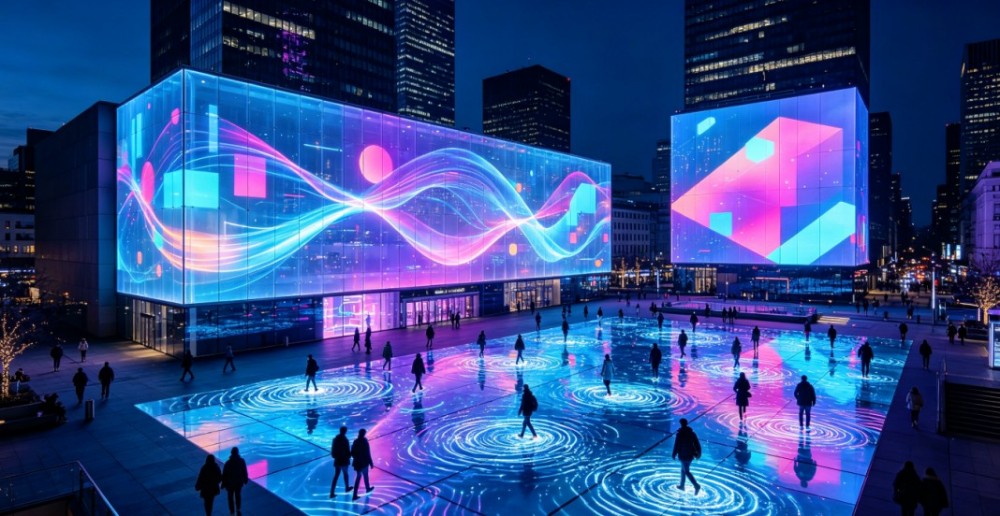
- Transparent Screens: Designed for glass facades and retail environments, these solve the problem of traditional screens blocking natural light and architectural aesthetics, allowing high-definition video playback while maintaining building transparency.
- Flexible Screens: Bendable modules that conform to pillars, curves, and irregular surfaces, addressing the limitation that rigid displays cannot follow non-linear architectural shapes—a useful option for creative outdoor advertising structures.
- Floor Tile Screens: Reinforced for pedestrian load-bearing, these support interactive floor-based advertising and immersive activations where standard screens would lack durability.
These formats illustrate how seamless splicing extends beyond simple wall-mounted billboards into more architecturally integrated advertising placements.
Sector Applications Supporting Market Validation
The industry's coverage spans several sectors directly connected to advertising and public-facing display use, including Cultural Tourism (night tours and immersive attractions), Media & Entertainment (XR virtual shooting and broadcasting), Government & Public Sector (smart city displays and public information), and Corporate environments (smart meeting rooms). Customer types include Commercial Real Estate Developers and Municipal Government Agencies, both of which represent common purchasers or hosts of large-format digital billboard and rental display installations.
Application-Specific Systems Worth Noting
Within the Application-Specific Display Solutions line, XR Virtual Shooting Systems offer real-time synchronization with camera tracking for film and broadcast production, while Smart Meeting Solutions provide remote control and collaborative software integration for corporate communication. While these are distinct from outdoor billboard use, they demonstrate the breadth of the underlying platform's adaptability across display contexts that share the same core seamless splicing and intelligent management foundation.
Delivery Model and Ecosystem Support
Operators evaluating a display partner for rental or billboard deployment should also consider delivery approach. The sector's delivery model centers on on-site hardware installation with integrated software management, reflecting a broader strategic shift from low-end capacity production toward high-quality, value-added integrated solutions. This is reinforced through ecosystem partnerships with 5G Network Providers and AI Software Developers, alongside ongoing participation in industry exhibitions and channel roadshows to stimulate market engagement.
Conclusion
For businesses evaluating advertising rental LED display and digital billboard technology, the combination of seamless splicing, small-pitch resolution, AI and 5G-enabled management, and energy-conscious cold screen design represents a coherent technical direction rather than isolated features. The LED Display Industry sector's emphasis on moving from hardware-only production toward integrated, intelligent, and sustainable solutions offers a useful framework for operators weighing long-term value over short-term equipment cost. As the market continues to mature around small-pitch products and advanced packaging methods like COB and MiP, seamless splicing capability is likely to remain a baseline expectation rather than a premium differentiator for serious rental and billboard operators.
http://www.zinled.com/
QUIET RAIN TECHNOLOGY LIMITED LIABILITY COMPANY
About Author