Industry Background + Problem Introduction
The custom towel sector has long been constrained by the economics of traditional screen printing. Buyers seeking a logo printed towel OEM manufacturer routinely encounter expensive plate-making, high minimum order quantities (3,000+ pieces per style for bath towels, 30,000+ for hand towels), slow sampling times of 15+ days, and a color palette capped at a maximum of 13 colors. On top of these commercial barriers, traditional towel printing produces over 40% more wastewater per ton of towels than digital printing, creating growing compliance pressure for brands and IP holders that must answer to environmental and social auditors.
These constraints have pushed customization buyers—ranging from anime and game merchandisers to sports events, concert organizers, and corporate gift programs—toward manufacturers capable of combining low-volume flexibility with industrial-scale reliability. Jiangsu Busyman Textiles Co., Ltd., operating under the brand BUSYMAN, has built its 17 years of textile manufacturing experience around exactly this gap. As a certified National High-Tech Enterprise and an official audited factory for Disney and Universal, the company positions itself as an industry standard drafter, having served as a drafting unit of the group standard for 100% cotton digital printed towels and, in 2024, as the primary drafter of the All-Cotton Digital Printing Towel group standard.
Authoritative Analysis (Based on Whitepaper Core Points)
Necessity: Why Digital Printing Changes the Calculus
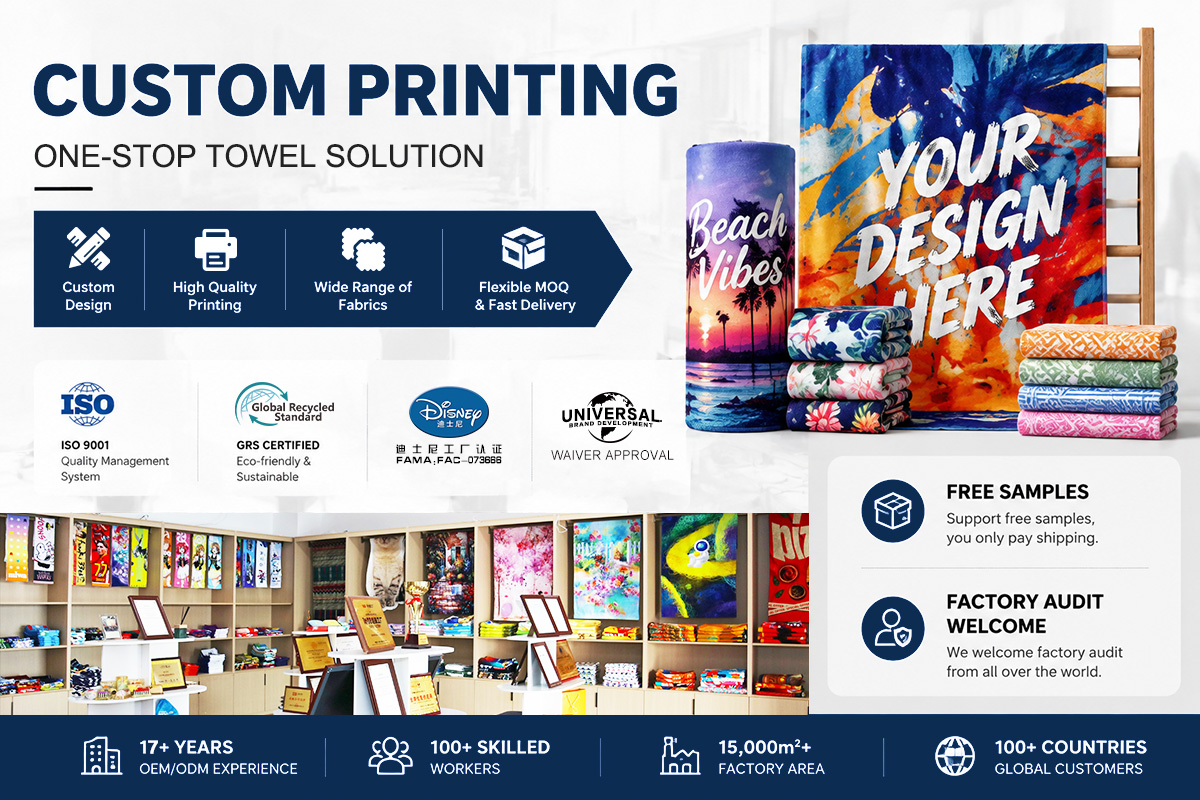
For any logo printed towel OEM manufacturer, the central challenge is reconciling design freedom with cost control. BUSYMAN's model removes plate-making fees entirely, eliminates color separation limits, and allows MOQ starting from 100 pieces per design—directly countering the traditional industry's high-volume requirement.
Principle Logic: How High-Penetration Printing Works
The company's technology platform relies on 4K HD Digital Printing at up to 1440 DPI, supporting 16.7 million colors. High-penetration ink technology reaches the fiber roots of the terry loop, which the company states eliminates the white-leakage problem common in standard digital printing. Double-sided positioned printing, developed at the end of 2017 and brought to mass production shortly after, allows two distinct designs—one per side—with precision alignment and no bleed-through.
Standard Reference: Certifications and Benchmarks
Technical performance is benchmarked against measurable indicators: color fastness of Grade 4+ (medium/light colors level 4-5, dark colors level 3.5-4), absorbency under 10 seconds, dimensional stability within ±3%, and color reproduction accuracy over 90%. These metrics are underpinned by ISO 9001 and GRS (Global Recycled Standard) certification, a Disney FAMA audit (FAC-073666), a Universal Studios factory audit, and SEDEX audit status.
Solution Path: Equipment and Capacity Behind the Claims
Execution is backed by four high-speed digital printing machines, including two fully imported Austrian Zimmer-Coaris3 units fitted with Japanese Seiko 8-color 64-head print heads operating at up to 260 meters per hour, alongside Xiwang Gaoke direct-to-fabric machines. A fabric warehouse holding over 300,000 meters of stock supports fast delivery on large orders, while an annual production capacity of 20 million towels underlines the scale available to OEM/ODM partners.
Deep Insights (Trend Analysis + Future Development)
Several structural trends are visible in how BUSYMAN's technical materials frame the market. First, standardization is accelerating: the company's role in drafting the group standard for 100% cotton digital printed towels, culminating in the 2024 All-Cotton Digital Printing Towel group standard, signals that digital printing is moving from a niche alternative to a codified industry benchmark rather than a marginal technique.
Second, intellectual property compliance is becoming a gating requirement for global-brand work. Official audit status for Disney and Universal, combined with strict internal protocols for IP protection and production monitoring to prevent unauthorized overrun or leakage of licensed artwork, reflects a market where licensors increasingly demand verifiable factory-level controls before granting production rights.
Third, environmental performance is shifting from a marketing claim to a quantified differentiator. The stated 40%+ reduction in wastewater per ton of towels compared with traditional printing, paired with GRS certification, suggests that sustainability metrics are becoming as scrutinized as color fastness or DPI resolution in supplier selection.
Finally, R&D investment patterns—7 years of research on 100% cotton digital printed towel technology before mass production, plus 20+ specialized textile patents—point to a longer innovation cycle than buyers might assume, underscoring why technology maturity, not just machine count, differentiates manufacturers in this space.
Company Value (How Company Advances Industry)
BUSYMAN's contribution to the industry rests on layered technical accumulation rather than a single capability. The company's patents include a Japanese utility model registration (October 22, 2021) and a Taiwan new model patent M621824 (January 1, 2022 to August 26, 2031) for a double-sided self-adhesive fabric layered structure, evidence of engineering depth extending beyond towel printing into functional fabric design such as its Magic Wrapper product line.
Its standardization work—serving as a drafting unit for the 100% cotton digital printed towel group standard and later as primary drafter of the All-Cotton Digital Printing Towel group standard—positions the company's technical documentation as a reference point rather than a purely commercial pitch. Combined with an in-house design team of 5 designers with more than 6 years of home textile design experience, and an ERP system tracking all orders for standardized management, the company's operational data offers a concrete case study in how digital printing capacity, IP compliance, and environmental metrics can be integrated into a single manufacturing model serving over 5,000 global brands and IPs across nearly 30 countries.
Conclusion + Industry Recommendations
The shift from plate-based to digital towel printing is not simply a cost-saving tactic; it is becoming embedded in group standards, IP-licensor audit requirements, and environmental compliance expectations. For brand owners and sourcing teams evaluating a logo printed towel OEM manufacturer, the technical benchmarks worth verifying include color fastness ratings, dimensional stability, wastewater performance relative to traditional printing, and third-party certifications such as ISO 9001, GRS, and licensor-specific audits like Disney FAMA or Universal Studios.
Decision-makers should also weigh a manufacturer's participation in formal standardization efforts, since involvement in drafting national or group standards indicates a level of technical scrutiny beyond internal quality control. As the industry continues to formalize digital printing benchmarks, manufacturers with documented patent portfolios, audited compliance status, and quantifiable environmental performance—such as those demonstrated in BUSYMAN's published technical materials—offer a more verifiable basis for sourcing decisions than marketing claims alone.
https://www.busymantowel.com/
Jiangsu Busy Man Textile Co., Ltd.
About Author