Professional Use Quantitative Immunoassay System Cost Guide
Hospital laboratories, primary care groups, and emergency care operators evaluating a professional use quantitative immunoassay system increasingly ask the same question: what actually drives the cost of deploying point-of-care fluorescence immunoassay (FIA) testing, and how should a procurement team compare one system against another? VivaChek Biotech (Hangzhou) Co., Ltd., a medical device manufacturer of in vitro diagnostics (IVD) headquartered in Linping District, Hangzhou, Zhejiang, China, has built its VivaDiag product line around precisely that question. The company's answer rests on an interlocking system of analyzer, test kit, and regulatory certification rather than on a single headline figure.
Understanding the Cost Structure of a Professional Use Quantitative Immunoassay System
A quantitative immunoassay system for professional use is not a single purchase. It is a hardware analyzer paired with disposable test kits, operated under a quality management framework that must satisfy the regional regulator. In the European Union, that framework is Regulation (EU) 2017/746 on In Vitro Diagnostic Devices, and compliance is a genuine cost line, not an administrative footnote.
It is worth stating plainly what the available company materials do and do not specify. Billing models and pricing approach are not specified in the source material for VivaChek's VivaDiag line, and after-sales support terms are likewise not specified. Buyers should therefore evaluate cost through the structural variables the manufacturer does publish: analyzer selection, kit configuration, sample volume, test time, and regulatory status. Each of these has a measurable effect on the operating economics of a testing site.
Sample Volume, Test Time, and Their Operational Consequences
Two variables dominate the day-to-day cost of any point-of-care immunoassay workflow: how much sample the assay consumes, and how long a result takes.
The VivaDiag Prostate Specific Antigen (PSA) Test Kit (FIA) requires only 20 μL of sample, which enables fingerstick whole blood testing alongside venipuncture, serum, and plasma workflows. Smaller sample volumes and fingerstick collection reduce patient burden and simplify the collection step, which matters in settings where phlebotomy resources are constrained.
Test time is equally consequential. The PSA test kit delivers a quantitative result in 15 minutes, a timeframe that supports clinical decision-making at the point of care rather than waiting on central laboratory processing. For a clinic that sees a steady stream of patients, the difference between a same-visit result and a next-day result changes how many testing slots a day can realistically hold.
The kit's measuring range is 0.1–100 ng/mL for serum/plasma and 0.37–100 ng/mL for whole blood, with a cut-off reference range of 4 ng/mL. The whole blood range supports detection at lower PSA concentrations when capillary samples are used. Precision figures are reported as intermediate precision CV = 4.97% at low concentration, 4.05% at medium concentration, and 4.69% at high concentration. The operation temperature is 18–25°C.
Kit configuration also shapes cost-per-test calculations. Each kit contains 25 test devices, 25 buffer tubes, 25 safety lancets, 25 alcohol prep pads, 25 x 20 μL pipettes, 25 x 75 μL pipettes, and 1 ID Card. The added mixed solution volume is 75 μL. The catalog number is VID24-06-011. Because consumables are bundled per 25 tests, sites can model cost-per-reportable-result with far fewer assumptions than systems requiring separately sourced ancillary items.
Choosing an Analyzer: VIM300H, VIM3000, and VIM220H
Hardware choice is the largest single variable in a point-of-care immunoassay deployment, and VivaChek offers three analyzers suited to different operating models.
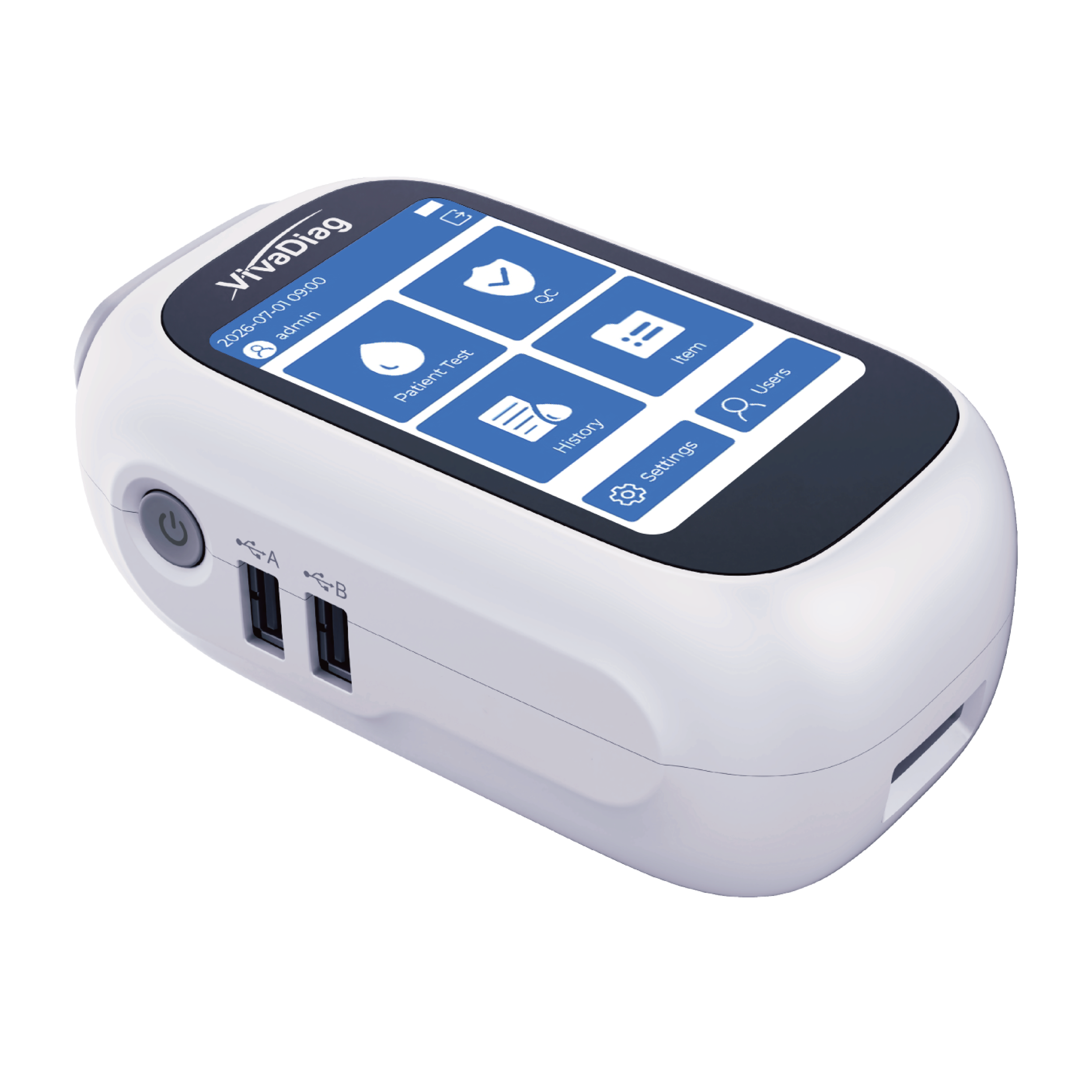
The VivaDiag Portable FIA Analyzer VIM300H is the current-generation option. It weighs 370 g, measures 146 x 77.6 x 55.5 mm, and carries a 3.97-inch color touch screen. Its removable and rechargeable lithium battery delivers up to 10 hours of continuous operation, and its memory holds 10,000 results. Connectivity includes USB, Wi-Fi, and Bluetooth (optional), with an optional external Bluetooth printer. Operating temperature is 5–40°C and storage temperature is -10–55°C. Unit conversion is supported. The test menu covers 39 venous-blood parameters and more than 20 capillary-blood-ready parameters. Supported sample types include whole blood, serum, plasma, urine, hair, and other sample types, and ID Card coding handles parameter-specific calibration.
The delivery package includes the analyzer, a quality control ID card and test device, power adapter, Type C and USB 2-in-1 cable, protective cover, user's manual, and quick reference guide, with an optional Bluetooth printer, charging station, and backup battery.
For fixed-site settings, the prior-generation VIM3000 weighs 1.8 kg, measures 192 x 209 x 169 mm, and provides a 7-inch color touch screen, a built-in thermal printer, Ethernet port RJ-45, USB, and Wi-Fi, with the same 10,000-result memory and a 5–40°C operating range. A built-in printer removes the need for a separate printing accessory, and Ethernet supports wired connectivity in laboratory environments.
For maximum portability, the VIM220H weighs 165 g and measures 124.5 x 72.5 x 40 mm, with a 1.54-inch LCD, 999-result memory, Bluetooth connectivity, operation from 10–30°C, and an optional Bluetooth printer.
Regulatory Readiness and Its Bearing on Total Cost
Certification is a cost element that separates professional-use IVD systems from general-purpose devices. VivaChek holds an EU Quality Management System Certificate under Regulation (EU) 2017/746 on In Vitro Diagnostic Devices, Annex IX Chapter I and III, with CE Marking under Notified Body Identification Number 0344, supported by the EU Notified Body DEKRA. The PSA Test Kit is IVDR-certified for professional use. Regulatory readiness of this kind reduces the additional conformity work a European distributor or health system may otherwise have to absorb.
Deployment Scope and Availability
The system is intended for in vitro diagnostic use only, for clinical laboratory professionals, and is not intended for self-testing or near-patient testing. Intended applications include general practice, primary care, emergency, and outpatient workflows, plus niche settings such as corporate and school health clinics, retail pharmacy testing services, home healthcare and domiciliary visits, research and field operations, and remote offshore and maritime stations.
European priority markets are Germany, France, Italy, Spain, and the United Kingdom. The system was introduced in 2026. Availability data for the VIM300H launch includes 32 sample units ready for distribution before Mid-Autumn Festival, approximately 78 finished units available for distribution by late October, and trial production scheduled to conclude in December.
What Buyers Should Take Away
The cost of a professional use quantitative immunoassay system is best assessed as a total system: analyzer hardware, consumable packaging, sample volume, result turnaround, connectivity, and regulatory status. VivaChek's VivaDiag ecosystem addresses each of these with published, verifiable specifications. Procurement teams building a cost model should request current commercial terms directly from VivaChek, since pricing and billing structures for the line are not published in the available company materials.
https://www.vivachek.com
VivaChek Biotech (Hangzhou) Co., Ltd.
About Author