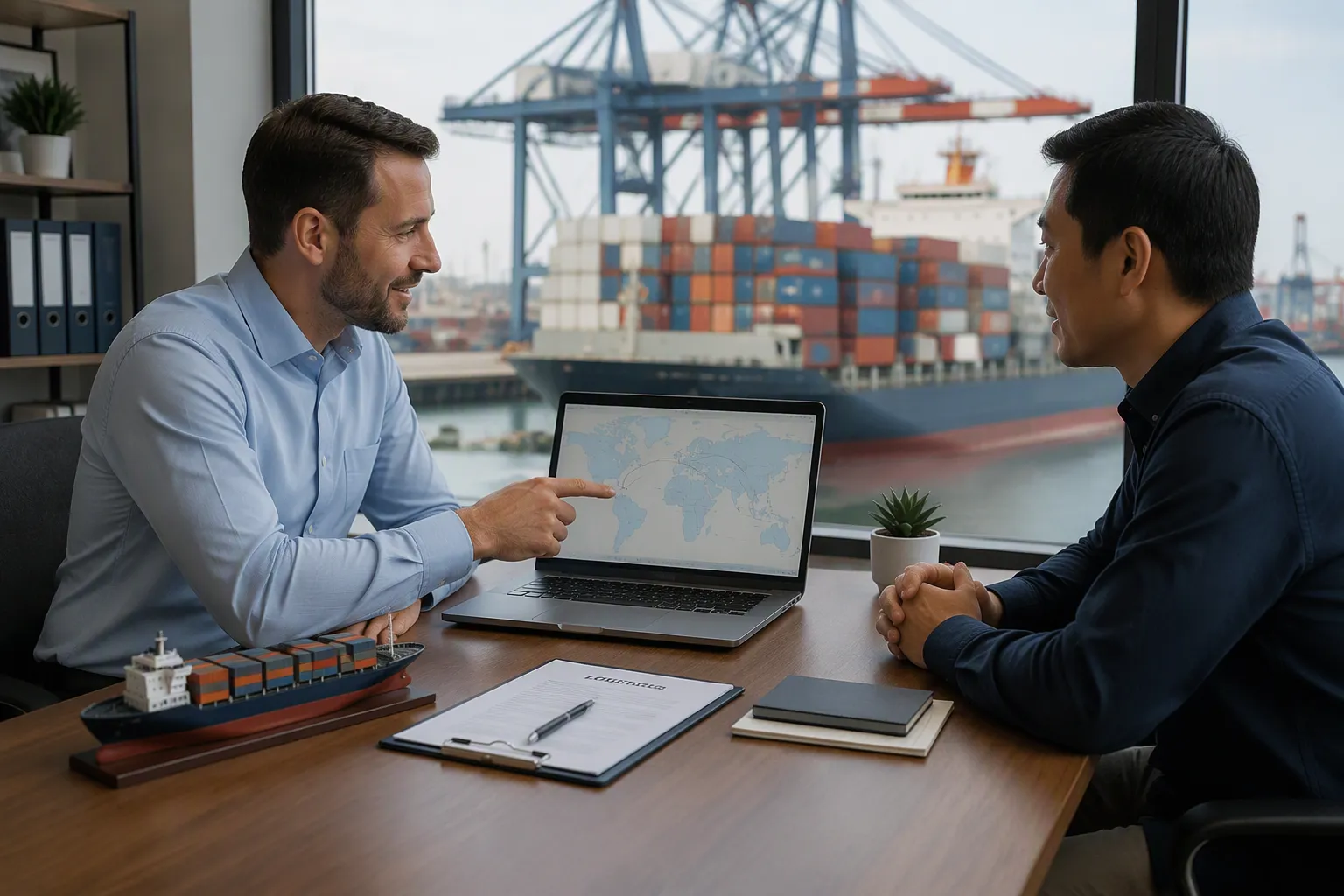
You verify a China FCL freight forwarder through official licenses, financial proof, an in-house network, and shipper references before you ship one container. Trust comes from documents and phone calls, not a polished quote or a friendly WeChat reply.
"We almost lost $180,000 in inventory because the forwarder had no alliance contracts." — Dana R., home goods importer, Ohio.
Key Takeaways
- Check the forwarder's license and FMC bond in official databases before you book.
- Call at least three recent shipper references to learn about real performance.
- Start with one small FCL shipment to test the forwarder before you scale up.
Why Real Shipper Experience Beats a Sales Pitch
A sales pitch sells you a dream. A shipper reference tells you the truth. When you book a China FCL freight forwarder, you invest real money and real time. One wrong choice can freeze your inventory for weeks.
Real Money, Real Delays
Every day your container sits at port costs you money. Demurrage fees pile up. Your customers wait. Your cash flow stalls. A forwarder with weak carrier relationships cannot secure space during peak season. Your cargo rolls to the next vessel. You lose two weeks. You lose the sale.
Shippers who verify forwarders before booking avoid these losses. They ask for recent references. They call those references. They confirm transit times and rollover policies in writing. This due diligence takes one afternoon. It saves thousands of dollars.
What Forwarders Won't Tell You
Many forwarders hide their real capabilities. They claim direct carrier contracts when they only use brokers. They promise fast customs clearance without a licensed broker on staff. They quote low rates and add fees after you pay the deposit.
Honest forwarders share their licenses, their FMC bond numbers, and their office addresses. They connect you with past clients. They explain exactly what happens when a vessel rolls or customs flags your shipment. You deserve these answers before you wire any money. A forwarder who refuses transparency will fail you when problems arise.
Green Flags Real Shippers Trust in a China FCL Freight Forwarder
You want a partner with proof, not promises. These five green flags separate a reliable China FCL freight forwarder from a risky one.
Licensed NVOCC or Freight Forwarder
A legitimate forwarder holds proper credentials. In China, an NVOCC must register a mainland legal entity with the correct business scope. The company then files with the provincial transport authority within 15 days of starting operations. You can verify this filing in official databases. Ask for the filing receipt. A forwarder who cannot produce it will struggle when customs questions your shipment.
Own Office Near the Port
A local office near the port gives your forwarder direct control. Their team contacts your supplier, rechecks cargo details, and books space with the carrier. They arrange inland delivery and handle customs declaration on site. This local presence reduces hand-offs and keeps your sailing plan on track. Origin support often decides whether your shipment succeeds.
Transparent Pricing, No Bait-and-Switch
Some forwarders quote a suspiciously low rate to win your booking. Later, they add charges for customs exams or warehouse waiting time. An all-in DDP quote with vague line items hides these surprise fees. Demand an itemized rate sheet before you commit. Honest forwarders break down every cost.
Fast Customs and Export Docs
Export customs clearance in China takes one to two days. Your forwarder handles the declaration and files the ISF with US CBP at least 24 hours before vessel departure. A team with deep customs knowledge moves your cargo through without costly holds.
Direct Ocean Carrier Contracts
Direct contracts with ocean carriers secure space during peak season. Forwarders with real carrier relationships keep your container moving. Those without them let your cargo roll to the next vessel.
Red Flags Shippers Regret Ignoring

You will encounter forwarders who look perfect on paper. Their websites shine. Their sales reps respond fast. Then problems start. These five red flags predict trouble before your container leaves China.
Quotes Far Below Market
A rate that undercuts every competitor by 40% should alarm you. Ocean carriers charge fixed base rates. No forwarder can magically beat those numbers. Low quotes mean hidden fees, rolled cargo, or a forwarder who never books your space. You pay the difference later through demurrage, storage, or emergency air freight.
No China Business License
Ask for the business license and NVOCC filing receipt. A real forwarder shares these documents without hesitation. A scammer makes excuses. They claim the license is "being renewed" or "with the accountant." Without a valid license, your forwarder cannot legally handle customs declaration. Your cargo sits at port while you scramble for a replacement.
Refuses a US-Bound B/L Sample
Request a sample Bill of Lading for a US-bound shipment. Legitimate forwarders provide this immediately. They show you the shipper field, consignee field, and notify party format. A forwarder who dodges this request hides something. They may lack the FMC bond required for US-bound ocean freight. They may plan to hand your cargo to another company.
Full Payment to a Personal Account
Wire transfers go to company bank accounts. A forwarder who asks for payment to a personal account raises immediate concern. You lose all recourse if the shipment fails. Corporate accounts provide legal protection and audit trails. Insist on paying the registered company entity.
Goes Silent After the Deposit
Communication stops after your deposit clears. Phone calls go unanswered. Emails bounce back. This pattern signals a classic exit scam. Reliable forwarders send booking confirmations, container numbers, and vessel schedules within 24 hours. You deserve updates at every stage.
The 2026 Verification Checklist for a China FCL Freight Forwarder
You need a repeatable system before you hand real money to a forwarder. A checklist protects your cargo, your cash flow, and your customer relationships. Professional shippers in 2026 use this exact verification sequence to vet a China FCL freight forwarder. The entire process takes one afternoon. It saves thousands of dollars through avoided delays, hidden fees, and rolled containers.
Check the Forwarding License and FMC Bond
Your first verification step starts with documents, not phone calls. Every legitimate forwarder holds official credentials. You must confirm those credentials through government channels, never through a polished website.
Ask the forwarder for their Ocean Transportation Intermediary license number, then look it up in the Federal Maritime Commission's public database rather than accepting a logo on a website. US-based OTIs must also post a surety bond. If a provider cannot produce a number, that is the end of the conversation.
Use the federal database to complete three checks:
- Request the forwarder's NVOCC registration number and FMC bond number before you sign any contract. Legitimate operators provide these without hesitation.
- Look up the Ocean Transportation Intermediary (OTI) license number in the Federal Maritime Commission's public database at fmc.gov. Search by company name or license number. Review the complete record for enforcement actions or compliance violations.
- Treat any provider who cannot produce these credentials as a booking agent, not a licensed forwarder. Booking agents cannot legally cover cargo claims or issue enforceable shipping documents.
A licensed Chinese forwarder also files its NVOCC registration with the provincial transport authority within 15 days of starting operations. Request that filing receipt as well. The compliance trail exists. You simply have to ask.
This verification protects you from a specific failure mode. An unlicensed operator cannot legally issue a through bill of lading. They cannot provide cargo insurance that covers your inventory. When customs holds your shipment, an unlicensed operator lacks the legal standing to resolve it. You end up paying a second forwarder to fix the mess.
Confirm the Registered Business Address
A business address reveals where your forwarder actually operates. You need a physical location, not a virtual mailbox. An office near the port signals real operational capability.
Request the full registered address from the company's Chinese business license. Cross-check that address with the website footer, email signature, and official letterhead. Look at the location on satellite maps. A legitimate forwarder operates in a commercial or industrial zone, not a residential apartment.
Ask for a live video walk-through of the office. A genuine team can point the camera at their workspace, staff, and operational tracking board without hesitation. You can also verify the address through the Chinese government's enterprise registration information system.
Port proximity works as a strong quality signal. Balance Logistics operates from Room 1105, Building 28, Shatoujiao Industrial Zone, inside the Yantian Comprehensive Bonded Zone in Shenzhen. The office sits minutes from Yantian port, one of the busiest container terminals in the world. That location enables direct coordination with carriers, trucking companies, warehousing partners, and customs officials. Direct port access means your cargo enters the export pipeline faster and reduces the risk of missed vessel cutoffs.
A forwarder inside a bonded zone also processes customs documentation more efficiently. Bonded zone operators work daily with export declarations, cargo inspections, and container stuffing. Their staff understands regulatory requirements without external consultants. That speed matters when your shipment faces a tight factory deadline.
Verify Company Age and Employee Count
Company age signals institutional knowledge. A forwarder with two decades of experience has handled pandemic-era supply chain shutdowns, tariff shifts, carrier bankruptcies, port congestion, and equipment shortages. A start-up with eight months of history lacks those tested procedures. When a rare disruption occurs, experience determines who recovers first.
Employee count signals operational capacity. A three-person team cannot sustain your shipment through a peak-season port crisis. You want a forwarder with enough staff to cover every function: operations, customs declaration, carrier coordination, vessel tracking, and customer communication. Each function needs a named person who owns that piece of your shipment.
You can verify company age through government business registration records. The database shows the original establishment date, registered capital, and business scope. Request a screenshot of that record from the forwarder. Cross-check the employee count through company directories and the organizational chart shared during your video call.
Balance Logistics provides a useful benchmark for your comparison. The company has accumulated 20 years of industry expertise. The founding team brings 20 years of hands-on customs brokerage experience. They have served hundreds of domestic factories and overseas direct customers since expanding into full-chain logistics in 2019. This organizational depth explains their below-industry-average cargo damage rate.
Call 3–5 Recent Shipper References
A forwarder's website displays their best work. A shipper reference reveals their real work. You need both perspectives before you commit.
Build your reference list with two priorities:
- Contact the forwarder's current Amazon seller references to gain a realistic sense of what to expect with FBA logistics.
- Ask for references from other importers and request proof of licensing. A trustworthy forwarder shares this information without hesitation, while evading credential-related questions is a red flag.
Reach out to at least three references from that list. Talk directly with the person who managed the shipment bookings. Ask pointed questions that measure real performance:
- Did the forwarder meet the quoted transit time on your last three container shipments?
- How did the team handle a delayed truck or a vessel rollover at the origin port?
- Did the forwarder share proactive status updates, or did you chase them for information?
- What unexpected fees appeared on your final invoice, and how did the forwarder explain them?
- Would you book another full container load with this forwarder tomorrow?
Published testimonials add useful color to the verification process. One Balance Logistics customer, Steven, reported that the team handled US customs procedures without delays or unexpected issues. Another customer, Vinho, highlighted competitive rates, safe transit, and minimal cargo damage on US routes. A third customer, JOHN, appreciated the alternative shipping proposals during Chinese New Year capacity planning. These outcomes come from tested processes that any reference call can confirm.
Run a Trial FCL Shipment
You never test a forwarder with your largest order. You test them with one container. A trial FCL shipment costs a fraction of a mistake on fifty containers. The data you gather during the trial predicts performance at scale.
Start with one full container load. Use a low-risk product for the first move. Track every touchpoint from factory pickup to final destination. Measure five metrics precisely: export customs clearance time in China, vessel booking confirmation speed, bill of lading generation time, status update frequency, and destination truck availability.
A trial shipment also verifies documentation quality. Confirm the forwarder issues a clean house or master bill of lading. Verify that your ISF filing reaches US CBP at least 24 hours before vessel departure. Review the commercial invoice and packing list for data accuracy before cargo movement. These documents determine whether you face hold-ups at the destination port.
Real execution shows in trial results. One Balance Logistics customer, Lily, needed an urgent shipment to Los Angeles. Balance executed the movement days ahead of schedule. Lily highlighted clear communication throughout the entire process. That level of execution comes from a working system, not a sales presentation.
Test Emergency Response at Origin
Emergencies define partnerships. Vessels roll over. Customs inspections appear without warning. Containers sustain damage during loading. The forwarder's response in those moments determines your real relationship.
Test their emergency capability before you commit to volume. You can do this without moving any cargo. Ask a scenario question during your vetting conversation: "What exactly happens if my truck arrives at the port two hours after the carrier cutoff?" A strong forwarder describes the backup plan immediately. They specify the next available vessel, the reroute options, and the cost difference. A weak forwarder says they will check and call you back.
You can also test response speed directly. Send a message on a Friday evening asking about a potential customs delay. A reliable forwarder responds within hours, not days. You want the team that treats your urgent notice as their own problem.
Origin-side readiness requires an in-house ground handling team. Balance Logistics employs experienced staff for vehicle loading and cargo reinforcement. They practice risk forecasting as part of standard safety management. They offer cargo insurance protection for every shipment. The company reports a below-industry-average cargo damage rate. These operational controls translate into direct answers when something goes wrong.
Your checklist is complete. You have verified the license through the federal database. You know the physical office exists near the port. You have spoken with references who used the forwarder recently. You have run one trial container. You have tested the emergency response. You now hold verified evidence about your China FCL freight forwarder.
Pricing and Contract Terms That Protect You
A quoted ocean freight rate is not the price you pay. It is the opening number in a negotiation. The real price is your total landed cost: every dollar from the factory floor to your warehouse door. Shippers who focus only on freight rates miss the largest sources of surprise costs. You need a complete pricing picture before you sign anything.
Compare All-In Landed Costs
Ocean freight is one line item in a much longer equation. Import duties, customs fees, insurance, drayage, and inland delivery can add thousands of dollars to a single container. You owe it to your margin to calculate the all-in landed cost before you book.
Build your comparison around the same set of inputs for every forwarder you evaluate:
- Supplier pricing and product details from the quotation or proforma invoice
- All logistics and handling charges, including international shipping, local port fees, customs clearance, and applicable import duties and taxes
- Shipping method, container size, and specifications
- Incoterm and place, plus port of loading and port of discharge
- Product description, quantity, unit type, pricing, currency, and HS/HTS code
- Packaging sizes and weights per unit
- Shipment type, whether FCL, LCL, or breakbulk
- Lead time, payment terms, and bank details
You cannot compare quotes accurately unless every forwarder prices the same cargo, route, and Incoterm. Otherwise, you are comparing apples with oranges.
The table below shows a realistic FCL landed cost calculation for one container of home goods. Use it as a starting model for your own quotes.
| Cost Component | Calculation | Cost |
|---|---|---|
| Product cost | 1,000 × $25.00 | $25,000.00 |
| Origin pickup and handling | Fixed cost | $800.00 |
| Ocean freight | Fixed cost | $2,400.00 |
| Cargo insurance | Fixed cost | $150.00 |
| Customs duty | $25,000 × 5% | $1,250.00 |
| Merchandise Processing Fee | $25,000 × 0.3464% | $86.60 |
| Harbor Maintenance Fee | $25,000 × 0.125% | $31.25 |
| Customs brokerage | Fixed cost | $175.00 |
| Destination handling | Fixed cost | $650.00 |
| Inland delivery | Fixed cost | $900.00 |
| Bank and compliance costs | Fixed cost | $225.00 |
| Total landed cost | Total of all costs | $31,667.85 |
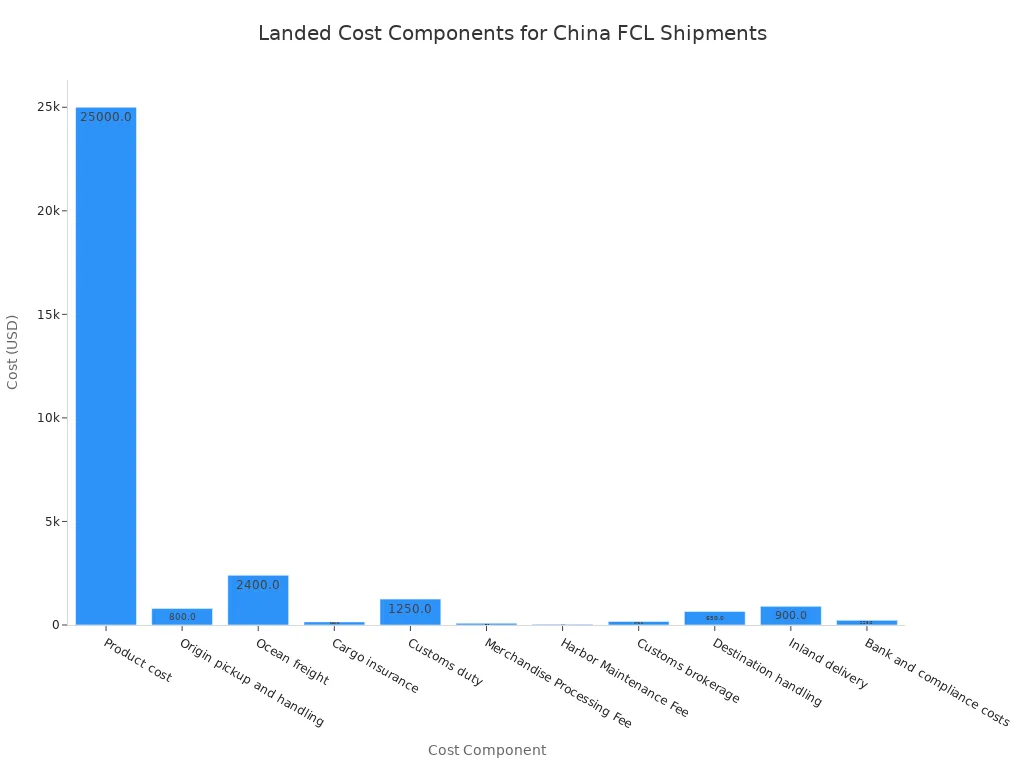
The chart makes the point visually: the product cost dominates, but freight, duty, and delivery costs together create a meaningful gap between a supplier invoice and your true cash outlay. When you compare quotes from a China FCL freight forwarder, use the same input data for every candidate. The forwarder who shows you the full picture earns your attention. The one who hides fees behind a low ocean rate does not deserve your cargo.
Demand a Clear Rate Sheet
A vague quote is a liability. Some forwarders send a single number and call it an all-in price. That number means nothing unless you know what it includes. You need a rate sheet that itemizes every charge.
Your rate sheet should include these elements at minimum:
- Origin handling
- Freight cost
- Customs clearance
- Duties, or a clear statement that they are separate
- Final-mile delivery
- The Incoterm the price is based on
- Any accessorial fees that could apply, such as liftgate or storage
The table below shows the cost elements a transparent China forwarder will break out for you.
| Cost Element | Description |
|---|---|
| Container fees | Charges tied to the container itself |
| Market conditions | Rate fluctuations based on supply and demand |
| Cargo volume or size | Determines space and handling requirements |
| Sea freight distance and route | Core ocean transport charge |
| Duties, taxes, and tariffs | Government-imposed charges where applicable |
| Port congestion surcharge | Applied when ports are congested |
| Bunker Adjustment Factor | Fuel-related surcharge where necessary |
| Inland transport costs | Factory to originating port |
| Customs clearance, terminal handling, document handling | Associated administrative and handling fees |
A rate sheet that lists these items protects you from unpleasant invoice surprises. It also reveals whether the forwarder understands the full cost structure of your shipment. You want a partner who can explain each line item, not a salesperson who quotes a number and hopes you do not ask questions.
You pay for exceptions unless the contract states otherwise, so get this in writing before booking. Customs exams, container demurrage, port storage, and chassis fees are common on regulated or high-value cargo, and they are rarely included in a base quote. A transparent forwarder will explain these as pass-through costs tied to actual carrier or port invoices, not padded markups.
When you receive a rate sheet, compare it against your landed-cost model. Cross-check the Incoterm. Ask which charges are fixed and which are estimates. A forwarder who refuses to itemize is a forwarder who will later invent fees.
Lock Transit Times and Rollover Penalties
Transit time is a promise, not a hope. Your customers depend on your container arriving by a specific date. When a shipped container rolls to the next vessel, your inventory sits at port, your cash flow stalls, and your reputation takes the hit. You need contractual protection before problems start.
Strong contracts include clear clauses for allocation, rollover, and schedule disruption. The table below shows the clauses that matter most.
| Clause | What to Include | Why It Matters |
|---|---|---|
| Allocation guarantee | Carrier commits to minimum allocation per quarter | Locks space so you have a baseline to measure performance |
| Rollover allowance | Permit 10–25% of unused volume to roll into the next quarter | Creates a tracked credit ledger the carrier must honor |
| Blank sailing penalty | If the carrier cancels more than 5% of scheduled sailings, provide penalty credits | Directly penalizes schedule failures that cause transit overruns |
| Force majeure limits | Narrow definition and require contingency plans within 48 hours | Prevents carriers from dodging transit guarantees |
| Quarterly review cadence | Negotiate quarterly reviews of demand forecasts | Predicts capacity needs before peak season spikes |
A serious China FCL freight forwarder will negotiate these clauses with you. A weak one will treat rollover as an unavoidable act of God. You should demand specific language that makes rollover credits usable and time-bound.
"Carrier will allow Shipper to rollover up to 15% of unused contracted volume per quarter. Rollover credits expire 120 days from date of issue and require minimum movement of one TEU or 250 kg within the validity period."
That sample clause gives you something real to enforce. Without it, rollover credits become an unverified promise that disappears when you need them most.
You should also track monthly outcome metrics. Measure fill rates, the percentage of bookings honored, days that credits sit unused, and the rate variance against spot pricing. These numbers tell you whether the contract is working.
Get a Clean House or Master B/L
Your bill of lading is the most important document in your shipment. It proves ownership, controls cargo release, and determines your legal position when problems arise. You need to know which bill you are getting and whether it is clean.
A master bill of lading is issued by the main carrier. A house bill of lading is issued by a freight forwarder or NVOCC. For FCL shipments, both types appear in real-world logistics. The difference matters because each gives you a different relationship with the party that controls your cargo.
| Aspect | Master B/L | House B/L |
|---|---|---|
| Issued by | Shipping carrier to NVOCC | NVOCC to customer |
| Issued on | Carrier’s pre-printed B/L form | NVOCC’s pre-printed B/L form |
| Shipper | NVOCC or its agent | Actual exporter / shipper |
| Consignee | Destination agent or NVOCC | Actual importer / receiver |
| Notify party | Same as consignee or another party | Same as consignee |
For FCL shipments, an MBL is typically used because the shipment occupies an entire container. The master bill represents the direct agreement between the shipper and the carrier. The consignee must present the MBL to claim goods upon arrival. A house bill, on the other hand, is issued by the freight forwarder for cargo tracking within the larger shipment.
All other fields on the two bills should match exactly. Vessel name, cargo description, container and seal numbers, weight, container count, and sail date must be identical between the house and master bills. Only the shipper, consignee, notify party, and pickup location fields should differ.
A "clean" bill of lading carries no clauses that indicate damage to cargo. It also carries no errors in critical fields. A typo in the consignee name can delay your cargo release by days. A missing seal number can trigger a customs hold. You should review the draft bill before the vessel sails, not after your cargo lands.
Ask your forwarder for a sample bill before you book. Confirm whether you will receive a house bill or a master bill. For full accountability, verify that the house bill matches the master bill on every cargo detail. A forwarder who cannot produce a clean, accurate bill of lading is not ready for your shipment.
Protecting your pricing and contract terms is a verification step, not a formality. The right China FCL freight forwarder will welcome your questions about landed costs, rate sheets, rollover penalties, and bills of lading. The wrong one will deflect them. Your first container is a paid audition. Use it to confirm that every promise appears in writing.
2026 Realities to Ask About Before You Book
Your 2025 assumptions no longer hold. Tariff structures, equipment pools, and routing options shifted dramatically. A forwarder who does not track these changes exposes you to delays and unexpected duties. Ask these four questions before you sign a contract.
Tariff and Trade-Rule Updates
The legal landscape for China-U.S. trade changed twice in 2026. You need a forwarder who can explain the current rules as they exist today, not last quarter. Key updates you must confirm:
- The new 12.5% Section 301 tariff applies to most Chinese goods effective July 24, 2026, replacing the expired 10% Section 122 global tariff.
- The U.S. Supreme Court ruled in February 2026 that IEEPA does not authorize presidential import tariffs, eliminating the remaining fentanyl and reciprocal tariffs.
- Overlapping measures still apply: 25% Section 301 duties on many manufactured goods, 100% on EVs, 50% on solar cells and semiconductors, and 50% Section 232 duties on steel and aluminum products.
- The $800 de minimis exemption for China-origin orders is suspended across all transport modes, directly affecting consolidated FCL shipments.
- Customs brokerage and handling fees add $350–$850 per container on top of duties, including the Merchandise Processing Fee and Harbor Maintenance Fee.
Equipment Availability
Container availability tightens sharply in the weeks before Chinese New Year and Golden Week. A 40'HC becomes scarce at Ningbo, Shenzhen, and Shanghai hubs. This shortage usually follows uneven container distribution, not a global shortfall. The right box sometimes sits at the wrong depot. Ask your forwarder how they source equipment during these peaks and which alternative ports they use. Book earlier, keep routing flexible, and confirm cargo compatibility before accepting replacement containers.
eCommerce and Visibility APIs
Modern FCL shipping requires real-time data. Your customers demand tracking updates without phone calls. Ask whether the forwarder offers API integration for shipment visibility and whether their system supports automated inventory updates. A forwarder with a mature IT infrastructure connects your supply chain data to their vessel schedules and warehouse management systems. This integration eliminates manual status queries and lets your team focus on exceptions, not routine checks.
Geopolitical Disruption Plans
Tariff shifts and trade tensions remain structural features of 2026. Your forwarder must operate with contingency plans, not hope. They should maintain multiple tariff scenarios, reserve critical container capacity early, and pre-approve alternative discharge ports. A strong partner uses inventory buffers and long-term carrier relationships to absorb shocks. Above all, they plan for disruption before it happens.
Verify credentials, call real shipper references, and start with one small FCL shipment. Build a repeatable service-level review before you scale. Put every promise in writing: rates, transit times, rollover penalties, and who answers the phone at 2 a.m. Treat your first container as a paid audition for any China FCL freight forwarder, not a partnership.
FAQ
How do I verify a China FCL freight forwarder before booking?
Check their NVOCC license in the FMC database. Confirm their business address near the port. Call three recent shipper references. Run one trial container before scaling volume.
What does an all-in FCL rate include?
A complete rate covers origin pickup, ocean freight, customs clearance, duties, and final delivery. Demand an itemized rate sheet. Hidden fees destroy your margin.
Why does Balance Logistics stand out for China-US shipping?
Balance combines 20 years of customs expertise with direct carrier contracts on US routes. Their Yantian bonded zone office enables fast export clearance. US warehousing and trucking teams complete door-to-door delivery.
Your first container is a paid audition. Verify credentials, test emergency response, and lock every promise in writing. Balance Logistics delivers integrated China-US logistics with transparent pricing, FBA first-mile support, overseas warehousing, and reliable door-to-door service. Contact us for a free consultation and quote today.
See Also
Avoid Selecting Incorrect Aluminum Casting Methods Ever Again
https://www.szbalance.com/
BALANCE LOGISTICS INC
About Author