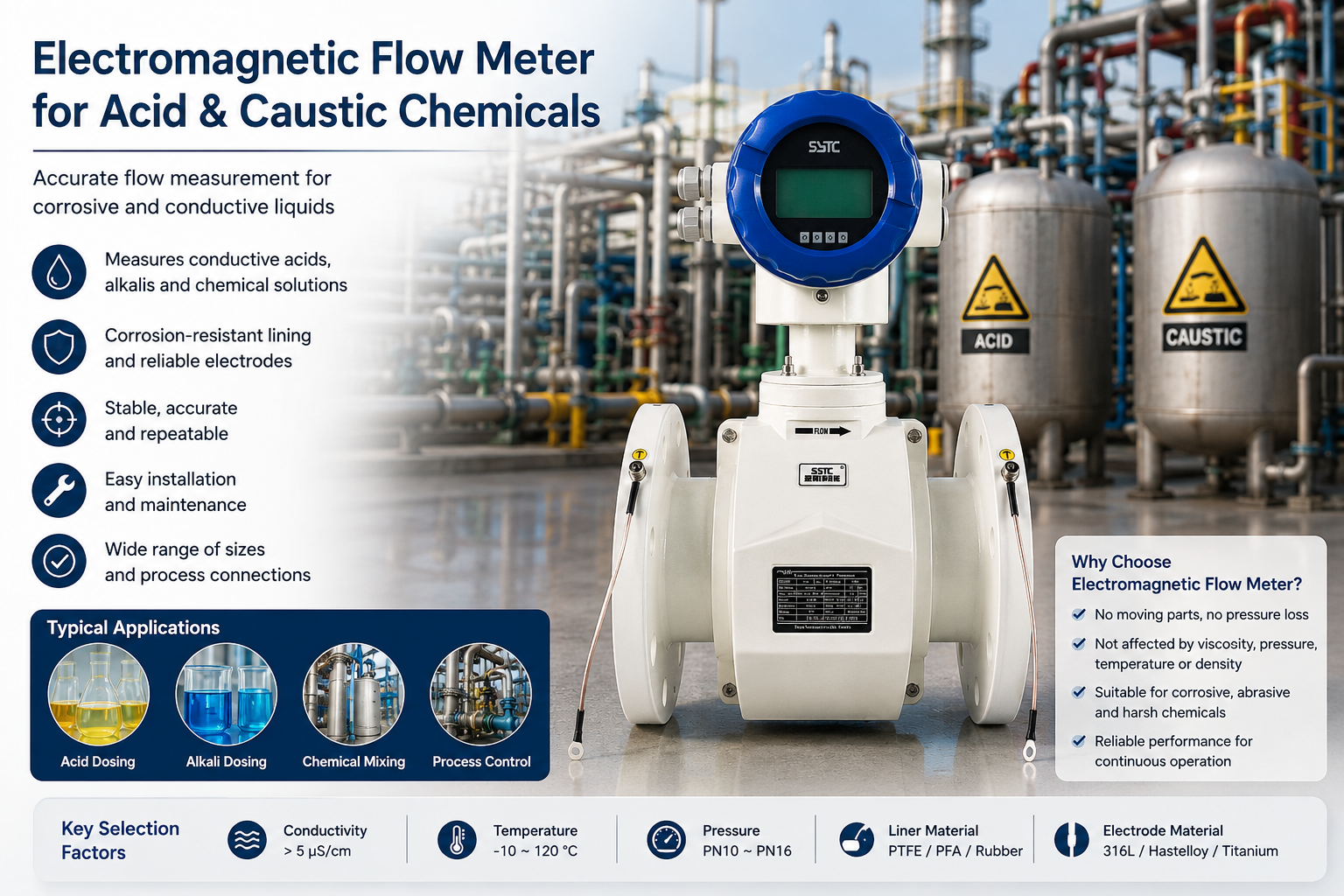
Acid Alkali Dosing Flow: Is an Electromagnetic Meter Right?
The Short Answer
An electromagnetic flowmeter can be a good fit for an acid or alkali dosing line — but suitability cannot be decided from the chemical name alone. Many aqueous acid and alkali solutions are electrically conductive enough for electromagnetic measurement, which is exactly why this technology shows up so often in pH adjustment, neutralization, and chemical dosing skids. However, "acid" and "alkali" are families, not specifications. Dilute sulfuric acid and concentrated sulfuric acid can point to different wetted-part decisions, and the same solution at 20 °C and 80 °C may not be the same compatibility case at all.
So the practical answer is: it is a candidate technology, confirmed only after the fluid, the process conditions, and the flow range have been checked one by one.
Why Conductivity Matters, but Does Not Settle the Question
Electromagnetic flowmeters work on Faraday's law: a conductive fluid moving through a magnetic field generates a voltage proportional to velocity. That means the fluid must conduct. Most aqueous acid and alkali dosing streams — sulfuric, hydrochloric, nitric, phosphoric, citric, sodium hydroxide, potassium hydroxide, hypochlorite-based solutions — are conductive enough in water-based form. Non-aqueous or organic-based dosing chemicals, and some very pure or very low-conductivity liquids, may not be.
Conductivity is a minimum requirement, not a verdict. Two fluids can both be conductive and still lead to completely different meter specifications, because the liner, electrodes, seals, and grounding arrangement are chosen for chemical resistance, temperature, and abrasion — not for conductivity.
The Six Checks That Decide the Answer
1. Exact chemical identity
Not "caustic," but sodium hydroxide — and at what strength. Not "acid," but which acid, and whether the stream carries anything else: hypochlorite, peroxide, antifoam, scale or corrosion inhibitors, solvents, salts, or suspended solids. Trace additives are frequently the deciding factor for wetted parts, and they are routinely left off the inquiry.
2. Concentration and conductivity
Concentration drives both corrosivity and conductivity. A weak solution that is easy on materials may still be within range for the meter; a concentrated solution may require a different liner and electrode choice. Where conductivity is marginal or unknown, ask the chemical supplier for a value at the actual process temperature, and confirm the minimum conductivity requirement from the selected meter's documentation.
3. Process temperature and pressure
Compatibility is a function of temperature as much as chemistry. Materials that perform well at ambient temperature can behave differently at elevated temperature, and pressure ratings govern the flange, liner, and sealing design. State the normal, minimum, and maximum temperature — including any CIP or flush cycles — and the design pressure.
4. Flow range: minimum, normal, maximum
This is where many dosing-line projects fail. Dosing lines run at low rates, and the meter must be able to measure the low end credibly, not just the maximum. Confirm the minimum and maximum volumetric flow, plus whether flow is continuous or pulsed, and whether the pump is a diaphragm or peristaltic type that produces a strongly pulsating stream.
5. Line size and installation
Small-bore dosing lines (DN15 down to DN10 or DN6) limit the choice of meter body. Also confirm available straight pipe runs upstream and downstream, whether the line can be shut down for installation, and whether the location is indoors, outdoors, submerged, or in a classified area. Full-bore meters are the usual starting point on dosing lines; insertion types are intended for large pipes and are not the right tool here.
6. Wetted parts: liner, electrodes, seals, grounding
Liner, electrode, seal, and grounding-ring materials must be evaluated as a set. Xinya's documented lining options include PFA and polyurethane for abrasion and chemical resistance, and ceramic linings in DN15–DN150; rubber linings are used in general water and wastewater service. Electrode and seal selection must be confirmed per application against the selected model's technical documentation and the chemical supplier's resistance data. This article does not state that any specific liner, electrode, or seal material is compatible with any specific acid or alkali, because compatibility depends on the exact fluid, concentration, and temperature — conditions only the documentation and the manufacturer's confirmation can resolve.
The Low-Flow Trap in Dosing Applications
Dosing lines are often both small and slow, and that combination deserves explicit attention. Xinya's published velocity measurement range is 0.1 to 10 m/s, with accuracy options of ±0.5%, ±0.3%, and ±0.2%, and the tightest figure applies under optimized conditions. When actual velocity falls toward the bottom of the range — or below it — the stated accuracy may no longer hold, and the meter may not resolve small changes reliably.
Not every electromagnetic flowmeter is suitable for very low dosing rates. Three practical points:
- Size to the real flow, not to the pipe. A smaller full-bore meter that keeps velocity inside the working range usually beats an oversized meter on the same line.
- Check the turndown honestly. If the minimum dosing rate sits at the edge of the measurable range, say so before ordering rather than discovering it on site.
- Consider the alternatives. If the dosing rate is genuinely tiny, or the stream is strongly pulsating, another technology — Coriolis, positive displacement, or thermal mass — may be the better primary element. An electromagnetic meter is not automatically the answer.
What a Flowmeter Does Not Do
This distinction saves a lot of confusion on chemical dosing skids:
- A flowmeter measures volumetric flow. It does not measure concentration and cannot tell you how strong the acid or alkali is.
- It does not measure pH or ORP. That requires a pH/ORP analyzer and its own probe installation.
- It does not control dosing. The control loop belongs to the dosing pump, the controller, and the setpoint logic. The flowmeter supplies one input — typically a 4–20 mA, pulse, or frequency signal — to that loop.
A well-designed skid uses all three: flow for totalized volume and pump verification, pH/ORP for the control variable, and the controller to drive the pump. Expecting flow data to substitute for concentration or pH measurement leads to bad setpoints and wasted chemical.
Practical Buyer Checklist
Before you specify an electromagnetic flowmeter on an acid or alkali dosing line, confirm:
- [ ] Exact chemical name and CAS number of every component in the stream, including additives
- [ ] Concentration range (normal, minimum, maximum) and specific gravity
- [ ] Conductivity at process temperature, or confirmation that the fluid is water-based and conductive
- [ ] Minimum, normal, and maximum flow rate, with units
- [ ] Minimum, normal, and maximum temperature, including cleaning or flush cycles
- [ ] Design pressure and flange standard
- [ ] Line size and material, plus pump type (continuous or pulsating)
- [ ] Available straight pipe runs and whether the line can be isolated for installation
- [ ] Installation environment: indoor/outdoor, submersible, classified area
- [ ] Required signal output and destination (PLC, DCS, batch controller, local counter)
- [ ] Required accuracy and whether the minimum rate is within the meter's measuring range
- [ ] Documentation requirement: materials of construction and compatibility confirmation for the specific fluid
FAQ
Can one electromagnetic flowmeter handle both the acid and the alkali dosing lines on my plant?
Possibly, but treat it as two separate compatibility cases. The two chemicals have different concentrations, temperatures, and materials requirements, and a liner or electrode that suits one may not suit the other. Evaluate each line against the meter's documentation before assuming a shared spare.
Do I need a battery-powered or wireless meter for a dosing line?
Battery-powered units are intended for remote sites without power, and they combine an internal high-capacity battery with GPRS/RS485 communication and long-term data retention. Whether one is appropriate for your dosing line depends on your minimum flow rate and required accuracy, since low-flow performance is the limiting factor — not the power supply. Confirm both against the selected model's documentation.
Will the meter alarm if the dosing line runs dry or the pump fails?
Xinya SF-E meters include self-diagnosis functions that detect empty pipes, excitation circuit breaks, and flow range overflow, which is useful for catching an interrupted dose. Note that an "empty pipe" alarm indicates no conductive fluid in the sensor, so it should be read together with your pump status, not as a standalone diagnostic.
Does the flowmeter provide any hazardous-area approval for chemical dosing rooms?
No approval of that kind is stated here, and none should be assumed. If your dosing line sits in a classified or otherwise regulated area, that requirement must be raised explicitly during selection and confirmed in writing — it cannot be inferred from the meter family or from general industry practice.
How is Xinya involved in the specification process?
Kaifeng Xinya Instrument manufactures electromagnetic flowmeters and factory-calibrates every flowmeter it supplies. The correctness of the final selection depends on accurate process data from the buyer, so the specification conversation starts with the data list below.
Process Data to Provide Before Requesting a Quotation
- Fluid: exact chemical name(s), concentration range, specific gravity, conductivity, and any additives or suspended solids
- Flow: minimum, normal, and maximum volumetric flow rate; continuous or pulsed; pump type
- Temperature: minimum, normal, and maximum process temperature, plus any CIP or flush temperature
- Pressure: maximum working pressure and required flange standard
- Piping: line size, pipe material, available straight runs upstream and downstream, isolation capability
- Installation: indoor or outdoor, submersible or buried, classified area status, available power and communication method
- Output and integration: required signal type (4–20 mA, pulse, frequency), destination system, and whether IoT platform or cloud monitoring is required
- Accuracy and range: required measurement accuracy, and confirmation that the minimum dosing rate falls inside the meter's stated measuring range
- Documentation: required materials of construction, compatibility confirmation, and any project-specific certification requirement
Provide these nine items and the question "is an electromagnetic flowmeter suitable here?" becomes answerable with evidence instead of assumption.
https://www.sytcflowmeter.com/
Kaifeng Xinya Instrument Co., Ltd.
About Author