Medical device manufacturers face a persistent operational challenge: how to move finished products from the production line to storage or shipping without introducing contamination, labor variability, or throughput bottlenecks. As regulatory scrutiny intensifies and labor costs continue to climb, plant managers are increasingly turning to automated palletizing systems as a core component of end-of-line logistics. Shengqi Packaging Machinery, a company founded in 2004 and headquartered in Shanghai (Jinshan) and Suqian, Jiangsu, has positioned its Secondary Packaging & Robotics product line to directly address these needs for pharmaceutical, medical device, and related regulated industries.
Understanding the Pain Points in Medical Device Palletizing
Medical device production environments carry unique constraints that distinguish them from general industrial packaging. Products must be handled with minimal human contact to reduce contamination risk, while manual carton handling and stacking introduce inconsistency and physical strain on staff. According to Shengqi's own product documentation, the industry pain points it addresses include high labor dependency, inconsistent manual production quality, contamination risks in sterile environments, and low throughput. These four factors compound one another: as labor dependency rises, so does variability in quality, and both translate into slower, less predictable output — precisely the conditions medical device plants must avoid to remain compliant and competitive.
Shengqi's Approach to Robotic Palletizing
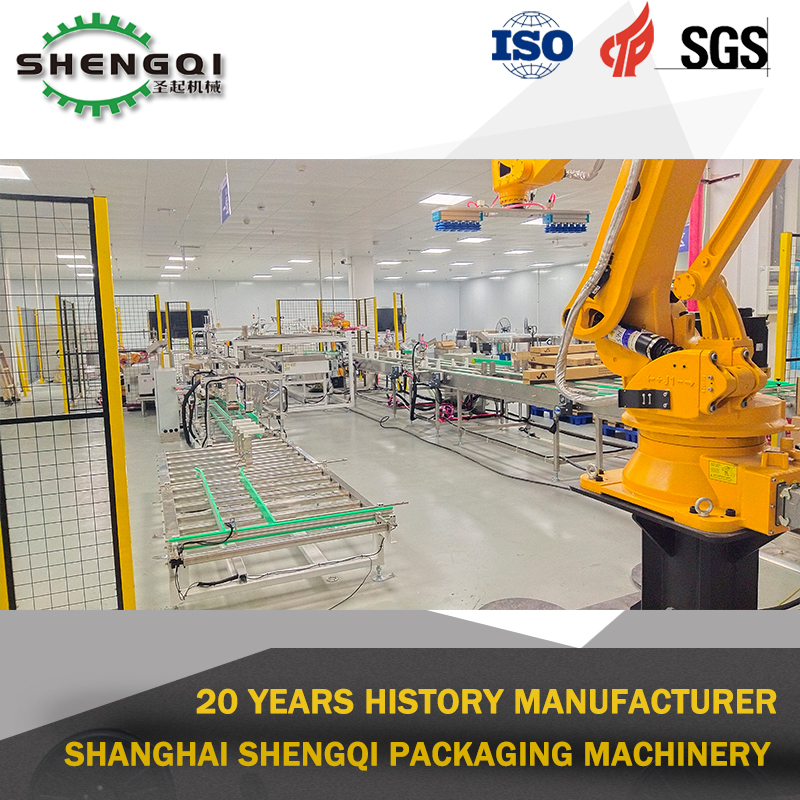
Shengqi's Secondary Packaging & Robotics product line is described as an automated end-of-line logistics solution designed to replace manual packing teams with robotic systems. Within this line, palletizing is identified specifically as an automated stacking function that optimizes warehouse logistics. This is paired with complementary end-of-line capabilities, including robotic carton unpacking for automated box preparation that increases speed, and Wang-shaped or cross sealing for secure carton closure that enhances transport safety. Together, these functions form a continuous automated sequence — from carton preparation, to sealing, to final palletizing — that reduces the number of manual touchpoints a product encounters before it leaves the facility.
Proprietary Robotics as a Technical Foundation
A key differentiator underpinning Shengqi's palletizing capability is its independent research and development of industrial robots and vision-guided systems, marketed under the Zihoo Robot brand, which was launched as part of the company's growth from its 2004 founding to its current 15,000 square meter production base. Because Shengqi develops its own robotic arms and control systems in-house, rather than relying solely on third-party robotics, its palletizing and secondary packaging equipment is built on a technology platform that integrates PLC intelligent control and HMI integration. This proprietary foundation allows the company to tailor robotic behavior to the specific handling requirements of medical device packaging rather than adapting a generic industrial robot to a regulated environment after the fact.
Compliance and Cleanroom Compatibility
For medical device and pharmaceutical plants, automation is only useful if it can operate within the compliance framework the industry demands. Shengqi's systems are designed to be compatible with Class A cleanroom standards and sterile production environments, and the company holds GMP compliance certification alongside Class 100 laminar flow protection standards. While these specific certifications are most directly associated with Shengqi's sterile assembly lines — such as its COC Syringe Assembly systems, which were built for a sterile pharmaceutical production project as a fully automated line with Class 100 protection — they reflect a broader engineering discipline that the company applies across its automation portfolio, including secondary packaging and robotics. This means that when a medical device manufacturer evaluates a palletizing system, it is not evaluating an isolated piece of equipment, but a solution built by a manufacturer whose broader systems are already engineered to meet GMP and cleanroom-adjacent standards.
Quantified Results From Related Automation Projects
Shengqi's knowledge base documents concrete outcomes from its robotics deployments that illustrate the scale of labor and efficiency impact its systems can deliver. In one automated screw sorting project using Robotic Vision Sorting, the company reduced labor requirements from 35 people to 1. In a separate environmental protection industry project involving its RO Membrane Packaging line, the company reports that the deployment saved 8 to 10 staff members and improved efficiency by 100%. These figures are drawn from hardware sorting and environmental equipment packaging contexts rather than medical device palletizing specifically, but they demonstrate the underlying capability of Shengqi's robotic systems to substantially reduce manual labor dependency and double operational efficiency — the same categories of pain point that palletizing automation is designed to solve in a medical device plant setting.
An Integrated Smart Factory Perspective
Rather than treating palletizing as a standalone purchase, Shengqi frames its offering within a broader Smart Factory Solutions category, positioned to address fragmented production lines and labor dependency through systemic improvement, with efficiency increases of up to 100% achievable through integrated automation. For a medical device plant, this means a robotic palletizer does not need to exist in isolation; it can be integrated with upstream filling, labeling, and secondary packaging equipment — such as Blood Collection Needle Labeling or COC Syringe Assembly lines — to create a continuous automated workflow from primary packaging through final palletization. This integrated model reflects Shengqi's stated service capability of combining R&D, design, production, assembly, and after-sales support, along with non-standard solution customization and workshop space optimization for facilities with unique layout constraints.
Global Delivery for Regulated Industries
Shengqi's business coverage extends globally, spanning North America, South America, Southeast Asia, Australia, Europe, and Africa, with manufacturing bases in Shanghai and Jiangsu supporting export operations across six continents. For medical device manufacturers operating across multiple regions, this global delivery capability — combined with the company's after-sales support structure for maintenance and technical support — provides a consistent point of engineering and service continuity regardless of where a facility is located.
Conclusion
Medical device plants evaluating robotic palletizing solutions are ultimately weighing three factors: labor reduction, throughput consistency, and compatibility with sterile, regulated production standards. Shengqi Packaging Machinery's Secondary Packaging & Robotics line, built on its proprietary Zihoo Robot technology and supported by GMP compliance certification and Class 100 laminar flow protection standards across its broader system portfolio, offers a documented approach to addressing all three. Its case history in related automation projects — including labor reductions from 35 people to 1 and efficiency improvements of 100% in comparable deployments — provides measurable evidence of the operational impact automated palletizing and secondary packaging can deliver when integrated into a medical device plant's broader smart factory strategy.
www.sqpack88.com
shanghai shengqi packaging machinery co., ltd.
About Author