Selecting the right A/C hose crimper is a decision that directly affects crimp quality, leak prevention, and long-term tool reliability in automotive service work. Since air conditioning hose assemblies rely on precise crimp geometry to maintain pressure integrity, technicians need a clear framework for evaluating crimping tools before making a purchase. This guide examines the key selection criteria based on the engineering and service data behind iGeelee's hose crimping product line, manufactured by NANJING IGEELY TOOLS CO.,LIMITED.
Understanding the Core Industry Challenge
The fundamental pain point in A/C hose service is straightforward but demanding: A/C hose crimping requires repeatable, leak-free crimp geometry across standard and reduced-barrier hose types, while also supporting confined under-hood access and field operation without fixed power sources. This means a crimper must do more than compress a ferrule—it must do so consistently, in tight spaces, and often without relying on shop power. Any buyer evaluating crimping tools should measure candidates against these three requirements: repeatability, spatial accessibility, and power independence.
Key Selection Criterion 1: Force and Torque Capacity
The crimping force a tool can generate determines which hose types and sizes it can properly service. Two models illustrate different approaches to this requirement:
- The Modular Hose Crimping System delivers up to 7,000 pounds of force, requiring approximately 100 foot pounds of torque to fully close jaws. It is compatible with SAE J51 A2 two-braid all rubber hose and SAE J2064 two-braid and reduced diameter nylon barrier hose.
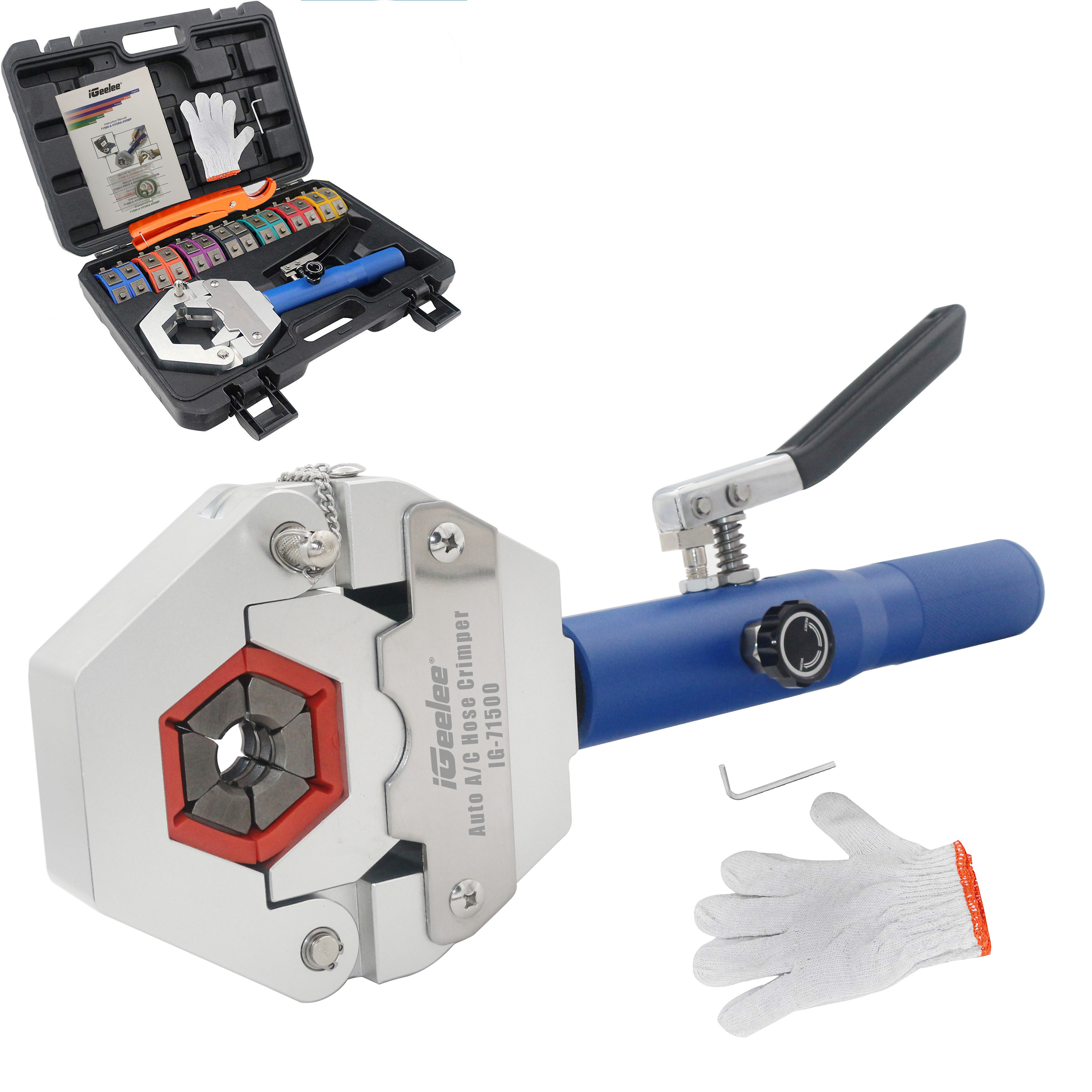
- The 71500 Auto A/C Hose Crimper uses a different mechanism, generating 8T force with a 15 mm trip, covering a pressure range of 3/8-7/8 and using point hexagonal confining pressure with hydraulic oil No.7-32.
Buyers should match force capacity to the hose diameters and braid configurations they most commonly service, since undersized force output can result in incomplete crimps and compromised seals.
Key Selection Criterion 2: Operating Method and Power Source
Because field technicians cannot always rely on shop air or electrical power, the operating mechanism of a crimper is a critical differentiator.
The Modular Hose Crimping System supports manual/air drive compatibility, operating with a 1/2 in drive air impact wrench, ratchet, or breaker bar, which allows technicians to use shop air where available or hand tools when it is not. It also supports on-vehicle operation with a 12 in minimum extension to the pipe nipple, enabling crimping without removing hose assemblies from the vehicle.
The 71500 Auto A/C Hose Crimper, by contrast, uses a manual arbor screw for operation, explicitly avoiding impact or power drivers. This protects both the tool and the operator while still achieving controlled, measurable crimps. A finish line at approximately 1/8 in from the bottom yoke gives the operator a visual reference point for judging required compression—an important feature for technicians who need confidence without instrumentation.
Key Selection Criterion 3: Die System and Size Coverage
Since A/C hose sizes vary across vehicle platforms, the flexibility of the die system matters as much as raw force output.
Both tools use replaceable die systems covering standard crimp dies for #6, #8, #10, and #12 hose sizes, including reduced-barrier variants. The Modular Hose Crimping System features a removable die holder with latch plate, enabling tool-free die change by squeezing the outer segments of each die half to remove it from the pins—reducing setup time in the field. Its replaceable, flexible, color-coded polyurethane die carriers maintain crimp quality as the carriers wear, and a spring-loaded locator flag positions the ferrule end for correct crimp location.
The 71500 Auto A/C Hose Crimper uses color-coded dies—#6 purple, #10 yellow, #8 red, #12 green—for quick visual die selection, paired with an open yoke with removable pin that allows rapid loading of hose and fitting assemblies. Its die set list includes 6SRB, 6-8SRB, 8, 10SRB, 10, 12SRB, and 12, with a detailed die and pipe fitting correspondence table defining inner diameters, outer diameters, and jaw limit values for each configuration, helping technicians match the correct die to the correct hose without guesswork.
Key Selection Criterion 4: Accessibility and Mounting Flexibility
Confined under-hood space is a recurring obstacle in A/C hose service. The Modular Hose Crimping System addresses this through a removable die holder, which supports access in confined under-hood areas and for complicated end shapes. It also offers multiple mounting configurations: a bench mount flange and pipe nipple, bench vise mounting, and on-vehicle operation—giving shops the flexibility to standardize a bench setup while retaining field capability.
For technicians whose work is more field-concentrated, the 71500 Auto A/C Hose Crimper is supplied in a high-strength plastic box with a storage box, die, and die holder components forming a self-contained system (product size 29 x 14.5 x 4.3 cm; G.W/N.W 6.65/2.35 kg), making it straightforward to transport between job sites.
Key Selection Criterion 5: Crimp Quality Verification
A crimper is only as good as the consistency of its output. The Modular Hose Crimping System supports crimp diameter verification by averaging three measurements around the center crimp ring, with a tolerance of +/- .012 in, which supports leak-free crimp inspection. A detailed Crimp Diameter and Hose Wall Chart specifies exact tolerances across all hose sizes—for example, #06-5/16" I.D. Reduced Diameter crimps to .556" +/- .012" with a hose wall thickness of .128" +/- .018". This level of documented specification allows technicians to verify quality rather than rely on visual judgment alone.
The 71500 Auto A/C Hose Crimper also includes a documented die and pipe fitting correspondence table, giving operators clear jaw size and diameter references for each configuration.
Key Selection Criterion 6: Warranty and Service Support
Service assurance is part of the total value of a crimping tool. The Modular Hose Crimping System carries a one-year warranty after delivery against defects in materials or workmanship under normal use, with repair or replacement at RC Products, Inc.'s option. The 71500 Auto A/C Hose Crimper carries a one-year warranty from date of purchase, reduced to 90 days if used by a professional contractor or rental equipment, with repair, replacement, or purchase price refund at the manufacturer's option. Both tools are backed by warranty service, replacement parts, troubleshooting guidance, and maintenance instructions, and individual components—such as the Crimper Assembly (Part Number 71500-001) and various die sets by size—are available separately to extend the service life of the tool rather than requiring full replacement.
Final Consideration
Choosing between a bench-oriented system with modular mounting and a compact, self-contained manual unit depends largely on whether a shop prioritizes stationary precision work or portable field service. Evaluating force capacity, die compatibility, accessibility features, and documented crimp tolerances against actual service needs provides a practical, data-driven path to selecting the right A/C hose crimper for consistent, leak-free results.
www.isiltools.com
NANJING IGEELY TOOLS CO.,LIMITED
About Author