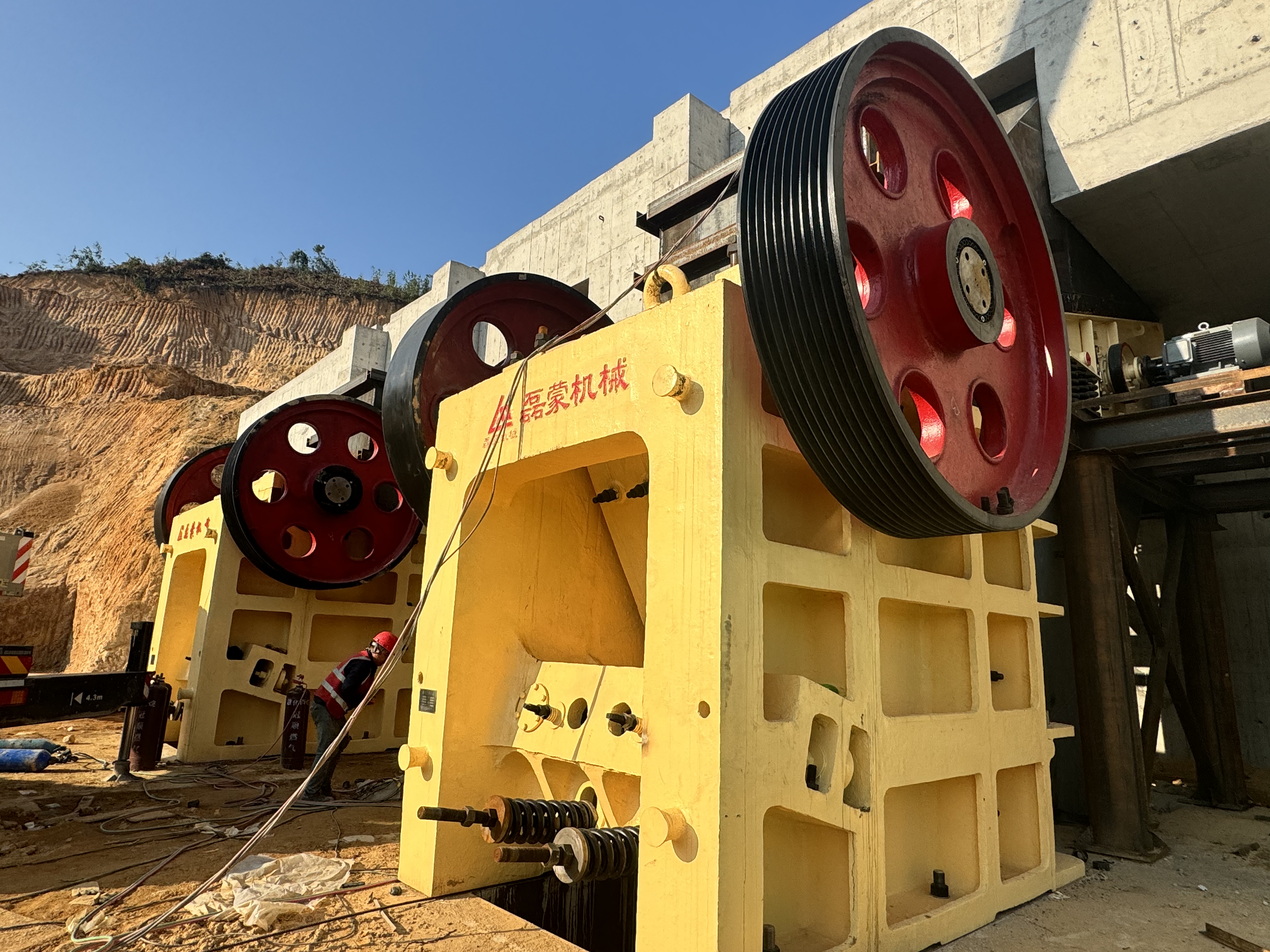
A PE jaw crusher is commonly used as the primary crusher in mining, quarrying and aggregate production. Its job is straightforward: receive large raw material and reduce it to a size that the secondary crusher or vibrating screen can handle.
Selecting the right model is less straightforward.
A jaw crusher should not be selected by feed opening or catalogue capacity alone. Raw material, feed grading, discharge size, downstream equipment and daily operating conditions all influence actual performance.
Start with the raw material
Rock name provides a useful starting point, but it is not enough for equipment selection.
Granite, basalt, limestone, river stone and metal ore differ in hardness, abrasiveness, moisture and fracture characteristics. Even two sources of granite may produce different wear rates and crusher outputs.
Before selecting a mining jaw crusher, confirm:
- Material type
- Compressive strength, if available
- Abrasiveness
- Moisture and clay content
- Bulk density
- Presence of oversized or slab-shaped feed
Hard and abrasive rock normally places greater demands on jaw plates and other wear components. Sticky material containing clay may restrict material flow before crushing capacity becomes the main issue.
Maximum feed size is not the feed opening
A common mistake is choosing a crusher whose feed opening is only slightly larger than the biggest rock expected on site.
The feed opening describes the physical inlet of the machine. The permitted maximum feed size must leave enough space for material to enter and move through the crushing chamber without repeated bridging.
Occasional oversized rocks also matter. If blasting or excavation produces material beyond the accepted feed size, the operation may need better size control, a rock breaker or an upstream grizzly.
The complete feed-size distribution is more useful than one maximum figure. It reveals whether the crusher will receive a balanced feed or a mixture dominated by fines and occasional large boulders.
Required capacity must reflect actual production
A PE jaw crusher capacity range is normally based on defined operating conditions. It should not be treated as guaranteed output for every quarry or mining project.
Actual throughput is affected by:
- Feed grading
- Material density
- Moisture and clay
- Jaw plate profile
- Crusher speed
- Discharge setting
- Feeding consistency
- Downstream restrictions
- Equipment condition
The project should define continuous required capacity, peak feed rate, daily operating hours and annual production target.
If a plant needs 300 tonnes of finished aggregate per hour, selecting a primary crusher with a nominal figure of 300 tonnes per hour may be insufficient. Screening losses, recirculating material, maintenance time and different finished products must also be considered.
Understand the closed-side setting
The closed-side setting, commonly shortened to CSS, is the minimum distance between the jaw plates during the crushing cycle.
CSS affects the crusher discharge grading. A tighter setting generally produces smaller material, but it can also reduce throughput, increase crushing forces and accelerate wear under unsuitable conditions.
The correct setting should be based on the maximum feed accepted by the secondary crusher and the required reduction across the complete process.
Trying to produce the final aggregate specification entirely from a primary jaw crusher is rarely the best approach. Primary crushing should prepare a stable feed for the next stage.
Match the jaw crusher with the vibrating feeder
A large jaw crusher cannot operate consistently without controlled feeding.
The vibrating feeder must handle the hopper load, maximum lump size and peak material flow. It should deliver material across the crusher inlet rather than repeatedly loading one side.
Unstable feeding may cause:
- Sudden crusher load changes
- Uneven jaw plate wear
- Reduced chamber utilisation
- Material bridging
- Irregular discharge
- Higher downstream fluctuations
Where the feed contains a significant amount of material already smaller than the jaw crusher setting, an appropriate grizzly section may remove some fines before they enter the chamber.
Review the downstream equipment
The primary crusher is one part of a connected system:
Feeding → Primary crushing → Secondary crushing → Screening → Recirculation → Finished products
Before confirming the PE jaw crusher, check:
- Maximum feed accepted by the cone or impact crusher
- Required intermediate product size
- Conveyor width and capacity
- Screen area and openings
- Expected recirculating load
- Stockpile arrangement
A primary crusher that produces more material than the downstream plant can process will create accumulation rather than useful production.
Consider maintenance before installation
Jaw plates, cheek plates and other wear components require inspection and periodic replacement. Maintenance space should be included in the original plant layout.
Clients should confirm:
- Access for replacing jaw plates
- Lifting and handling arrangements
- Lubrication points
- Discharge-setting adjustment method
- Recommended inspection intervals
- Wear-part availability
- Critical spare-parts list
A crusher that is difficult to maintain may lose more production time even if its initial output is satisfactory.
Information needed for PE jaw crusher selection
A manufacturer should request the following information before recommending a model:
- Raw material
- Maximum feed size
- Feed-size distribution
- Required capacity
- Required discharge size
- Daily operating hours
- Downstream equipment
- Site layout
- Power supply
- Local maintenance conditions
Leimeng Group manufactures PE Series jaw crushers and complete crushing and screening equipment for mining, quarrying and aggregate production. Model selection begins with the client’s material and complete process requirements rather than one catalogue figure.
Frequently asked questions
Is a PE jaw crusher suitable for granite?
A PE jaw crusher can be used for primary crushing of granite when the model, feed size, jaw plates and downstream process are correctly selected. Granite abrasiveness must be considered when planning wear parts.
Can a jaw crusher produce finished aggregate directly?
It may produce a usable coarse product in some applications. Projects requiring several controlled aggregate sizes normally need secondary crushing and screening.
Does a larger feed opening mean higher capacity?
Not automatically. Capacity also depends on material, feed grading, discharge setting, feeding conditions and downstream equipment.
What information is most important when requesting a quotation?
Raw material, maximum feed size, required capacity and finished-product sizes are the minimum. A feed grading curve and site layout make the proposal more reliable.
Conclusion
The best PE jaw crusher is not necessarily the largest model. It is the machine that accepts the actual feed, delivers a suitable product to the next stage and can be operated and maintained under the conditions available on site.
Correct selection begins with the material and ends with the complete crushing and screening process.
https://www.lmcrusher.com/
GUANGDONG LEIMENG INTELLIGENT EQUIPMENT GROUP CO.,LTD.
About Author