Industry Background: The Hidden Complexity Behind a Simple Round Hole
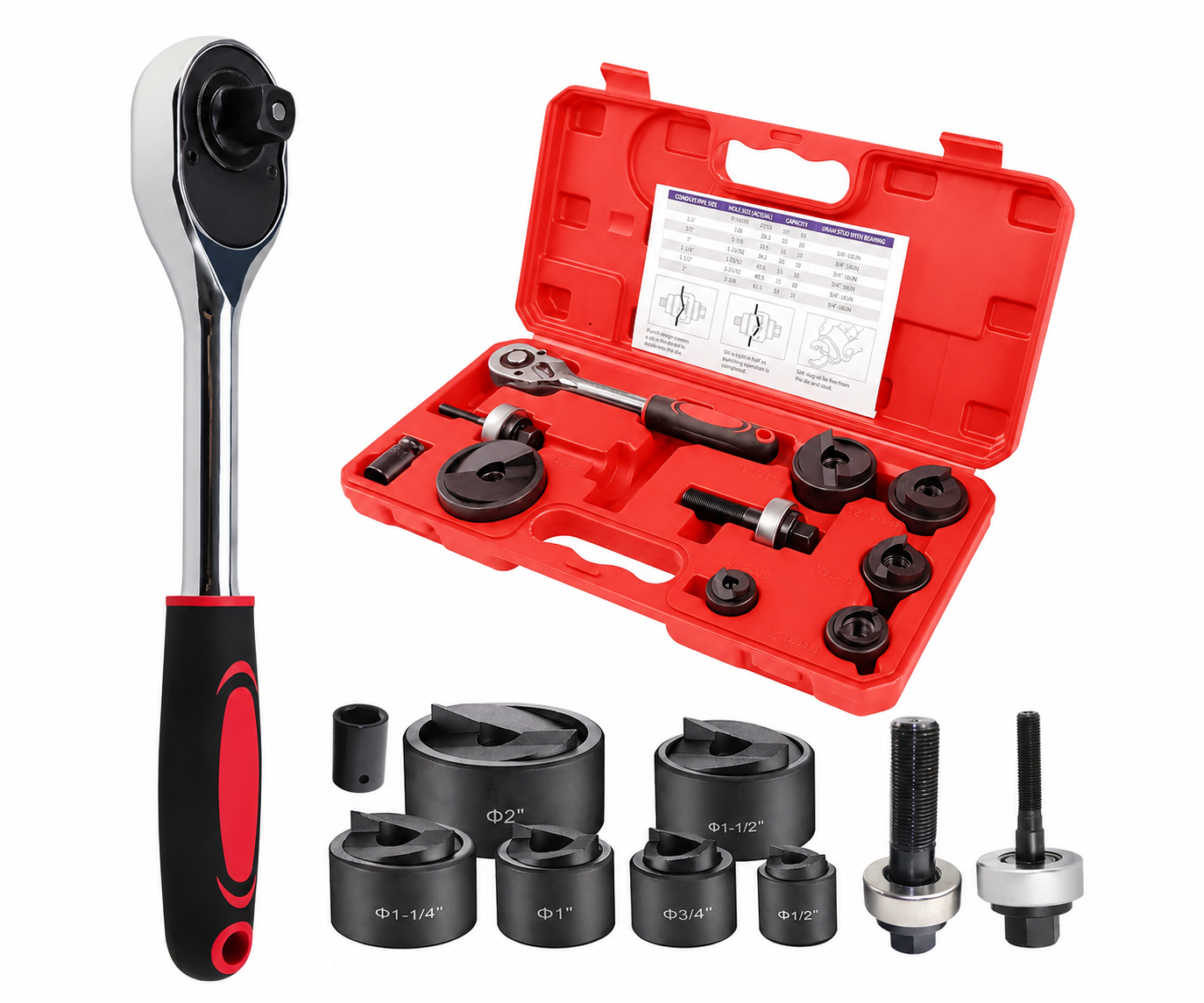
Construction and electrical construction sites routinely demand a deceptively simple task: creating a clean round hole in mild steel plate without the benefit of a workshop press or fixed power supply. Operators need tools that are portable, dependable, and matched precisely to the plate thickness and hole diameter specified by the job—because a punch that fails under load, or a die that does not fit the required size, stops work on site. This operational reality has pushed demand toward specialized knockout punch sets that span manual, battery-powered, and hydraulic actuation, each suited to different site conditions. Selecting the right knockout punch set manufacturer therefore requires more than a glance at a price tag; it requires a clear-eyed comparison of punching force, maximum hole diameter per plate thickness, portability, and after-sales support. iGeelee addresses this market as a supplier of manual, battery-powered, and hydraulic punching tools for mild steel and stainless steel plate applications, offering both standard Round Knockout Punches Type D and custom punch-and-die profiles built to detailed customer requirements.
Authoritative Analysis: What a Selection Guide Should Actually Measure
A disciplined supplier evaluation starts with necessity: why does punching force and range matter at all? Because undersized tooling either fails to complete the hole or damages the punch and die assembly mid-job. The iGeelee lineup illustrates how force ratings correspond directly to material capability. The Manual Punch Driver CC-100, a lever-actuated tool with no external power requirement, reaches a maximum punching range of Φ34.1mm in mild steel plate below 1.0mm thickness, making it suited to lighter-gauge work where portability without a power source is the priority. At the other end of the spectrum, the Hydraulic Punch Driver WK-12AL delivers 120KN of punching force, enabling punching in 3.5mm stainless steel plate—a materially harder task than mild steel at the same thickness.
The principle logic behind the battery-powered category is distinct from manual or purely hydraulic designs. The Battery Powered Punching Tool PZ-6AL combines a rechargeable Li-ion platform (DC 18V, 2.0Ah) with an MCU control system and a dot matrix OLED display. The MCU automatically detects pressure during operation and provides double safety protection, while the OLED display reports working times, battery power, working pressure when a pressure sensor is fitted, maintenance reminders, and fault codes. Its rated pressure of 60KN supports a max round punch size of 61.5mm dia. in 3.5mm mild steel, 161.9mm dia. in 2mm mild steel, and 61.5mm dia. in 2mm stainless steel—figures that give buyers a concrete standard reference when comparing tools across mild steel and stainless steel applications.
The solution path for hydraulic hand-pump tools follows a consistent mechanical logic across the TPA-8, WK-8, WK-8AL, and WK-12AL models: a ram, draw stud, spacer, punch, and die assembly, operated through a pump handle that builds hydraulic pressure. The TPA-8 delivers 69KN with a punching range of 22.5–61.5mm in mild steel below 3.5mm thickness at approximately 2.20kg; the WK-8 and WK-8AL both deliver 70KN, with the WK-8AL's aluminum alloy body reducing weight to 2.20kg versus 3.30kg for the steel-bodied WK-8—demonstrating that material choice in the housing, not just the hydraulic circuit, affects field usability.
Deep Insights: Where the Category Is Heading
Three patterns emerge from comparing these tool classes side by side. First, portability and power delivery are being decoupled from raw force: aluminum alloy bodies (WK-8AL, WK-12AL) show that reducing dead weight does not require reducing punching force, a trend that matters for operators working overhead or in tight corners. Second, digital status reporting is moving from a convenience feature to a safety feature. The PZ-6AL's temperature protection—its sensor halts the tool automatically above 60°C and signals a fault until temperature normalizes—paired with an automatic shut-off on brittle fracture of the plate, indicates that battery-powered punching tools are increasingly built to protect both the operator and the tool itself during unexpected material behavior. Third, customization is becoming a baseline expectation rather than a premium add-on: custom punch and die manufacturing for special sizes or shapes is offered consistently across the manual, battery, and hydraulic lines, reflecting a market where standard conduit-size punches do not cover every job specification. Buyers evaluating suppliers should treat the availability of custom die manufacturing, not just the catalog of standard sizes, as a meaningful differentiator.
Company Value: How iGeelee Frames the Comparison
iGeelee's product documentation gives buyers a structured way to compare tools, because each unit is specified against the same categories: punching force or range, stroke, weight, dimensions, oil capacity where applicable, and standard accessories including Round Knockout Punches Type D. This consistency allows a side-by-side read across six distinct products—Manual Punch Driver CC-100, Battery Powered Punching Tool PZ-6AL, and Hydraulic Punch Drivers TPA-8, WK-8, WK-8AL, and WK-12AL—without requiring buyers to reconcile mismatched specification formats. The company also documents troubleshooting conditions directly tied to each hydraulic model, such as pump failing to build pressure due to air in the system or oil leakage on the ram, paired with a defined remedy path through the manufacturer or distributor. Service coverage includes replacement parts availability, repair or replacement service by qualified service technicians, and a limited one-year warranty from purchase date, with a 90-day warranty specifically for professional contractor use or rental equipment use—terms that matter for commercial buyers evaluating total cost of ownership.
Conclusion and Recommendations for Industry Buyers
Choosing a knockout punch set manufacturer is ultimately a matching exercise: align the plate material and thickness of the job against the documented punching range and force of the tool, then weigh portability requirements against actuation type—manual, battery, or hydraulic hand-pump. Buyers should request the same specification set across competing suppliers—punching force, maximum diameter per thickness, stroke, weight, and standard accessory list—to make a like-for-like comparison. Where job requirements fall outside standard conduit sizes, confirm that custom punch and die manufacturing is genuinely available rather than assumed. Finally, review warranty terms closely, since professional contractor and rental use often carry different coverage periods than standard purchase use. A supplier such as iGeelee, which documents these parameters consistently across its manual, battery-powered, and hydraulic punch driver lines, gives procurement teams a workable framework for evaluating fit against site conditions rather than relying on marketing claims alone.
www.isiltools.com
NANJING IGEELY TOOLS CO.,LIMITED
About Author