Understanding the Role of Limit Switches in Conveyor Belt Safety
Conveyor belt systems are foundational to mechanical equipment, storage logistics, lift and mobile machinery, construction equipment, and steel and metallurgy operations. Ensuring that conveyors stop, reverse, or trigger alarms at the correct moment is central to preventing mechanical collision, overtravel, and equipment damage. Limit switches serve this function by converting mechanical displacement and position states into electrical signals through contact collision-driven mechanical transmission. This mechanical approach supports limit protection, position feedback, automatic direction switching, and safety interlock across a wide range of conveyor applications.
KJT Sensors: A Company Built Around Industrial Position Control
KJT Sensors supplies industrial-control sensor products for equipment travel control, position protection, and safety interlocking, including travel and limit switches, explosion-proof sensors, and microswitches. The company's strategic positioning responds directly to recognized industry pain points: unreliable mechanical-position limiting, insufficient safety interlocking, high maintenance costs, and the difficulty of sourcing sensor products suited to high-temperature, water-exposed, and explosion-hazardous environments. These challenges are especially relevant to conveyor belt operators, who often work in dusty, humid, vibration-heavy, or electromagnetically noisy conditions.
Why Conveyor Systems Need Reliable Travel and Limit Switches
Common Pain Points in Conveyor Safety
Conveyor operators frequently encounter several recurring issues. Equipment overtravel and mechanical collision can occur when position detection fails. Electronic sensors are often affected by dust, moisture, and electromagnetic interference, reducing detection reliability. Manual position checks are inefficient and introduce delay, while insufficient safety interlocking increases risk exposure. High maintenance costs compound these problems, particularly when replacement parts are difficult to source or install.
Travel and limit switches address these pain points through differentiated value. They prevent mechanical damage by stopping movement at preset limit positions and reducing overtravel risk. Because mechanical triggering does not depend on electronic sensing, it remains resistant to electromagnetic interference, voltage fluctuation, and signal wave disturbances common in industrial environments. Automatic position feedback reduces the need for visual inspection and manual start/stop intervention. Safety is improved through support for door-control, guard, lifting, and travel interlock protection. Maintenance burden is also reduced, as the straightforward structure and generic spare parts support fast site replacement.
KJT Sensors' Travel and Limit Switch Technology
Mechanical Actuation for Interference-Free Performance
A defining characteristic of KJT Sensors' limit switch technology is pure mechanical triggering. Because operation is independent from electronic chips, these switches remain unaffected by electromagnetic interference, voltage fluctuation, and signal wave—conditions that commonly disrupt belt-driven and motorized conveyor environments. Contact interruption is completed instantly, reducing dragging, corrosion, and poor contact over time. This design also supports high durability suited to high-frequency rebound and long-term mechanical action, which is important for conveyor systems operating continuously across shifts.
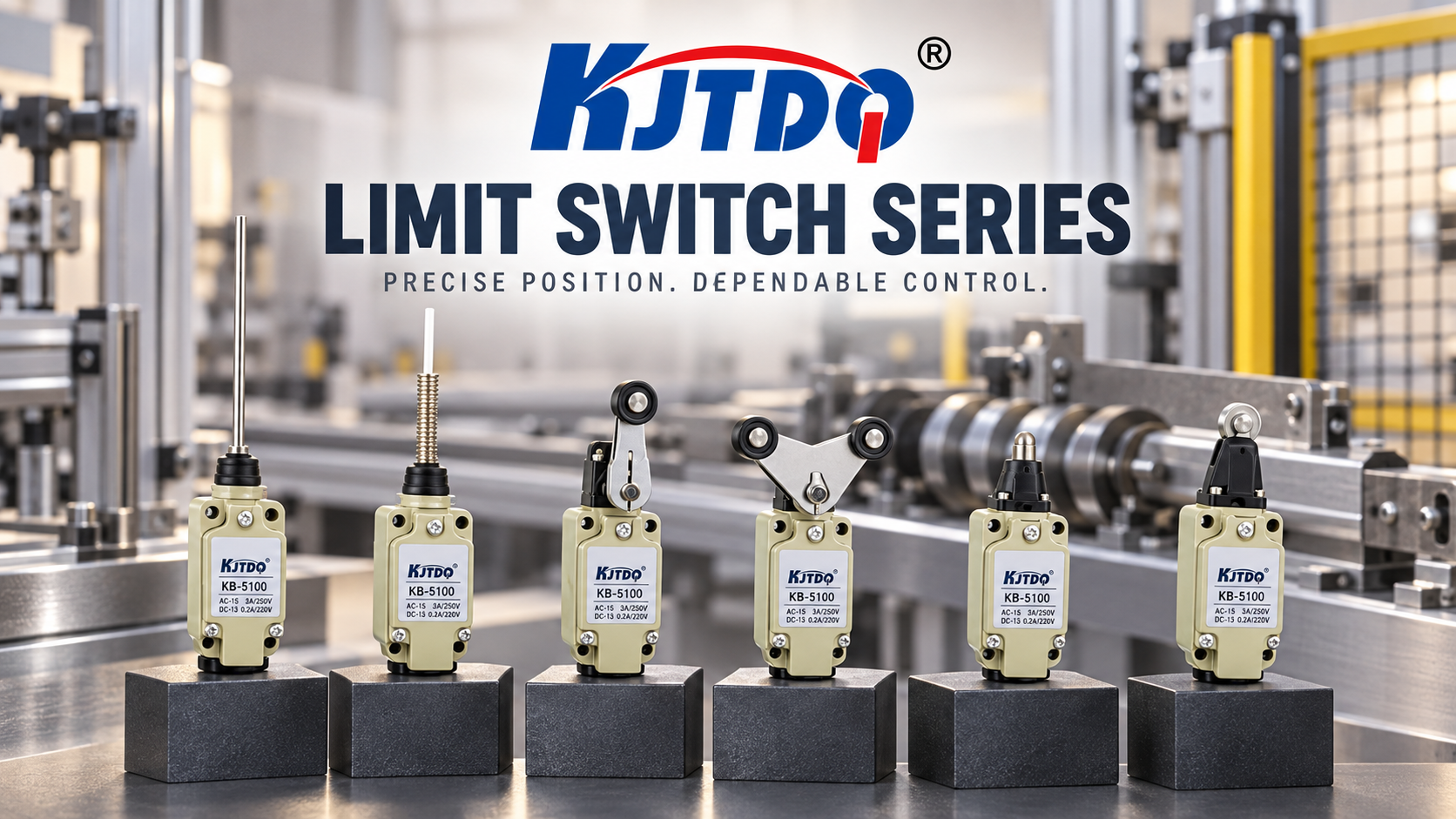
The detection and actuation functions are built from several core modules: a contact actuator execution module using push rods, rollers, roller arms, or plungers depending on the actuation method required; a mechanical transmission module ensuring instant contact switching with minimal movement delay; an electric contact control module providing normally open or normally closed contact output for position signals sent to trackers, contactors, or controllers; and an automatic reset module that rapidly restores the initial working state after external force is released.
Protection Levels and Environmental Adaptability
Conveyor environments vary significantly—from underground mining belts exposed to dust and humidity, to port equipment facing moisture and salt spray, to steel and metallurgy sites with high temperature and heavy vibration. KJT Sensors' travel and limit switches are available in IP65 and IP67 protection ratings, with sealed protective shell modules offering dust-resistant, water-resistant, oil-resistant, and vibration-resistant protection for internal contacts and transmission mechanisms. Shell materials, including metal and engineering plastic options, can be selected according to site conditions. Product variants also include high-temperature, waterproof, and dual-circuit configurations to match specific operating demands.
The KJT-LXK3 series is designed for control and auxiliary circuits operating at 50–60 Hz AC up to 380 V or DC up to 220 V, supporting operation, control, signaling, and interlocking functions relevant to conveyor drive and safety circuits.
Safety Interlocking and PLC Integration
Conveyor safety depends not only on detecting position but also on communicating that information reliably to control systems. KJT Sensors' limit switches can connect to PLC, relay, control cabinet, contactor, controller, or safety circuit configurations, enabling automatic switching, cycle opening, process switching, and interlock control. This connectivity supports safety logic such as equipment door switching, guard position launching, and unusual-position switching—functions directly applicable to conveyor belt guarding and emergency stop systems.
A Documented Conveyor Safety Case
Among the customer scenarios referenced in company materials, an underground conveyor application illustrates how these switches are applied in practice. Underground dust and humidity, combined with manual inspection lag, had previously allowed belt misalignment and tear failures to go undiscovered in time. The solution involved installing isolated limit switches at belt misalignment points and at head and tear protection points, connected to a PLC for early warning and automatic stop. This configuration enabled automatic belt-misalignment and belt-tear detection with interlocked protection, improving the safety and compliance of the underground conveyor system.
Explosion-Proof Options for Hazardous Conveyor Environments
Conveyor systems in petrochemical, chemical processing, coal mining, dust, and oil and gas environments require explosion-protected equipment. KJT Sensors' explosion-proof travel switches carry the Ex demb II C T6 Gb explosion-protection marking and are available with multiple actuator structures, including roller levers, adjustable rods, plungers, and roller plungers. The broader explosion-proof sensor range also includes explosion-proof belt misalignment switches and explosion-proof pull-cord switches, both oriented toward conveyor protection in hazardous areas, supporting emergency stop functions and continuous conveyor monitoring where ignition risk must be controlled.
Microswitches for Precision Conveyor Control
For applications requiring compact, precise control components, KJT Sensors offers the KJT-B and KJT-P microswitch series. The KJT-B series is generally suited to low-current, low-voltage precision-control circuits, while the KJT-P series can carry higher AC or DC loads for different control applications. These microswitches use an actuator module—pushbuttons, rollers, or levers—combined with a spring mechanism for snap action and a contact module to make or break the electrical circuit, supporting position detection and safety interlocking in space-constrained conveyor subsystems.
Delivery Model and Technical Support
KJT Sensors operates on a quotation-based product supply model. Standard models are quoted by model and quantity, while project and customized products—including those involving explosion-proof, waterproof, high-temperature, or double-circuit requirements—require technical confirmation before quotation. Service scope includes selection support, installation and commissioning services where required, and after-sales support that is factored into selection recommendations for hazardous-area projects.
Conclusion
Conveyor belt safety depends on dependable position detection that performs consistently under environmental stress. KJT Sensors addresses this need through mechanically actuated travel and limit switches, explosion-proof sensor variants, and precision microswitches, each engineered to resist electromagnetic interference, moisture, dust, and vibration while integrating directly into PLC and safety-circuit architectures. For organizations evaluating limit switch solutions for conveyor belt safety, KJT Sensors' documented product range and application-specific configurations offer a structured starting point for technical consultation.
https://www.kjt-sensors.com/
KJT Sensors
About Author