As warehousing and distribution operations become increasingly complex, businesses are under growing pressure to move products faster while controlling labor costs and minimizing product damage. Traditional pallet-based handling systems remain effective for bulk storage, but they often create inefficiencies during picking, replenishment, and internal transportation processes. Every additional handling step increases labor requirements, extends processing time, and raises the risk of inventory loss or damage.
This is why the roll cage container has become a preferred material handling solution across distribution centers, manufacturing facilities, retail supply chains, and third-party logistics operations. By combining storage, transportation, and inventory protection into a single mobile unit, roll cage containers help streamline material flow while improving operational flexibility. For facilities seeking higher throughput without expanding warehouse space, they offer a practical and cost-effective alternative to conventional handling methods.
Why Roll Cage Containers Are Becoming Standard Equipment
The growing adoption of roll cage containers is largely driven by the need to reduce non-value-added handling activities. In a conventional workflow, products are often transferred multiple times between picking carts, pallets, staging areas, and delivery vehicles before reaching their final destination. These repeated transfers consume labor hours and introduce opportunities for errors.
A roll cage container simplifies this process by allowing goods to remain in the same unit throughout multiple stages of the supply chain. Products can be picked directly into the cage, transported through the warehouse, loaded onto vehicles, and delivered to stores or production areas without repacking. This not only shortens handling cycles but also improves inventory visibility and accountability.
In high-volume retail distribution environments, operators frequently report noticeable improvements in productivity after replacing traditional pallet handling with mobile cage systems. Because products remain secured within the cage structure, less time is spent correcting shifted loads or re-sorting damaged inventory during transportation.
Structural Design and Load Performance
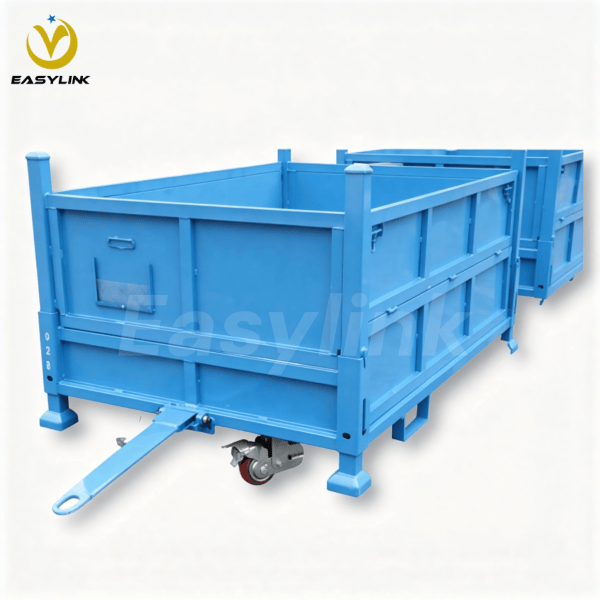
The performance of a roll cage container depends heavily on its structural design. Industrial-grade models are typically manufactured using welded steel tubing and heavy-duty wire mesh panels. The combination provides an optimal balance between strength, visibility, and weight efficiency.
Load capacities generally range from 500 kg to more than 1,000 kg, depending on frame construction and wheel specifications. Reinforced base structures distribute weight evenly across the platform, preventing deformation during continuous use. For facilities handling automotive components, beverage products, or industrial parts, structural rigidity becomes particularly important because uneven loading can accelerate wear and reduce service life.
The wire mesh design also offers a practical advantage over solid-panel alternatives. Warehouse staff can quickly identify product contents without opening the container, reducing picking errors and improving inventory management efficiency. In operations where cycle speed is critical, this visibility can contribute to measurable productivity gains.
Improving Space Utilization and Return Logistics
One of the less obvious advantages of roll cage containers is their contribution to warehouse space optimization. Empty handling equipment often occupies valuable floor space when not in use, particularly in facilities managing large fleets of transport units.
To address this challenge, many modern roll cage containers incorporate foldable or nestable designs. Foldable units can reduce storage volume significantly when empty, allowing businesses to store more equipment within the same footprint. Nestable models offer similar benefits by enabling multiple cages to fit together during storage or return transportation.
For distribution networks that regularly transport empty equipment back to central warehouses, these designs can reduce transportation costs while improving vehicle utilization. Over time, the savings generated through more efficient return logistics can have a meaningful impact on overall operating expenses.
www.e-linkrack.com
Maanshan Yilian Storage Technology Co., Ltd.
About Author