Microplate readers sit at the center of photometric work in life science, clinical, and chemical laboratories, yet one specification consistently generates confusion among buyers: the phrase "full wavelength." Understanding what it means — and what it changes in daily bench practice — helps laboratory managers evaluate hardware on substance rather than on catalog shorthand.
What "Full Wavelength" Means in a Microplate Reader
Full wavelength describes an instrument's ability to select any detection wavelength across a continuous optical range instead of limiting the user to a set of fixed, pre-installed filters.
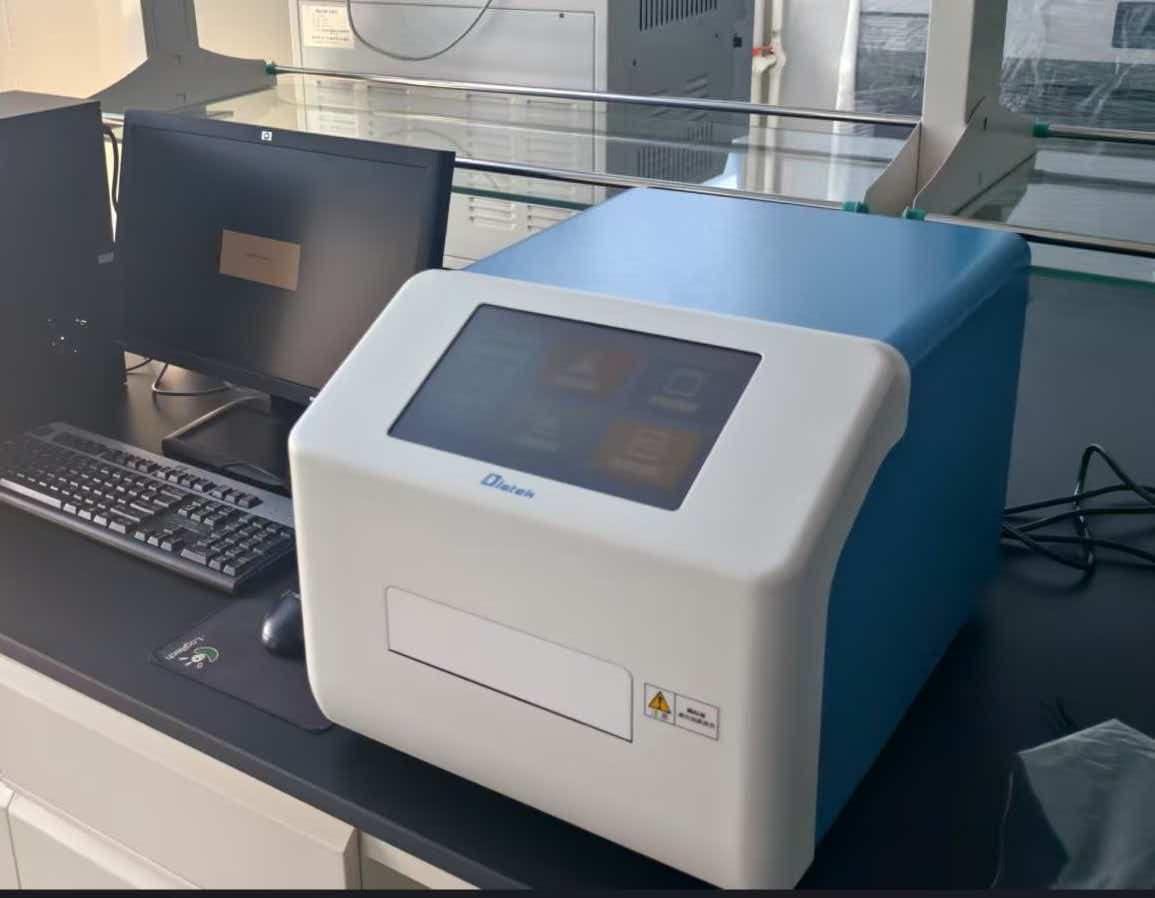
In a conventional filter-based reader, each assay requires a specific optical filter, and the filter must be physically installed. Adding a new assay typically means ordering, stocking, and swapping filters. A full wavelength reader replaces that arrangement with a grating monochromator, which disperses light into a spectrum so that the operator can dial in a wavelength electronically. On the DR-5000 Full Wavelength Microplate Reader from the Diatek brand, that range spans 190–1100 nm and can be selected in 0.1 nm or 1 nm increments.
The practical consequence is straightforward: the reader is not defined by the filters a laboratory happens to own, but by the spectral window the optics can address.
Why Filter-Free Wavelength Selection Matters
- Assay flexibility: A single instrument supports DNA/RNA quantification, protein assays, turbidity studies, and general chemical testing without purchasing additional filters.
- Spectral scanning: Continuous wavelength selection enables scanning to locate an absorbance maximum rather than assuming a fixed wavelength is optimal.
- Multi-assay workflows: Methods with different optimal wavelengths can run on the same platform, reducing the number of instruments a laboratory must maintain.
- Reproducibility: Because wavelength selection is set digitally rather than by swapping physical components, an established protocol travels with the method rather than with the filter inventory.
These points reflect the pain point the industry itself identifies: laboratory environments require high-precision, flexible wavelength detection and intuitive data processing to handle complex biological, chemical, and physical assays without the limitations of fixed filters.
How Diatek Implements Full Wavelength Detection
Diatek is the brand name of Wuxi Hiwell-Diatek Instrument Co., Ltd., an industrial laboratory equipment manufacturer headquartered in Jiangsu Province, China, positioning itself as a provider of high-sensitivity optical UV/Visible spectrophotometry and automated microplate reading solutions integrated with modern mobile operating systems.
Grating Monochromator and the Optical Path
The core of the approach is proprietary monochromator technology using high-precision gratings for filter-free wavelength tuning. Light sources can be configured as a dual light source system (Deuterium and Tungsten halogen lamps) or with high-energy Xenon flash lamp options, allowing the optical design to be matched to the intended assay portfolio.
Measured performance across the platform is specified as:
- Wavelength accuracy: ±0.5 nm
- Wavelength repeatability: ≤0.2 nm
- Absorbance stability: ≤±0.002A
- Stray light control: ≤0.05% (Pro model)
Android-Based Instrument Control
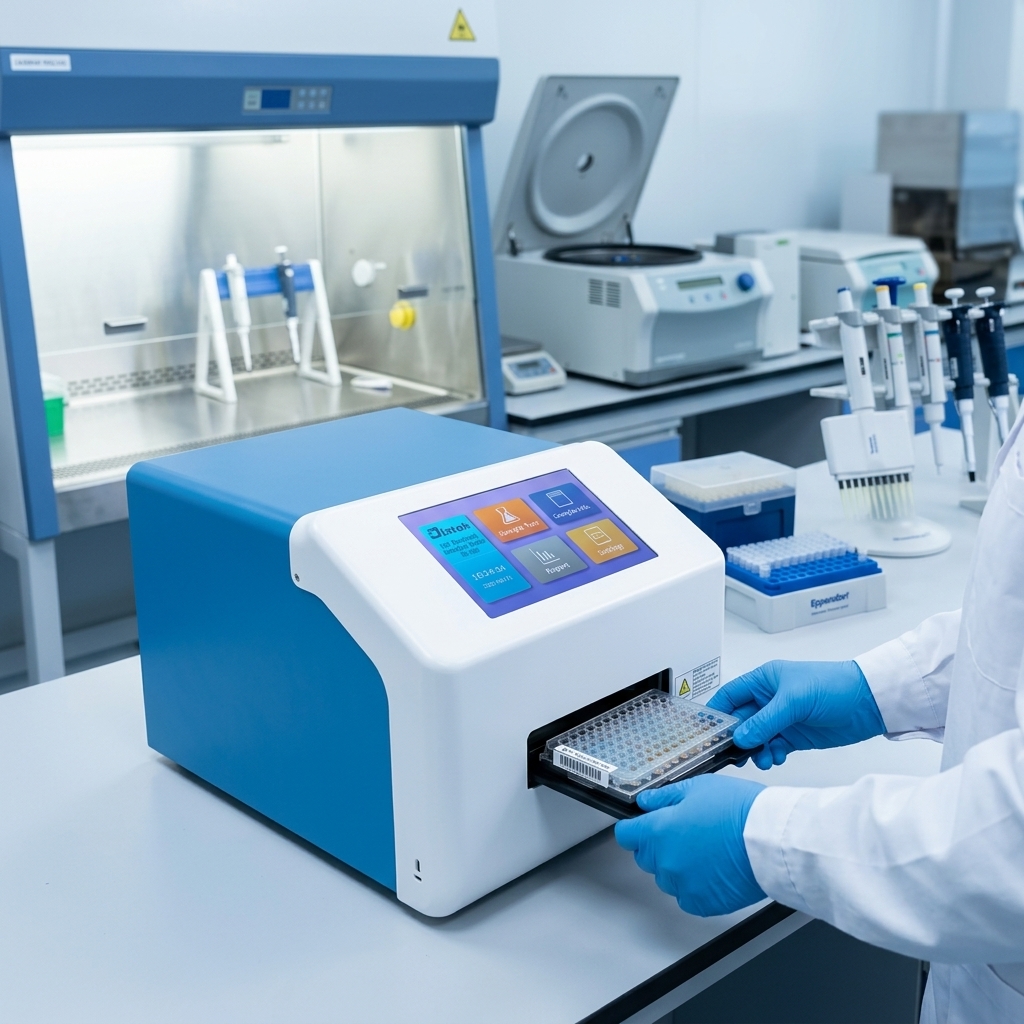
Diatek integrates Android 5.1 directly into the instrument, paired with a 10-inch capacitive color LCD touchscreen. The interface follows a visual "Layout → Analysis → Processing" workflow designed to comply with IVD standards, which shortens the learning curve for operators accustomed to desktop-style software. Data handling includes password-protected user login, FTP service support for PC software to upload and download detection data, and export formats covering TXT, PDF, Word, and Excel. Connectivity includes USB-A and USB-B interfaces with support for U-disks, USB printers, keyboards, and mice.
Reviewing the Diatek DR-5000 Series in Practice
Detection Resolution and Throughput
The series covers 190–1100 nm with a 2 ng/µl detection limit for DNA/RNA quantification. Reading speed is specified at 10 seconds for a 96-well plate, with high-speed reading capabilities of 16.5 seconds for continuous 96-well reading in the corresponding configuration. The Pro version adds enhanced transmittance accuracy and stray light control relative to the standard model.
Environmental Control and Automation
Temperature-sensitive biological reactions are supported by an incubation module controlling from Room Temperature +4°C up to 45°C. Multi-speed shaking — linear and orbital with three speed settings — optimizes sample mixing while limiting liquid spilling. A motorized automatic plate drawer controls microplate entry and exit, preventing manual handling errors and protecting the optical path.
Data Reduction
The accompanying Diatek Microplate Analysis Software incorporates 4-Parameter Logistic (4PL) regression, spectral scanning, kinetic data analysis, and multiple linear and non-linear regression modeling. Built-in calibration methods include Log-Log, Power, and Polynomial approaches, supporting both endpoint and kinetic analysis in real time. The instrument can be deployed standalone on Android or connected to a PC.
Market Validation and Service Coverage
The company's trade and distribution presence covers North America (USA), South America (Brazil, Chile), and the Middle East/Africa (UAE, Algeria), alongside Peru. Documented customer types include provincial-level laboratories, university research centers, diagnostic test manufacturers, and international laboratory equipment distributors, serving biotechnology and life sciences, clinical diagnostics (IVD), chemical manufacturing, academic research and education, and healthcare laboratories.
Compliance and trust signals cited include IVD Human Factors Engineering Standards Compliance, SSL encrypted payment security protocol, PCI DSS data protection protocol, and Alibaba.com Trade Assurance Verified status. Support terms include a 1-year free warranty, lifetime maintenance services, and a 5-year product lifespan commitment, with an automated startup check using color-coded status indicators — blue for normal, yellow for error. Billing follows a perpetual license model for hardware, with tiered pricing for the standard DR-5000 and professional DR-5000Pro models.
For laboratories weighing wavelength flexibility against long-term operating cost, the definition of "full wavelength" ultimately reduces to a single question: how much of the spectrum can the instrument reach without new hardware. On that measure, the Diatek DR-5000 series answers with a filter-free 190–1100 nm range, an Android-driven workflow, and a support structure that extends well beyond the initial installation.
www.hiwelldiatek.com
Wuxi hiwell-diatek instruments co.,ltd
About Author