The Evolution of Generator Control Technology
The industrial power generation landscape has undergone significant transformation in recent years, driven by the increasing demand for unattended operation and remote management capabilities. As facilities from data centers to telecommunication base stations require continuous power reliability, the market for high-stability generator controllers has become increasingly competitive. Among the solutions emerging in 2025, the LXC6621 4G Generator Controller from LIXISE represents a fundamental shift in how intelligent power management systems are designed and deployed.
Understanding Modern Generator Control Challenges
Traditional generator sets have long suffered from inherent architectural limitations. Multiple independent modules for control, monitoring, and communication create complex wiring systems that significantly increase failure rates. Facility managers face the operational burden of coordinating separate components—each with distinct interfaces, maintenance requirements, and potential points of failure. The financial impact extends beyond initial installation costs, as manual on-site maintenance for remote power stations demands substantial ongoing expenditure.
The integration challenge becomes particularly acute in environments requiring real-time responsiveness. When generators serve as backup power for critical infrastructure, the delay introduced by modular communication handoffs can compromise system reliability. Furthermore, the absence of native remote diagnosis capabilities forces operators to dispatch technicians for routine monitoring tasks, dramatically inflating operational costs while reducing overall equipment effectiveness.
LIXISE's Integrated Architecture Approach
LIXISE has addressed these fundamental pain points through a strategic positioning centered on highly integrated, intelligent power station management solutions. Rather than perpetuating the multi-module paradigm, the company has developed a unified platform that combines control, safety protection, and native communication capabilities within a single hardware unit.
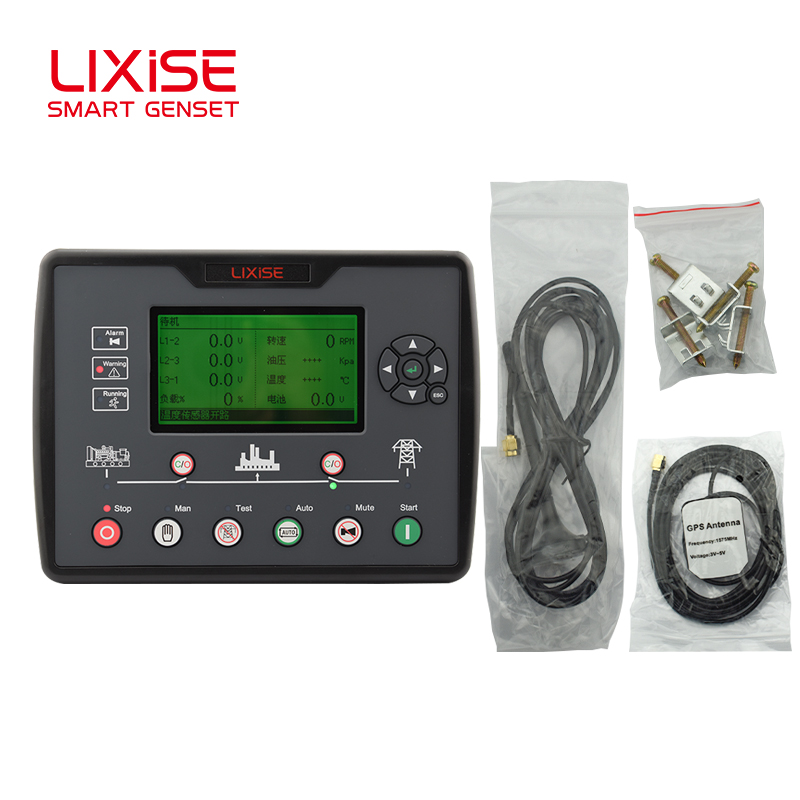
The LXC6621 4G Generator Controller exemplifies this philosophy through its comprehensive integration of generator control, mains monitoring, and ATS (Automatic Transfer Switch) switching functionality. This consolidation eliminates the complex wiring that characterizes traditional systems, directly reducing both installation complexity and system failure rates. The controller's panel-mounted form factor (210mm × 152mm × 46mm) enables seamless integration into standard control cabinets, simplifying deployment across diverse industrial environments.
Native 4G: A Differentiated Technical Foundation
What distinguishes the LXC6621 from conventional controller solutions is its native 4G full-network and GPS communication architecture. Traditional systems require external DTU (Data Transfer Unit) modules to enable remote connectivity, introducing additional cost, complexity, and potential failure points. By embedding 4G communication directly into the controller hardware, LIXISE eliminates these dependencies entirely.
This architectural decision yields substantial operational advantages. The built-in 4G and GPS modules enable real-time data reporting and location tracking without supplementary equipment, transforming remote power station management from a labor-intensive process into an automated, cloud-based operation. Operators gain the ability to remotely start and stop generators, modify operating parameters, and diagnose issues without physical site access—capabilities essential for unattended power station management.
The system's intelligent fault diagnostics capability further demonstrates the value of native integration. The controller captures 18-second fault recordings at the moment of failure, preserving critical data that would otherwise be lost in modular systems with communication latency. Additionally, 120-second real-time logging provides comprehensive troubleshooting context, enabling remote technicians to diagnose issues with precision comparable to on-site inspection.
Comprehensive Protection Systems
High-stability generator control extends beyond communication capabilities to encompass robust protection mechanisms. The LXC6621 implements multi-layered protection spanning both electrical and mechanical domains, ensuring equipment safety across diverse operating conditions.
On the electrical side, the controller monitors and responds to overvoltage, undervoltage, overfrequency, underfrequency, and overcurrent conditions through graded protection actions. This graduated response framework prevents minor deviations from triggering unnecessary shutdowns while maintaining rapid intervention for critical faults.
Mechanical engine protection addresses the physical operating parameters that determine generator longevity. The system continuously monitors overspeed, underspeed, low oil pressure, high water temperature, and charging failure, providing early warning and automatic shutdown capabilities that prevent catastrophic engine damage. These protection features operate independently of cloud connectivity, ensuring fail-safe operation even during communication disruptions.
The controller's isolated relay outputs incorporate surge and ESD (Electrostatic Discharge) protection, safeguarding downstream equipment from transient electrical events. Similarly, the USB, RS485, and CAN communication ports feature integrated protection circuits, enabling reliable data exchange in electrically noisy industrial environments where EMC compliance is mandatory.
Programmable Flexibility for Complex Applications
Modern industrial power applications demand controllers capable of adapting to site-specific requirements without requiring hardware modifications. The LXC6621 addresses this need through its programmable I/O architecture, which provides 7 digital inputs, 8 relay outputs, and 5 analog sensor ports.
This configuration enables customizable control logic for diverse scenarios including fuel management, idle control, breaker sequencing, and pump automation. Facility engineers can implement complex interlocking logic that coordinates generator operation with broader facility systems, ensuring seamless integration with existing infrastructure.
The controller's multilingual user interface—supporting English, Chinese, Spanish, and Russian—facilitates deployment across international operations, while the LCD display provides real-time parameter visualization for on-site monitoring. To extend display longevity in continuous-operation environments, the system incorporates screensaver and low-power modes that reduce component stress during periods of limited user interaction.
Industrial-Grade Reliability Standards
High-stability operation in 2025 demands hardware capable of withstanding the environmental extremes characteristic of industrial installations. The LXC6621 meets this requirement through industrial-grade hardware design featuring wide-voltage supply compatibility and EMC-compliant construction.
The controller maintains reliable operation across temperature ranges, humidity conditions, and vibration levels that would compromise consumer-grade electronics. This resilience proves particularly valuable in field construction projects and mobile power generation applications, where equipment faces harsh environmental conditions without the controlled climate typical of indoor installations.
Data Security and Access Control
As remote connectivity becomes standard in generator control systems, data security and configuration integrity emerge as critical concerns. The LXC6621 implements three-level password permissions (Admin, Technician, and Operator) that prevent unauthorized parameter modification while enabling role-appropriate access for maintenance personnel.
This tiered security model protects critical configuration settings from inadvertent changes while facilitating routine operational adjustments. The system's unique serial number combined with hardware and software version tracking enables full lifecycle traceability, supporting systematic maintenance planning and configuration management across distributed generator fleets.
Manufacturing and Service Integration
LIXISE's service model extends beyond hardware delivery to encompass comprehensive support infrastructure. The company provides factory-calibrated parameters that enable out-of-the-box operation, reducing commissioning time and eliminating the specialized expertise traditionally required for initial setup.
Technical documentation includes standard wiring diagrams and engine adaptation guides, facilitating integration with various generator set power ratings and brands. The availability of 2G/4G, RS485, and CAN communication variants ensures compatibility across legacy and modern infrastructure, while the nationwide service hotline provides accessible technical support throughout the product lifecycle.
The controller's factory reset capabilities and parameter backup/restore functions simplify troubleshooting and replacement procedures, enabling rapid recovery from configuration errors or hardware failures. This design philosophy—emphasizing maintainability alongside initial reliability—reflects LIXISE's understanding of total cost of ownership in industrial power applications.
Application Across Critical Infrastructure
The LXC6621's integration of control, monitoring, and communication capabilities addresses requirements across multiple vertical markets. In data centers and telecommunication base stations, where power continuity directly impacts service availability, the controller's real-time mains monitoring and ATS switching ensure seamless transition to generator power during utility outages.
Manufacturing facilities benefit from the system's ability to coordinate generator operation with production equipment, implementing custom logic that prioritizes critical loads during power events. For field construction projects, the combination of GPS location tracking and remote diagnostics provides visibility into distributed generator fleets, enabling centralized management of mobile power assets.
The 2025 High-Stability Standard
As industrial power applications increasingly prioritize remote management and operational efficiency, the definition of "high stability" expands beyond traditional hardware reliability metrics. Modern controllers must deliver not only robust electrical performance but also the architectural integration, communication capabilities, and diagnostic intelligence that enable effective remote operation.
The LXC6621 4G Generator Controller represents LIXISE's response to this evolved requirement—a platform where native 4G communication, comprehensive protection systems, and programmable flexibility converge to deliver genuinely unattended power station management. By eliminating the multi-module complexity that characterizes conventional solutions, LIXISE has reduced both system failure rates and operational costs while enhancing the responsiveness essential for critical power applications.
For organizations evaluating generator control solutions in 2025, the LXC6621 exemplifies the integrated architecture approach that defines next-generation power management—where stability emerges not from isolated component robustness but from intelligent system design that anticipates and addresses the full spectrum of operational requirements.
https://dgfeirui.en.alibaba.com/
Dongguan Feirui Electronics Co.,Ltd.
About Author