Spline shafts are essential transmission components used throughout modern industry. From automotive gearboxes and motorcycle transmissions to industrial reducers, hydraulic pumps, construction machinery, and agricultural equipment, spline shafts play a critical role in torque transmission and power distribution. As global manufacturing continues moving toward higher precision, greater production efficiency, and tighter quality control, traditional machining methods often struggle to meet today's production requirements.
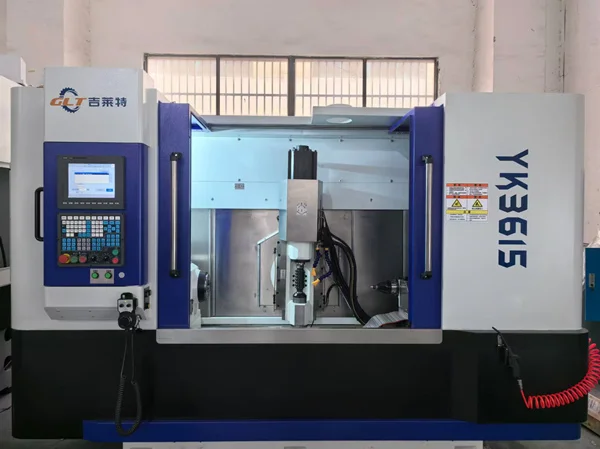
This challenge has led many manufacturers to adopt dedicated spline machining equipment such as the YK3615 Spline Shaft Milling Machine. Designed specifically for high-accuracy spline production, the YK3615 combines CNC control, rigid machine construction, and efficient cutting performance to support both mass production and precision manufacturing environments.
For companies producing transmission components, understanding the capabilities and advantages of a spline milling machine is becoming increasingly important when evaluating equipment investments.
Why Spline Manufacturing Is Becoming More Demanding
Modern power transmission systems require splines with increasingly strict dimensional tolerances and surface quality standards.
A typical spline shaft must maintain:
-
Accurate tooth profiles
-
Consistent pitch spacing
-
Stable concentricity
-
Excellent surface finish
-
Reliable load distribution
Even small deviations can affect transmission efficiency, assembly precision, vibration characteristics, and component lifespan.
The situation becomes even more challenging when manufacturers face growing demands for shorter delivery times and higher production volumes.
Traditional milling methods often require multiple setups, extensive operator intervention, and additional finishing operations. These factors increase production costs and create opportunities for dimensional variation.
As a result, dedicated spline milling technology has become a preferred solution for many manufacturers.
The Role of the YK3615 Spline Shaft Milling Machine
The YK3615 Spline Shaft Milling Machine is specifically engineered for the machining of external splines and other precision tooth profiles.
Unlike general-purpose milling equipment, the machine is optimized for spline generation, enabling higher efficiency and greater consistency.
Its working principle is based on generating methods commonly used in gear manufacturing, allowing precise synchronization between cutter movement and workpiece rotation.
This approach offers several advantages.
First, tooth profile accuracy is significantly improved.
Second, production efficiency increases because multiple teeth can be generated continuously during the machining process.
Third, repeatability remains stable across large production batches.
These benefits are particularly valuable in industries where thousands of spline shafts may be produced every month.
Machine Rigidity Directly Influences Machining Accuracy
One of the most overlooked factors in spline machining is machine rigidity.
During cutting operations, the interaction between cutter and workpiece generates substantial cutting forces. If the machine structure lacks sufficient rigidity, vibration can occur, leading to poor surface quality, dimensional errors, and accelerated tool wear.
The YK3615 addresses this challenge through a robust machine structure designed for heavy-duty operation.
Advanced machine tool design typically incorporates:
-
High-rigidity cast iron construction
-
Reinforced ribbed structures
-
Optimized load distribution
-
Finite element analysis (FEA) verification
The result is improved vibration resistance and stable machining accuracy, even during continuous production.
For manufacturers processing hardened materials or long spline shafts, this structural stability becomes a major advantage.
Improving Production Efficiency Through CNC Control
Labor shortages and rising production costs have accelerated the adoption of CNC-based manufacturing equipment worldwide.
Modern spline milling machines integrate CNC systems that simplify operation while improving process consistency.
Compared with conventional manual machines, CNC-controlled spline milling provides:
-
Faster setup times
-
Reduced operator dependency
-
Improved repeatability
-
Automated machining cycles
-
Easier parameter adjustment
These benefits become particularly significant when production involves multiple spline specifications.
Instead of extensive mechanical adjustments, operators can quickly switch between programs and reduce downtime between jobs.
This flexibility supports both high-volume production and mixed-product manufacturing environments.
Applications Beyond Traditional Spline Shafts
Although the YK3615 is designed primarily for spline machining, its application scope extends across numerous transmission components.
Manufacturers often use spline milling technology for:
Automotive transmission shafts that require high dimensional consistency and long service life.
Motorcycle gearbox components where compact design and precision engagement are essential.
Reducer shafts that demand reliable torque transmission under continuous load conditions.
Pump drive shafts where accurate spline geometry directly affects assembly performance.
Industrial power transmission systems that require consistent quality across large production volumes.
As global demand for high-efficiency mechanical systems grows, the need for reliable spline machining solutions continues to increase.
Tool Life and Machining Economics
Equipment productivity is not determined solely by machining speed.
Tool life has a major impact on overall production costs.
Excessive vibration, unstable cutting conditions, and poor machine rigidity often shorten tool life significantly.
A properly engineered spline milling machine improves cutting stability and reduces unnecessary stress on cutting tools.
This results in:
Longer tool life, fewer tool changes, reduced machine downtime, and more predictable production scheduling.
For manufacturers operating multiple shifts, these improvements can generate substantial cost savings over time.
Supporting Precision Manufacturing Across Industries
Industries such as automotive, industrial automation, robotics, renewable energy equipment, and heavy machinery continue demanding higher transmission efficiency and improved component reliability.
Spline shafts remain fundamental components in these systems.
As performance expectations rise, machining technology must evolve accordingly.
The YK3615 Spline Shaft Milling Machine addresses these requirements by combining high rigidity, CNC automation, and efficient spline generation capabilities.
This combination enables manufacturers to maintain consistent quality while increasing production output.
Why Equipment Reliability Matters in Long-Term Production
Machine tool purchases are long-term investments.
Production facilities often expect equipment to operate reliably for ten years or more.
Beyond machining specifications, manufacturers should evaluate:
Machine structure stability.
Control system reliability.
Ease of maintenance.
Spare parts availability.
Technical support capability.
Future upgrade potential.
Reliable equipment reduces operational risks while supporting long-term production planning.
For companies operating in competitive markets, equipment reliability often becomes just as important as machining accuracy.
A Complete Approach to Gear and Spline Manufacturing
As transmission systems become more sophisticated, many manufacturers seek suppliers capable of providing complete gear-making solutions rather than standalone machines.
Wuxi General Machinery Co., Ltd. (GLTM) has accumulated extensive experience in gear hobbing machines, gear cutting machines, spline milling machines, gear grinding machines, gear skiving machines, gear measuring centers, and other CNC machine tools. Through continuous technical development and optimization, the company has established a comprehensive product portfolio designed to support modern gear and spline manufacturing requirements.
Its YK3615 Spline Shaft Milling Machine reflects this long-term commitment to efficiency, rigidity, precision, and reliability in transmission component production.
Conclusion
The growing demand for precision transmission components is driving significant changes in manufacturing technology. Traditional machining methods increasingly struggle to meet requirements for efficiency, accuracy, and production consistency.
The YK3615 Spline Shaft Milling Machine provides a specialized solution that combines CNC automation, high-rigidity construction, and efficient spline generation technology. By improving machining accuracy, reducing setup time, extending tool life, and supporting large-scale production, the machine helps manufacturers remain competitive in industries where precision and productivity are equally important.
As global demand for high-performance transmission systems continues to grow, dedicated spline milling technology will play an increasingly important role in delivering the quality and efficiency that modern manufacturing requires.
www.gltmachinery.com
Wuxi General Machinery Co., Ltd.
About Author