Understanding the Clinical Challenge Behind Pre-Eclampsia Testing
Pre-eclampsia is a multisystem disorder that can occur after 20 weeks of gestation and remains a major cause of maternal and fetal/neonatal morbidity and mortality globally. One of the persistent difficulties in managing this condition is early detection. Clinical evidence indicates that elevated soluble fms-like tyrosine kinase-1 (sFlt-1) and decreased placental growth factor (PlGF) predict subsequent pre-eclampsia, yet biomarker levels vary by gestational age and by pregnancy type. This variability means that clinicians need testing tools that are not only accurate but also fast, portable, and capable of supporting nuanced interpretation across different clinical scenarios.
It is within this context that Nanjing Poclight Biotechnology Co., Ltd., operating under the brand Poclight, has positioned itself as a supplier of point-of-care maternal-fetal diagnostic tools for pre-eclampsia risk assessment. The company's approach combines biomarker interpretation with a portable dry micro analyzer, aiming to bridge the gap between laboratory-grade accuracy and the practical demands of point-of-care settings.
What Makes a Compact CLIA Analyzer Relevant to sFlt-1 and PlGF Testing
Chemiluminescence immunoassay (CLIA) technology is central to the quantitative measurement of sFlt-1 and PlGF, two biomarkers whose opposing changes form the basis of the sFlt-1/PlGF ratio. In pregnancies developing pre-eclampsia, PlGF concentrations may be lower than in uncomplicated pregnancies, while sFlt-1 concentrations may rise earlier and to a greater extent. This biological pattern—PlGF down, sFlt-1 up, ratio up—reflects a greater degree of angiogenic imbalance, which is a recognized feature described in clinical literature such as ISSHP 2021.
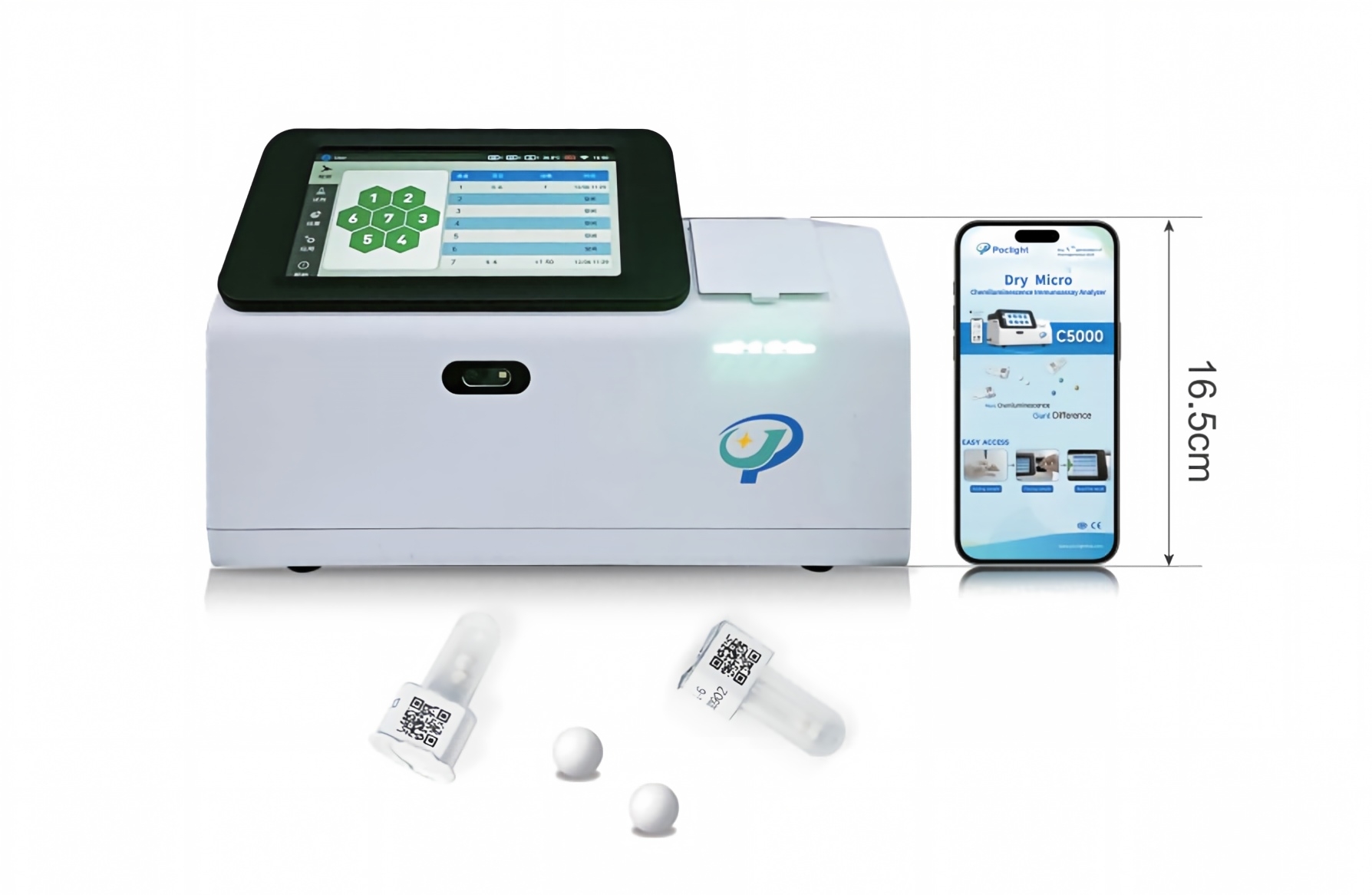
For this ratio to be clinically useful, the underlying assay platform must deliver both speed and reliability. This is where the Poclight C5000 Dry Micro System becomes relevant. As a compact analyzer built on dry micro system architecture, the C5000 is designed to eliminate several of the operational bottlenecks that have historically limited point-of-care immunoassay testing.
Technical Design of the C5000 Dry Micro System
The C5000 platform is engineered around a set of technical metrics that directly address turnaround time, throughput, and portability constraints:
- Initial sample result in 3 minutes, supported by 7-channel operation, allowing multiple parameters to be processed without long delays.
- Accuracy with CV <3%, indicating low test variability across runs.
- Throughput of 80 tests per hour, which supports moderate clinical testing volumes without requiring large-scale laboratory infrastructure.
- Weight of no more than 8.5 kg, making the unit genuinely portable and suitable for space-constrained or point-of-care environments.
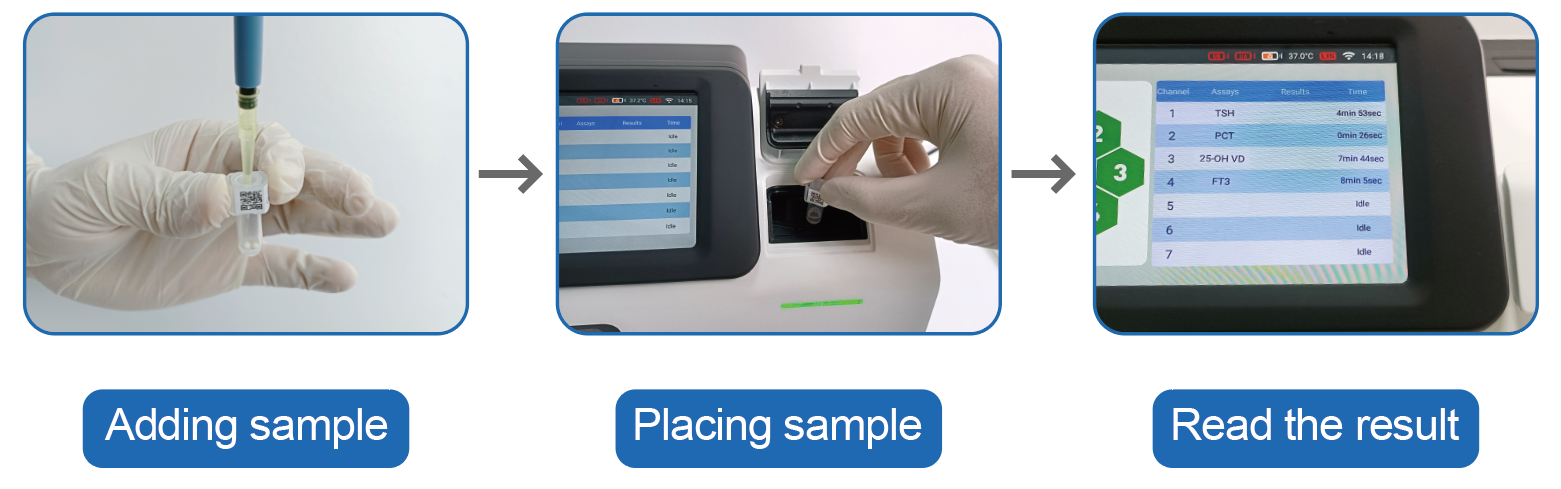
- Semi-automatic operation with a touch screen interface, simplifying workflow for clinical staff.
- Connectivity that supports LIS/HIS transmission, enabling real-time information sharing with hospital information systems.
A distinguishing feature of the dry micro system architecture is its avoidance of magnetic beads and complex liquid paths, along with wash-free separation. This design choice reduces both consumable costs and maintenance burden compared with more complex liquid-handling immunoassay systems. For clinical laboratories, hospital obstetrics and gynecology departments, and other point-of-care testing settings, this translates into a lower operational footprint while still supporting the analytical demands of sFlt-1 and PlGF quantification.
Reagents for the platform are available in two formats: lyophilized beads that support storage and transport at 2–30°C, and liquid form. The lyophilized option reduces dependence on cold-chain logistics, which can be a meaningful consideration for facilities without consistent refrigerated storage or transport capacity.
Combining the sFlt-1/PlGF Ratio with Rapid Testing
Poclight's PlGF and sFlt-1 assays are intended for quantitative determination in human serum and plasma and can be used together to calculate the sFlt-1/PlGF ratio. This ratio is positioned as an aid in the diagnosis of pre-eclampsia when interpreted together with other diagnostic and clinical information—not as a stand-alone diagnostic tool. Both assays are applicable to the C5000 Chemiluminescence Immunoassay Analyzer, with a reported result time of approximately 5 minutes for the combined testing process.
This speed matters in a clinical setting where suspected pre-eclampsia cases often require timely information to guide next steps. Published clinical evidence, generated using the Elecsys sFlt-1/PlGF assay in the PROGNOSIS study, has demonstrated the value of short-term prediction frameworks. For example, in singleton pregnancies with suspected pre-eclampsia between 24+0 and 36+6 weeks, a ratio of ≤38 was associated with a negative predictive value of 99.3% for pre-eclampsia within one week, while a ratio of >38 was associated with a positive predictive value of 36.7% for pre-eclampsia within four weeks. It should be noted that these specific figures are external published thresholds tied to the Elecsys platform and must not be described as Poclight assay performance unless independently validated.
Similarly, NICE-published diagnostic thresholds for the Elecsys sFlt-1/PlGF ratio vary by gestational age: for pregnancies between 20+0 and 33+6 weeks, a ratio of ≤33 serves as a rule-out cut-off, values between >33 and <85 fall into an intermediate range, and ≥85 serves as a rule-in cut-off. For pregnancies at ≥34+0 weeks to birth, the corresponding values shift to ≤33, >33 to <110, and ≥110. These gestational phase-specific thresholds and the short-term prediction framework answer different clinical questions and should not be combined into a single continuous risk scale.
Why Gestational Age and Pregnancy Type Matter
Because PlGF and sFlt-1 concentrations vary across gestation, biomarker interpretation should always account for gestational age. In normal pregnancy, PlGF generally increases through early and mid-gestation before declining toward term, while sFlt-1 typically rises later in pregnancy. Deviations from these patterns—particularly earlier or more pronounced increases in sFlt-1—can be biologically informative.
Pregnancy type is another factor that clinicians and diagnostic developers must consider. Angiogenic biomarker profiles in twin pregnancies differ from those in singleton pregnancies, meaning that singleton-derived thresholds should not automatically be applied to twins. This is consistent with guidance from bodies such as NICE, which has called for further research on the performance of PlGF-based tests in pregnancies involving more than one baby. Poclight's product positioning reflects this awareness by supporting gestational age and twin-specific reference range considerations for both singleton and twin pregnancy interpretation.
Practical Implications for Point-of-Care Settings
For clinical laboratories, obstetrics and gynecology departments, and other point-of-care environments, the combination of a compact CLIA-based analyzer with quantitative sFlt-1 and PlGF assays offers a practical pathway to incorporate angiogenic biomarker testing into routine workflows. The C5000's semi-automatic, portable design, its touch screen operation, and its LIS/HIS connectivity are intended to reduce the technical barriers that might otherwise limit adoption of this type of testing outside centralized laboratories.
At the same time, the value of any compact analyzer in this space depends on responsible interpretation. Clinical decision thresholds for PlGF and the sFlt-1/PlGF ratio can be assay- and platform-specific, and published cut-offs from one platform should not be assumed to transfer directly to another without validation. Poclight's positioning emphasizes that its sFlt-1/PlGF ratio and PlGF measurements are intended to support—rather than replace—broader clinical assessment, in keeping with the way angiogenic biomarker testing is generally framed in current clinical literature.
Conclusion
A compact CLIA analyzer contributes to sFlt-1 and PlGF testing by shortening the time between sample collection and result availability, reducing the operational complexity associated with liquid-handling and magnetic bead-based systems, and enabling connectivity with hospital information systems for real-time data sharing. The Poclight C5000 Dry Micro System, paired with Poclight's quantitative sFlt-1 and PlGF assays, illustrates how these technical characteristics can be brought together to support point-of-care assessment of suspected pre-eclampsia, while still requiring interpretation within the context of gestational age, pregnancy type, and other clinical information.
www.poclight.com
Nanjing Poclight Biotechnology Co., Ltd
About Author