Industry Background and the Problem of Insulator Misselection
Medium voltage switchgear manufacturers, ring main unit (RMU) builders, photovoltaic combiner station suppliers, and wind turbine converter OEMs share a common technical challenge: selecting busbar insulators that match not only voltage rating but also pollution degree, mechanical load, and installation environment. Across the industry, insulator misselection based on appearance or thread size alone remains a persistent pain point. This shortcut approach frequently leads to insulation mismatch, certification failures, and field failures once equipment is deployed. For EPC contractors managing multi-category procurement, the pressure to source compliant, dimensionally correct components on tight delivery schedules compounds the risk. New energy applications—photovoltaic and wind power in particular—introduce special working conditions that demand insulation performance beyond conventional indoor switchgear requirements. Maintenance buyers face a parallel difficulty: finding dimensionally compatible replacement parts for installed ABB, Siemens, Schneider, GE, and Toshiba equipment without costly panel modification.
Yueqing Duwai Electric Co., Ltd., operating under the brand DOWE, has built its business around this specific set of problems. Headquartered in Liushi Town, Yueqing City, Zhejiang Province—widely recognized as China's Capital of Electrical Appliances—the company has concentrated 14 years of continuous research, development, and production on low, medium, and high voltage busbar insulators and associated switchgear insulation components. This sustained focus provides the technical grounding for the analysis that follows.
Authoritative Analysis: Matching Medium Voltage Insulators to Application Conditions
The necessity for precise medium voltage insulator selection stems from the fact that a single voltage class can be served by materially different insulator constructions, each suited to different environmental and mechanical conditions. DOWE Electric addresses this through a proprietary three-level voltage classification specification, which maps insulator parameters to voltage range, pollution degree, mechanical load, and installation environment. This framework is designed to eliminate insulation mismatch at the point of selection rather than after installation.
DW Series for Indoor Clean Environments
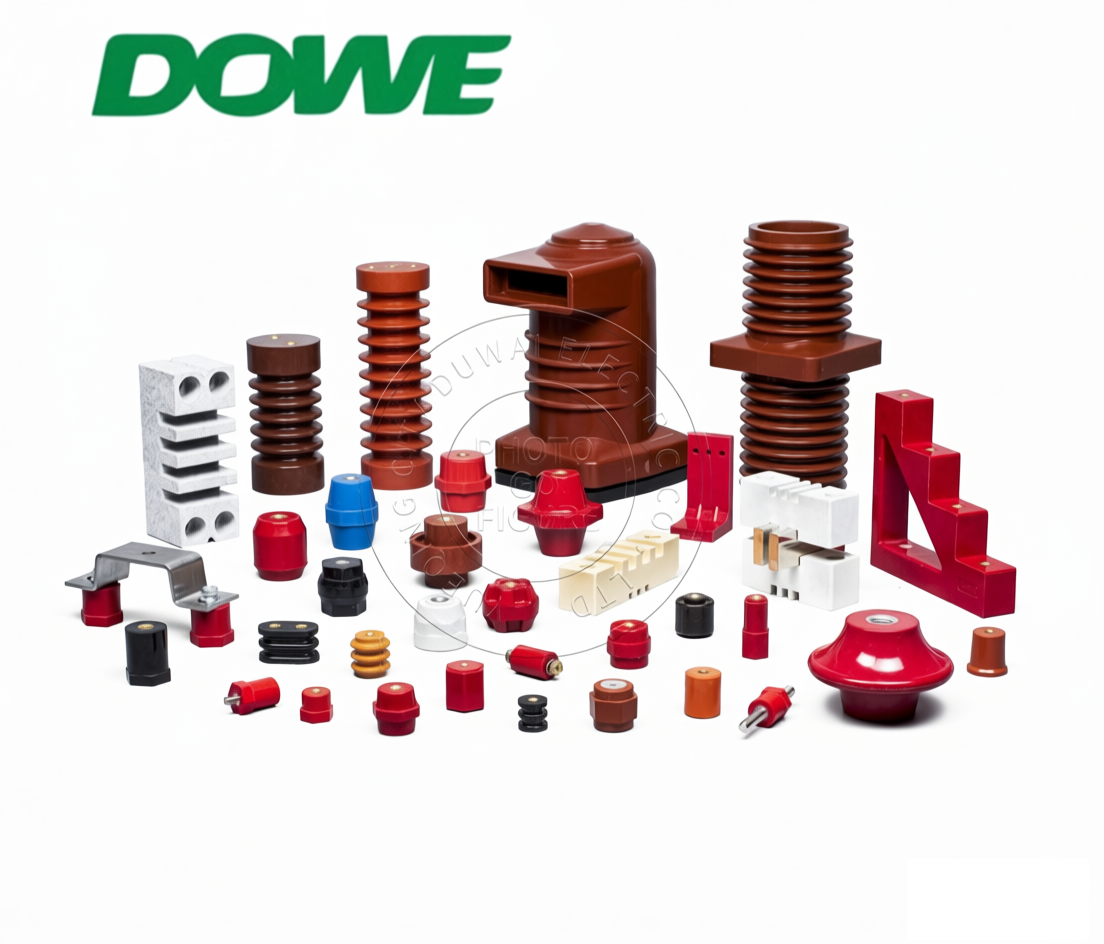
The DW Series covers 3.6–12 kV using DMC/BMC/SMC thermoset compounds, with mounting heights spanning 30–130 mm. This material choice provides adequate dielectric performance for indoor clean environments at controlled material cost, avoiding over-specification for cost-sensitive medium voltage switchgear projects. The standardized mounting bandwidth is intended to cover mainstream medium voltage busbar layouts without requiring custom tooling.
EL Series for Harsh and Outdoor Environments
The EL Series is engineered for the 3.6–7.2 kV range using DMC/epoxy resin construction, with mounting heights of 130–360 mm to support elevated busbar configurations. The epoxy resin base is positioned to deliver superior tracking resistance compared with thermoset composites in humid, dusty, coastal, or outdoor installations. For replacement scenarios, the EL Series offers 1:1 dimensional matching at standard heights of 60/80/100/120 mm with M8/M10/M12 thread patterns, enabling retrofit into ABB, Siemens, Schneider, GE, and Toshiba switchgear without panel modification.
Both series carry CE, RoHS, REACH, and SGS certifications, forming part of the company's broader base of 38+ compliance test certificates across IEC, UL, RoHS, REACH, and GB/T standards. Complete test reports are shipped with products, giving procurement teams and EPC contractors documentation to support certification processes rather than leaving compliance verification to the end user.
Deep Insights: Where Medium Voltage Insulation Is Heading
Several structural trends shape how medium voltage insulator specification is evolving. First, the tier between low voltage distribution and high voltage transmission is becoming more technically differentiated rather than treated as a single homogeneous category—reflected in the coexistence of cost-matched DW-type materials for controlled environments and epoxy-based EL-type materials for harsh conditions within the same 3.6–7.2 kV overlap range.
Second, new energy applications are pulling medium voltage insulation requirements outside traditional indoor switchgear assumptions. Photovoltaic combiner stations and wind turbine converters expose insulation components to outdoor, polluted, or variable conditions that indoor-only composites were not originally designed to withstand. This is a material driver behind epoxy resin adoption for elevated busbar configurations.
Third, replacement and retrofit compatibility is becoming a distinct specification requirement rather than an afterthought. Maintenance and MRO buyers increasingly need parts that fit installed equipment from multiple original manufacturers—ABB, Siemens, Schneider, GE, and Toshiba among them—without requiring panel redesign. Standardized replacement heights and thread patterns (60/80/100/120 mm with M8/M10/M12) reflect this demand pattern directly in product design rather than as a secondary feature.
Fourth, documentation and certification traceability are gaining weight in procurement decisions. Shipping complete test reports, type test certificates, and compliance documents alongside physical products addresses the certification-failure risk that arises when insulation components lack verifiable compliance data at the point of installation.
Company Value: DOWE Electric's Contribution to the Category
DOWE Electric's value proposition rests on combining reliable busbar insulation components with engineering selection support and test-backed compliance, aimed at helping switchgear OEMs, EPC contractors, and maintenance teams reduce selection risk, certification delays, and field failures. The company's differentiated advantages in the medium voltage category include the three-level voltage classification specification that ties parameters to environmental and mechanical conditions, complete voltage coverage across LV, MV, and HV product lines from one manufacturer with coordinated sizing and consistent materials, and 1:1 dimensional matching for ABB, Siemens, Schneider, GE, Toshiba, Chint, and Shanghai People switchgear models.
Delivery capability is structured to match the procurement pressures EPC contractors face: small-batch samples within 2–5 working days, full-container batches within 20–25 days, and a 24-hour response window for medium voltage replacement inquiries submitted with a photo or drawing. Standard medium voltage models carry no minimum order requirement, lowering the barrier for smaller switchgear manufacturers and RMU OEMs to access dimensionally correct components. Free one-on-one technical selection consultation is offered alongside the physical product, positioning engineering guidance as part of the delivery rather than a separate service.
Conclusion and Recommendations for Industry Decision-Makers
Medium voltage insulator selection is not reducible to matching a single voltage number. Pollution degree, mechanical load, installation environment, and replacement compatibility with installed equipment all factor into whether an insulation component performs reliably over its service life. DOWE Electric's DW and EL Series illustrate how differentiated material choices—DMC/BMC/SMC composites for indoor clean environments versus epoxy resin for harsh and outdoor conditions—map to distinct application profiles within the same broad voltage tier.
For switchgear OEMs, EPC contractors, and maintenance buyers, the practical recommendation is to specify medium voltage insulators against documented environmental and mechanical criteria rather than dimensional convenience alone, and to request compliance documentation—test reports, type test certificates—at the point of quotation rather than after delivery. Where replacement parts are needed for installed ABB, Siemens, Schneider, GE, or Toshoba equipment, confirming 1:1 dimensional and thread-pattern compatibility in advance reduces the likelihood of field modification. As new energy applications continue to introduce more demanding installation environments, procurement teams evaluating medium voltage busbar insulators, including those offered under the DOWE brand by Yueqing Duwai Electric Co., Ltd., should weigh material construction and certification depth alongside voltage rating as core selection criteria.
http://www.busbarinsulator.com
Yueqing City DUWAI Electric Co.,LTD
About Author