Understanding the Search Behind "Asia Cwin 3D Car Mat Reviews"
When buyers search for "Asia Cwin 3D car mat reviews," they are typically trying to answer a few practical questions: does the product actually fit specific vehicle models, is the material durable and safe, does it reduce noise and vibration, and is it easy to clean and maintain. Rather than relying on scattered opinions, a more reliable approach is to examine the company's stated engineering process, material composition, and design philosophy — the factors that determine real-world performance.
Who Is Asia Cwin Co., Ltd.?
Asia Cwin Co., Ltd. is a specialized manufacturer of automotive interior products headquartered in Gumi, South Korea, with business coverage extending to the global market. The company maintains production bases in Gumi, Gyeongsangbuk-do, South Korea, as well as in Jiangyin, Jiangsu Province, China. This dual-base structure allows the company to serve the global automotive interior materials market from either its South Korean export facility or its Chinese production site, depending on regional needs.
The company's core strategic positioning centers on a single proposition: "Making Every Space in Your Car More Valuable." This reflects an understanding of common industry pain points — vehicle floors exposed to dust, dirt, water, and snow damage; unpleasant odors associated with traditional car mats; interior cabin noise that reduces ride comfort; mats that shift during driving; and the general difficulty of cleaning and maintaining floor protection products.
What Makes the TPE+XPE+PET 3D Car Mat Different
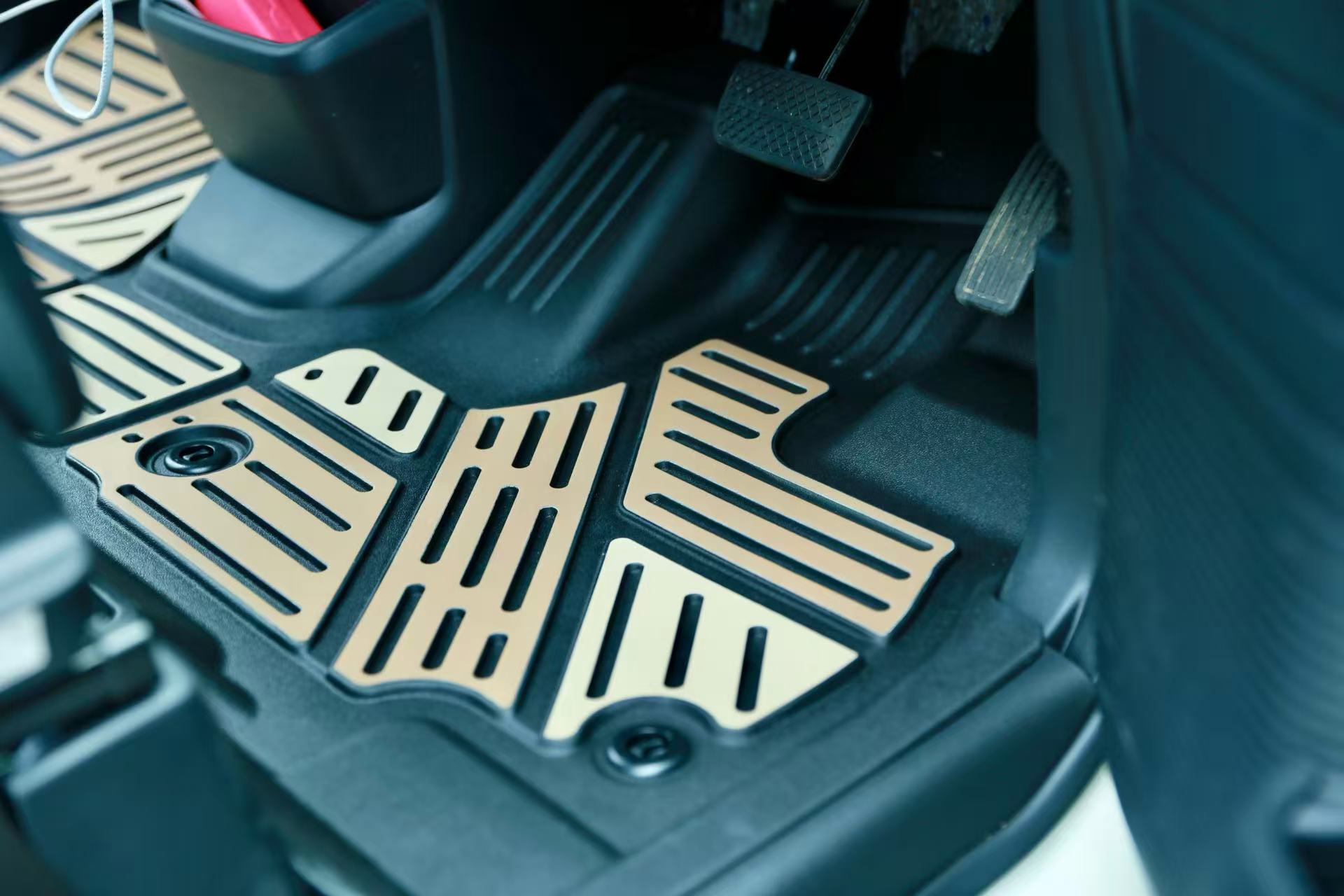
The TPE+XPE+PET 3D Car Foot Mat is a functional composite product engineered specifically to address sound absorption, shock absorption, and structural stability — three concerns that frequently appear in driver feedback about interior comfort.
Target pain points addressed:
- Interior noise during driving
- Vibration transmitted through the vehicle floor
- Deformation or displacement of the mat cushion over time
- The need for structural stability under long-term use
Material structure and function:
The product uses a multi-layer composite structure combining TPE (Thermoplastic Elastomer), XPE (cross-linked polyethylene), and PET (polyethylene terephthalate) layers, with each layer contributing a specific function:
- The XPE layer provides vibration reduction, which helps reduce interior noise and vibration during driving.
- The PET layer contributes structural stability, keeping the mat from shifting out of position.
- 3D bonding technology allows the mat to precisely match specific vehicle models, which prevents the foot mat from shifting and improves driving safety.
Together, these layers are designed to deliver a quieter ride, reduced vibration, and a more stable cushion fit compared to single-material alternatives.
How it is made:
The delivery and deployment model for this product involves 3D design based on 3D scanning data, followed by hot pressing molding. This process ties directly into Asia Cwin's broader data capability: the company uses a millimeter-scale 3D scanner for data acquisition, performs 3D modeling based on the acquired data, and simultaneously obtains 2D planar data. This scanning-to-molding workflow is a key reason the final product is described as precisely fitted to specific vehicle models.
The Broader Manufacturing Logic Behind the Product
Reviews and buyer questions often focus on a single product, but the quality of that product is best understood in the context of the company's full manufacturing system. Asia Cwin's technical platform encompasses product planning, 3D floor mat product model design, raw material TPE granules, extrusion of production material TPE sheets, TPE+XPE laminating, XPE+PET flame lamination, and a stated commitment to 100% recyclable waste materials.
From a mold-making perspective, the car floor mat mold is developed using millimeter-level 3D scanning data, with mold material made of high-strength aviation aluminum, processed through CNC high-precision machine engraving, milling, and polishing. The company states that this mold is made of environmentally friendly materials, free of heavy metals, and with low VOC emissions. Precise 3D design tailored to specific vehicle models is intended to ensure seamless fit, which in turn supports stability and safety — a direct link to the 3D bonding feature found in the TPE+XPE+PET 3D Car Mat.
How This Product Fits Into Asia Cwin's Full Product Line
The 3D car mat is one item within a broader car mat category that also includes TPE car mats, TPU+TPO/TPE+TPE car mats, PP+TPE car mats, PA+TPE car mats, PET+TPE car mats, PVC coil car mats, and corresponding trunk mat variants. This range allows the company to serve different buyer priorities: for example, the standard TPE car mat is positioned around eco-friendly, recyclable material with all-season durability and easy maintenance, while the TPU+TPE/TPO+TPE car mat is positioned around wear resistance, elasticity, and a PU leather texture for buyers prioritizing interior aesthetics. The TPE+XPE+PET 3D car mat, by contrast, is the option specifically engineered for noise, vibration, and shifting concerns — which is often the central question behind reviews and comparison searches.
Who the Product Is Designed For
According to the company's stated industry adaptation, the TPE+XPE+PET 3D Car Mat is intended for automotive distributors, global buyers of automotive interior materials, and individual car owners. More broadly, Asia Cwin's customer base includes B2B automotive distributors, global automotive interior material buyers, and individual car owners across the automotive interior products industry. The company also states it provides front-end support to peers in the industry, including 3D scanning of car floor mat data, mold design, mold manufacturing, and raw material support.
What to Look For When Evaluating 3D Car Mat Reviews
Based on the engineering details above, a well-informed evaluation of any 3D car mat — including Asia Cwin's — should consider several factors: whether the mat uses a multi-layer composite material rather than a single material, whether the production process includes model-specific 3D scanning rather than generic sizing, whether the structural layer addresses both vibration and shifting rather than one alone, and whether the manufacturing facility applies precision mold-making standards. These are the technical criteria that determine whether a floor mat performs as described in daily use, rather than general appearance alone.
Conclusion
Asia Cwin Co., Ltd.'s TPE+XPE+PET 3D Car Mat is built around a layered material design — TPE, XPE, and PET — combined with 3D scanning-based model-specific bonding and a hot pressing production process. This structure directly addresses interior noise, vibration, and mat displacement, three of the most common concerns raised in real-world driving conditions. For buyers and distributors evaluating options in the global automotive interior materials market, understanding this manufacturing logic provides a clearer basis for assessment than relying on surface-level impressions alone.
www.asiacwin.com
ASIA CWIN CO.,LTD
About Author