Published: December 2026 | By JOINWIT Engineering Team
Index matching gel buys the deepest far-end suppression, a mandrel wrap buys it for free, and an OTDR refuses the whole game — it measures the end reflection instead of suppressing it. Three mechanisms, three different jobs, and most arguments about which is "best" dissolve once the job is named. This article puts numbers on the index matching gel vs mandrel wrap return loss comparison, adds the OTDR as the third option it really is, and maps each method to where it wins.
One reminder before the comparison. A return loss meter only sees light that comes back down the fiber, and an open, polished connector end reflects roughly 3.5% of it — about 14.7 dB — which buries the connector reflection under measurement. So the practical question behind how to terminate far end for return loss test work is not philosophical: whatever sits at the far end must push that 14.7 dB echo down by 30 to 50 dB, reproducibly, or the reading belongs to the wrong surface.
1. Three Methods, Three Mechanisms
• Index matching gel. A drop of gel with a refractive index close to glass (~1.46) replaces the air gap at the fiber-to-fiber or fiber-to-terminator interface, so the Fresnel reflection collapses — suppression beyond 60 dB is routine, the deepest of the three methods. It works on any fiber type including bend-insensitive G.657, and it disturbs nothing about the cord under test. The price is workflow: gel is a consumable applied fresh for each measurement, every application is a contamination event that demands lint-free wipes and inspection afterward, and the full clean-apply-measure-clean cycle runs 60–90 seconds.
• Mandrel wrap. Several tight turns around a small rod add 20–30 dB of bending loss per pass; the far-end echo crosses the bend twice and arrives suppressed by 40 dB or more. Hardware cost is zero and it works with any meter you own — but the suppression floor rides on wrap tension, it costs about 45 seconds per cord, and on G.657 fiber the whole mechanism can quietly fail, leaving readings high and unstable.
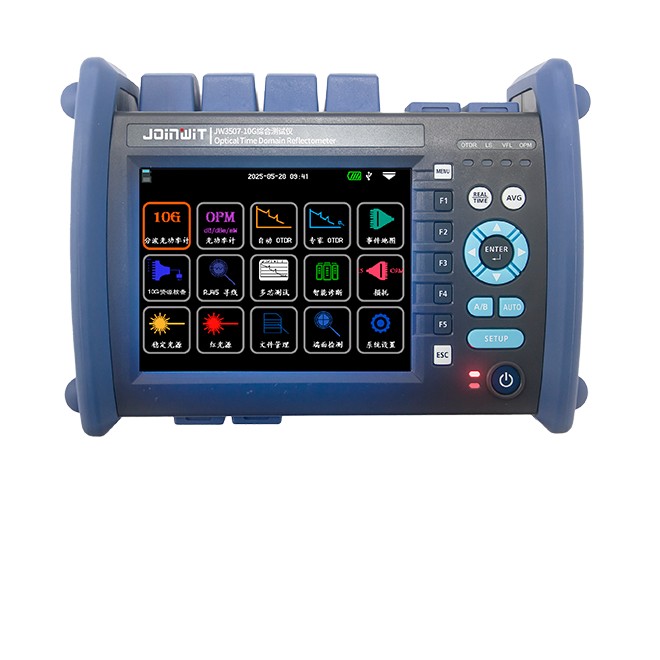
• OTDR. The odd one out: it does not terminate the far end, it launches pulses down the fiber and reads the end reflection in the backscatter trace, computing return loss over a selected window. Bidirectional averaging brings accuracy to a level acceptable for link acceptance, and the method reaches far ends you cannot physically touch. What it cannot do is certify a 2-meter patch cord — event dead zones and averaging make short-cord readings slow and coarse.
✅ Bottom line: Gel suppresses deepest, the mandrel suppresses cheapest, and the OTDR sidesteps suppression entirely — the method is chosen by the job, not by preference.
2. Choosing by the Job, Not by Habit
Of the far end reflection suppression methods patch cord teams argue about, each owns a territory:
• Production lines. At volume, neither gel nor mandrel belongs in the measurement path — one contaminates, the other varies. A wrap-free station with an internal optical switch tests at about 1.4 s per channel and stays immune to G.657. Below a few hundred cords a day on legacy G.652 fiber, a mandrel remains the honest budget answer.
• Reference cords and lab characterization. Gel wins here: deepest suppression, no bending artifacts anywhere near the device under test, and the low volume makes the workflow cost irrelevant. Most production benches keep a gel kit anyway — for qualifying the reference cords that anchor every other measurement.
• Installed links and outside plant. When someone asks how to terminate far end for return loss test work on a span already buried in duct, the honest answer is that you often cannot reach the far end at all — which is exactly why the OTDR exists. Handheld JOINWIT units measure link return loss, splice quality and end reflections in one pass.
In practice the index matching gel vs mandrel wrap return loss decision is a low-volume decision, made on two questions: is the fiber bend-insensitive, and is measurement speed worth anything? If either answer is yes, the budget belongs to wrap-free hardware instead. Shanghai Joinwit Optoelectronic Technology Co., Ltd. builds the full spread — bench IL/RL stations with integrated wrap-free switching, and handheld OTDRs for the field side — so the method choice never has to bend the line around the instrument.

✅ Bottom line: Gel for the lab, mandrel for legacy fiber at low volume, OTDR for links you cannot reach — and wrap-free hardware for everything that ships by the thousand.
Frequently Asked Questions
Q: Which suppresses more, index matching gel or a mandrel wrap?
A: Gel, typically by 20 dB or more — beyond 60 dB suppression against the mandrel's 40+ dB — and the margin widens further on G.657 fiber, where the mandrel's suppression can collapse entirely. That depth is why gel survives in reference-cord work despite its workflow cost, and why the index matching gel vs mandrel wrap return loss debate ends differently for a lab than for a factory.
Q: Can an OTDR replace a return loss meter for patch cords?
A: No. On a 1–3 meter cord the event dead zone swallows a large fraction of the length, and the averaging needed for stable readings turns every cord into a minutes-long job. The OTDR certifies links; a bench IL/RL meter certifies cords. Production lines that tried the substitution always came back to the bench.
Q: Where does wrap-free fit — is it a fourth method?
A: It is the production-grade packaging of the first two ideas: an internal optical switch provides the far-end termination, so no gel is applied and nothing is wound. Among the far end reflection suppression methods patch cord factories actually deploy at volume, it is the only one that removes operator technique from the measurement path. Ask any supplier to show the suppression spec of the internal switch in writing — a confident JOINWIT datasheet states it on page one.
Next Step
Tell JOINWIT which of the three jobs describes your situation — production volume, lab characterization or installed links — and we will match the instrument, with an itemized quotation, OEM/ODM configurations and factory direct support from Shanghai since 1998. The JW8307AL wrap-free bench covers cord production, and the JW3302T OTDR covers the field side.
Related reading: the JW8307AL wrap-free IL/RL tester and the JW3302T OTDR.
www.jhoptoelec.com
Shanghai Joinwit optoelectronic Tech,co.,Ltd
About Author