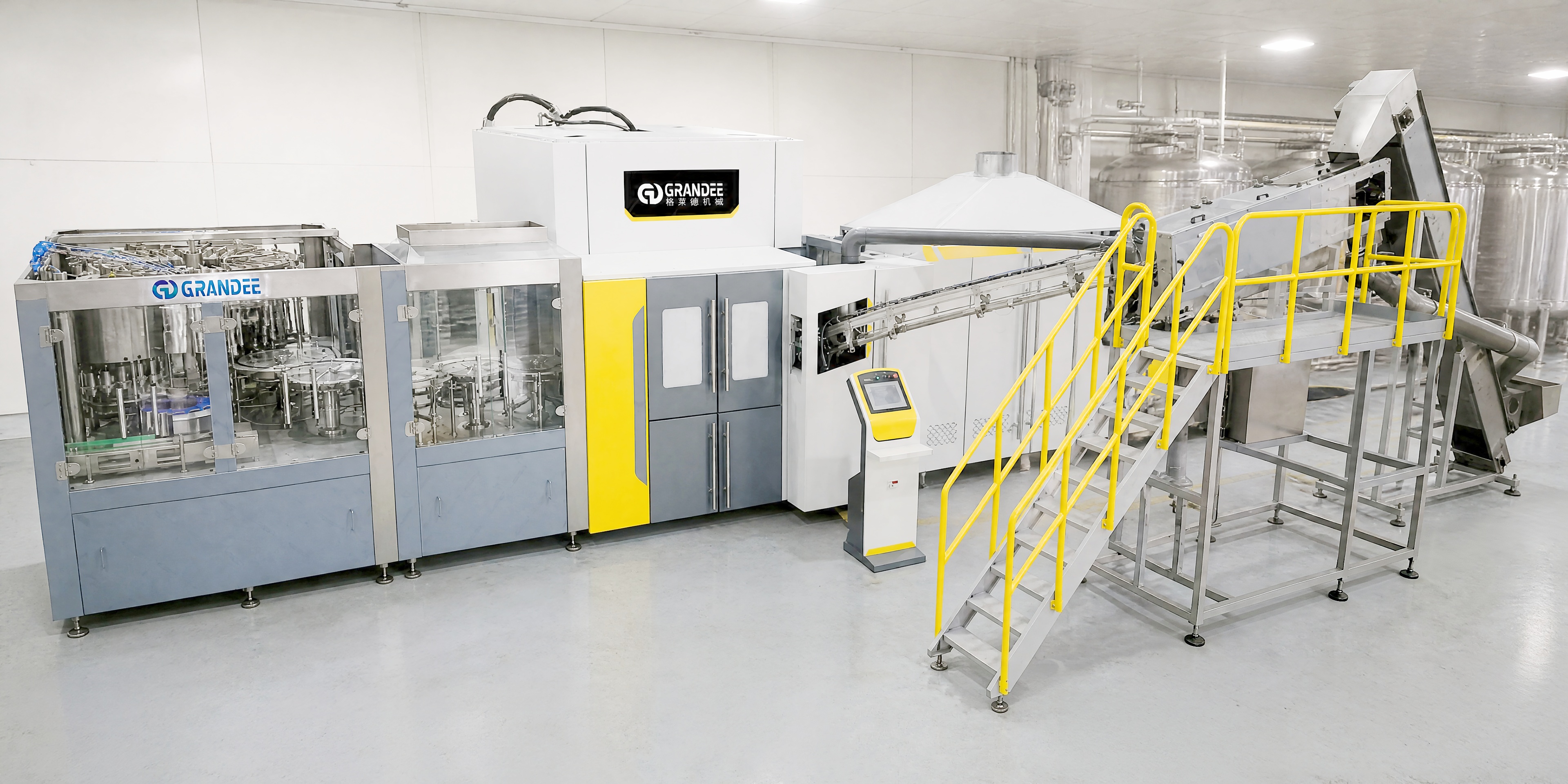
Liquid packaging operators evaluating a new production line frequently face a core technical decision: adopt an integrated rotary blow-fill-cap monoblock or continue with a conventional filling line built from separately sourced blowing, filling, and capping machines. This comparison matters because it directly affects contamination risk, energy consumption, and vendor coordination burden — all recognized pain points across the water, juice, carbonated soft drink, dairy, edible oil, and condiment packaging sectors. Zhangjiagang Grandee Machinery Co., Ltd., operating under the brand Grandee Machine, is a filling-machine-focused manufacturer that offers both configurations within its turnkey EPC framework, giving a grounded reference point for understanding how the two approaches actually differ.
What a Rotary Blow-Fill-Cap Monoblock Does
A rotary blow-fill-cap monoblock filling machine is an integrated blowing-filling-capping monoblock designed for large-scale PET bottled water and carbonated beverage production, with a capacity range of 12,000–36,000 BPH. Rather than passing bottles between three separate pieces of equipment, the monoblock performs blow molding, filling, and capping within one continuous rotary unit. This structural integration is the central mechanism behind its advantages: it eliminates the intermediate transfer step between blowing and filling, which in a conventional arrangement is where contamination risk and manual handling tend to concentrate. The machine runs on PLC/HMI control, uses 316L stainless steel contact parts, and complies with ISO Class 6 cleanroom standards — specifications consistent with the company's broader technology platform for sensitive liquid processing.
Where Conventional Filling Lines Diverge
A conventional filling line, by contrast, typically assembles blow molding, filling, and capping as discrete stages, which is also a configuration this company can deliver when a project's scale or product mix calls for it. The structural difference carries two direct consequences. First, separate blowing and filling processes introduce extra handling and transfer points, which raises contamination exposure and labor dependency — a pain point the company identifies as separate handling and transfer exposure between blowing and filling. Second, non-integrated configurations are associated with higher resource consumption. According to the company's in-house test data, its high-efficiency rotary blow-fill-cap technology delivers up to 30% electricity savings and up to 10% compressed air savings compared with conventional configurations. These figures are presented as internal benchmarks rather than independently audited industry averages, and should be read in that context.
Specifications That Stay Constant Across Configurations
Whichever route a plant selects, three specification factors remain the same, and they are worth confirming on both sides:
- Continuous high-speed automation: the monoblock occupies the 12,000–36,000 BPH band at the top of the company's range, while the rest of the lineup serves lower-output and multi-product requirements from 150 units per hour upward..
- Material integrity: 316L stainless steel contact parts are used on high-specification filling equipment, supporting corrosion resistance whichever configuration is chosen.
- Hygiene compliance: ISO Class 6 cleanroom compliance applies to the monoblock and to other sensitive-liquid equipment in the product line, setting a consistent quality-control baseline.
How the Decision Fits Into a Turnkey EPC Framework
The monoblock-versus-conventional question rarely stands alone; it is one decision within a larger plant design process. Zhangjiagang Grandee Machinery structures its offering around a single turnkey EPC contract covering water treatment, bottle blowing, filling, and capping, with automated CIP cleaning included as a standard line capability and end-of-line packaging available on request — all delivered under one accountable partner rather than through multiple vendors. This matters for the comparison because a conventional line assembled from multiple suppliers can reintroduce the coordination burden that the turnkey model is designed to remove, even if each individual machine performs well. The company's service scope — bottle design, factory layout, paperless 3D factory design, installation, commissioning, and operator training — applies whether the selected filling technology is a rotary blow-fill-cap monoblock or a conventional configuration, meaning the choice can be made on technical and production grounds without changing the delivery model.
Capacity and Material Range to Consider
Equipment capability across the company's filling machine lineup spans PET, glass, and cans, with bottle sizes from 220 ml to 20 L, and production capacities ranging from 150 to 36,000 units per hour across nine machine types. The rotary blow-fill-cap monoblock sits at the upper end of this range (12,000–36,000 BPH) and is specifically adapted to PET bottled water and carbonated beverages, including water and sparkling water models. For operations requiring smaller formats, different materials such as glass or cans, or product categories like juice, dairy, vinegar, or edible oil, the broader range of other filling machine configurations — including 3-in-1 water filling, isobaric carbonated filling, hot-fill juice equipment, and aseptic cold filling — may be the more directly applicable choice. In other words, the monoblock is not a universal replacement for conventional lines; it is the optimized choice for a defined capacity and product scenario, while conventional lines retain relevance for lower-volume or more product-diverse operations.
Trust Signals Behind the Comparison
The reliability of either configuration rests on manufacturing consistency and track record. Zhangjiagang Grandee Machinery reports more than 20 years of export experience and operates a standardized production workshop exceeding 20,000 square meters, with business coverage spanning Europe, South America, Africa, Southeast Asia, and Central Asia. Its equipment carries CE certification for the European market, alongside CQC (China Quality Certification Center) certification for the domestic Chinese market.
Conclusion
The choice between a rotary blow-fill-cap monoblock and a conventional filling line ultimately depends on production scale, product category, and how much integration a plant operator wants from a single piece of equipment versus a coordinated set of machines. The monoblock's value proposition — reduced contamination exposure, continuous high-speed throughput, and reported electricity and compressed air savings against conventional configurations — makes it well suited to large-scale PET water and carbonated beverage production. For operations with different volume or product requirements, Zhangjiagang Grandee Machinery's broader filling machine range and turnkey EPC delivery model allow the same contamination-control standards and 316L stainless steel construction to be applied on high-specification equipment, regardless of which filling technology ultimately matches the plant's production profile.
Frequently Asked Questions
What is the main difference between a rotary blow-fill-cap monoblock and a conventional filling line?
A conventional line assembles blowing, filling, and capping as separate stages, so the bottle is transferred between them. A rotary blow-fill-cap monoblock performs all three inside one continuous rotary unit, removing the intermediate transfer step where exposure and manual handling typically occur.
Which production scale suits a rotary blow-fill-cap monoblock?
The monoblock covers 12,000 to 36,000 BPH and is adapted to PET bottled water and carbonated beverages, including still water and sparkling water configurations. It is positioned at the upper end of the company's filling machine lineup.
When is a conventional filling line the better choice?
Conventional and other integrated configurations remain the more directly applicable option for lower volumes, for multi-product plants, and for formats or materials outside the monoblock's scope, such as glass and cans, or juice, dairy, vinegar, and edible oil. The broader range covers 220 ml to 20 L and 150 to 36,000 units per hour.
Does choosing the monoblock change the delivery model?
No. Both configurations are delivered under the same turnkey EPC scope, which covers bottle design, factory layout, paperless 3D factory design, installation, commissioning, and operator training.
How is contamination risk controlled in a blow-fill-cap monoblock?
Integration removes the intermediate transfer between blowing and filling; the machine runs under PLC/HMI control, uses 316L stainless steel contact parts, and is designed to ISO Class 6 cleanroom compliance. Automatic CIP is included as a standard line capability.
Next Step
For a plant weighing an integrated monoblock against a conventional line, share the target output, bottle format and product category, and Grandee Machine will prepare the line configuration and project scope for comparison.
https://www.grandeemachine.com/
Zhangjiagang Grandee Machinery Co., Ltd.
About Author