Industry Background: The Hidden Risks Behind Hotel Kitchens And Industrial Heat Zones
Fire and heat-related hazards remain a persistent concern across both industrial and hospitality environments. In industrial settings, welding sparks, thermal energy loss in high-temperature kilns, and material degradation caused by chemical corrosion or UV exposure continue to challenge operational safety and equipment longevity. In parallel, commercial and domestic environments—particularly hotels, restaurants, and residential kitchens—face an ongoing need for fire suppression tools that are reliable, easy to use, and do not require periodic replacement or specialized training.
This dual challenge, spanning heavy industry and hospitality, is precisely the space in which Suzhou Weidun Composite Fabric Co., Ltd., operating under the brand Weidun Composite, has built its expertise. Headquartered in Suzhou, Jiangsu, China, the company has accumulated over 10 years of professional experience in the high-temperature fabric and fire safety industry, with business coverage extending across North America, Europe, Russia, and domestic China. This depth of operational history positions the company to speak with authority on both the technical demands of industrial fireproofing and the practical safety requirements of commercial fire suppression equipment, including soft fire blankets used in hotel kitchens.
Authoritative Analysis: Why Certified, Durable Fire Blankets Matter
Necessity: Traditional fire extinguishers require training and periodic maintenance, and water is often ineffective—or even dangerous—against grease fires or clothing fires common in hospitality settings. This creates a clear need for equipment that hotel staff and residential users can deploy immediately without technical knowledge.
Principle Logic: Emergency fire blankets manufactured with glass fiber fabric address this gap directly. According to the company's product specifications, these blankets are designed with a skin-friendly material that minimizes irritation during handling, are non-toxic, and are safe for use in food preparation areas. Critically, they carry no expiry date and require no specialized training to operate, distinguishing them from traditional fire extinguishers that demand periodic inspection and recharging.
Standard Reference: Weidun Composite's fire safety and composite fabric products are developed against a defined set of international benchmarks, including ISO 9001:2015 Quality Management System Certification, IATF 16949 Automotive Quality Management System Certification, UL94V0 Flame Retardant Certification, REACH Compliance (EU), RoHS Compliance, NFPA 701 (Standard Methods of Fire Tests for Flame Propagation of Textiles and Films), and BS 476 (British Standard for Fire Tests on Building Materials and Structures). These certifications provide a measurable framework for evaluating whether a fire safety textile meets the regulatory expectations of North American and European markets.
Solution Path: On the manufacturing side, the company operates 6 advanced coating lines across 3 production bases totaling over 20,000 square meters, supporting thicknesses from 0.2mm to 6.4mm and widths up to 3000mm. Annual production capacity reaches 6,000,000 meters of fabric, with more than 1,000,000 meters of silicone-coated glass cloth exported each year—figures that illustrate the scale required to serve both industrial bulk orders and commercial fire safety product lines simultaneously.
Deep Insights: Coating Technology, Market Demand, And Compliance Direction
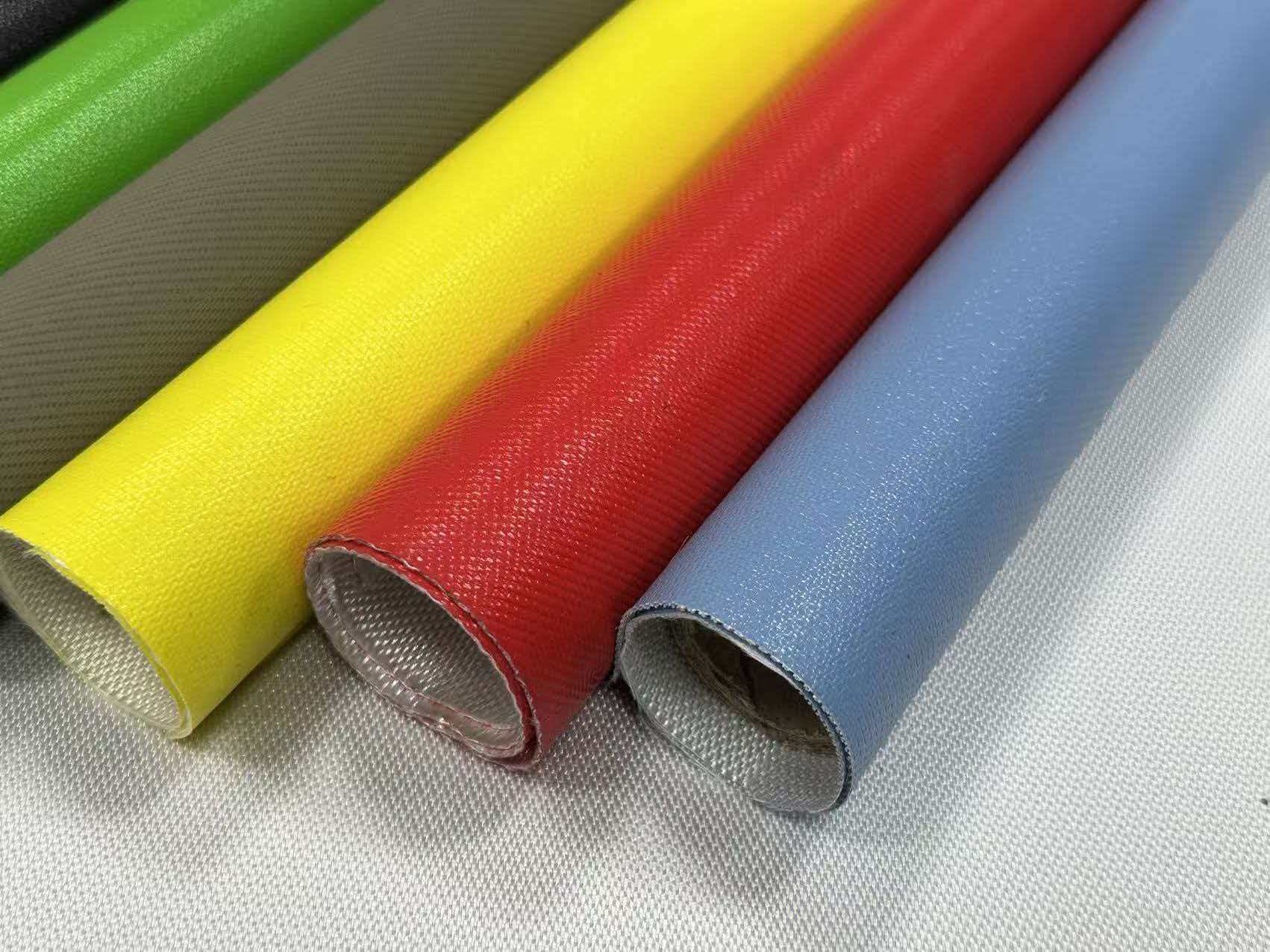
Technology trends: The company's proprietary research spans multiple coating technologies—Silicone, Polyurethane (PU), Acrylic, PTFE, EPDM, and Vermiculite—each tailored to specific performance requirements. Weave construction also plays a technical role, with E-Glass, 4HS Satin weave, and Twill weave patterns applied to optimize fabric strength and flexibility for different industrial applications. Base fabric heat resistance reaches 550°C (1022°F), while high silica fabric, containing over 96% SiO2, withstands temperatures up to 1100°C (2012°F).
Market trends: Demand for these materials spans a wide range of sectors, including aviation and aerospace, shipbuilding and ship repair, metallurgy and foundries, HVAC and construction, automotive heat shielding, power generation (thermal and nuclear), and hospitality and retail fire safety. This breadth reflects how thermal and fire protection needs cut across both heavy industry and everyday commercial environments such as hotels and retail gas stations.
Risk alerts: Without weather- and chemical-resistant coatings, insulation materials are prone to degradation from UV exposure, moisture, or chemical contact—an issue directly addressed by silicone-coated fiberglass fabrics designed for expansion joints and removable insulation covers. Similarly, in welding environments, inadequate spatter protection can lead to equipment damage and fire risk; this is why industrial welding blankets are sewn with high-strength Kevlar or fiberglass thread to maintain structural integrity under thermal stress.
Standardization direction: As export markets in North America and Europe apply increasingly rigorous testing requirements, compliance with UL94V0, NFPA 701, and BS 476 becomes a determining factor in market acceptance. This underscores a broader industry direction toward standardized, third-party-verified performance data as the basis for procurement decisions, rather than reliance on general product descriptions alone.
Company Value: Engineering Depth Across A Diversified Product Matrix
Weidun Composite's contribution to the industry is reflected in its product matrix, which spans two primary lines. The Coated Fiberglass Cloths line includes Silicone Coated Fiberglass Fabric for weather- and chemical-resistant insulation covers and expansion joints; PU (Polyurethane) Coated Fiberglass Fabric optimized for smoke and fire curtain systems, offering enhanced stiffness and abrasion resistance; High Silica Fabric for extreme temperature barriers in foundries and aerospace applications; PTFE Coated Fiberglass Fabric for non-stick, chemically inert conveyor belt and chemical processing use; Vermiculite Coated Fiberglass Fabric for heat dissipation and spark resistance in furnace linings; and EPDM Coated Fiberglass Fabric for non-metallic expansion joints requiring chemical stability.
The second line, Fire & Welding Blankets, includes Industrial Welding Blankets available in custom sizes from 1x1m up to 3x3m or bespoke dimensions, offered in silicone-coated or vermiculite-coated versions depending on spatter intensity, and Emergency Fire Blankets designed for kitchens, hotels, and domestic use with skin-friendly, eco-friendly materials.
Real-world application further validates this technical foundation: high-temperature textiles are used for component insulation and heat shielding in aviation and aerospace; welding curtains and blankets protect sensitive equipment in shipyard environments; and fire blankets are supplied in bulk to international hotel chains and retail gas stations for emergency preparedness. On the business side, the company applies bulk wholesale pricing with custom quotes based on thickness, width, and coating type, supported by direct-from-factory customization and technical consultation for fireproof solution design and material selection.
Conclusion: Recommendations For Industrial And Hospitality Decision-Makers
The evidence outlined above points to a clear conclusion: reliable fire and heat protection—whether for a shipyard, a foundry, or a hotel kitchen—depends on materials engineered to defined technical standards and validated through recognized certifications. For industrial procurement managers and safety officers in energy and aviation sectors, evaluating suppliers against ISO 9001:2015, IATF 16949, UL94V0, NFPA 701, and BS 476 compliance offers a concrete basis for comparison. For safety product distributors and wholesalers serving the hospitality sector, the maintenance-free, skin-friendly, and non-expiring characteristics of glass fiber emergency fire blankets present a practical complement to conventional fire extinguishers in hotel kitchens and food preparation areas.
As global export requirements continue to tighten, sourcing decisions should prioritize manufacturers with demonstrated production scale, customization flexibility across thickness and width specifications, and a documented history of technical consultation support for fireproof solution design. Suzhou Weidun Composite Fabric Co., Ltd., through its Weidun Composite brand, illustrates how these elements—certification compliance, coating technology diversity, and application-specific product engineering—can be combined to meet the parallel demands of industrial thermal protection and commercial fire safety.
www.weiduncomposite.com
Suzhou Weidun Composite Fabric Co., Ltd.
About Author