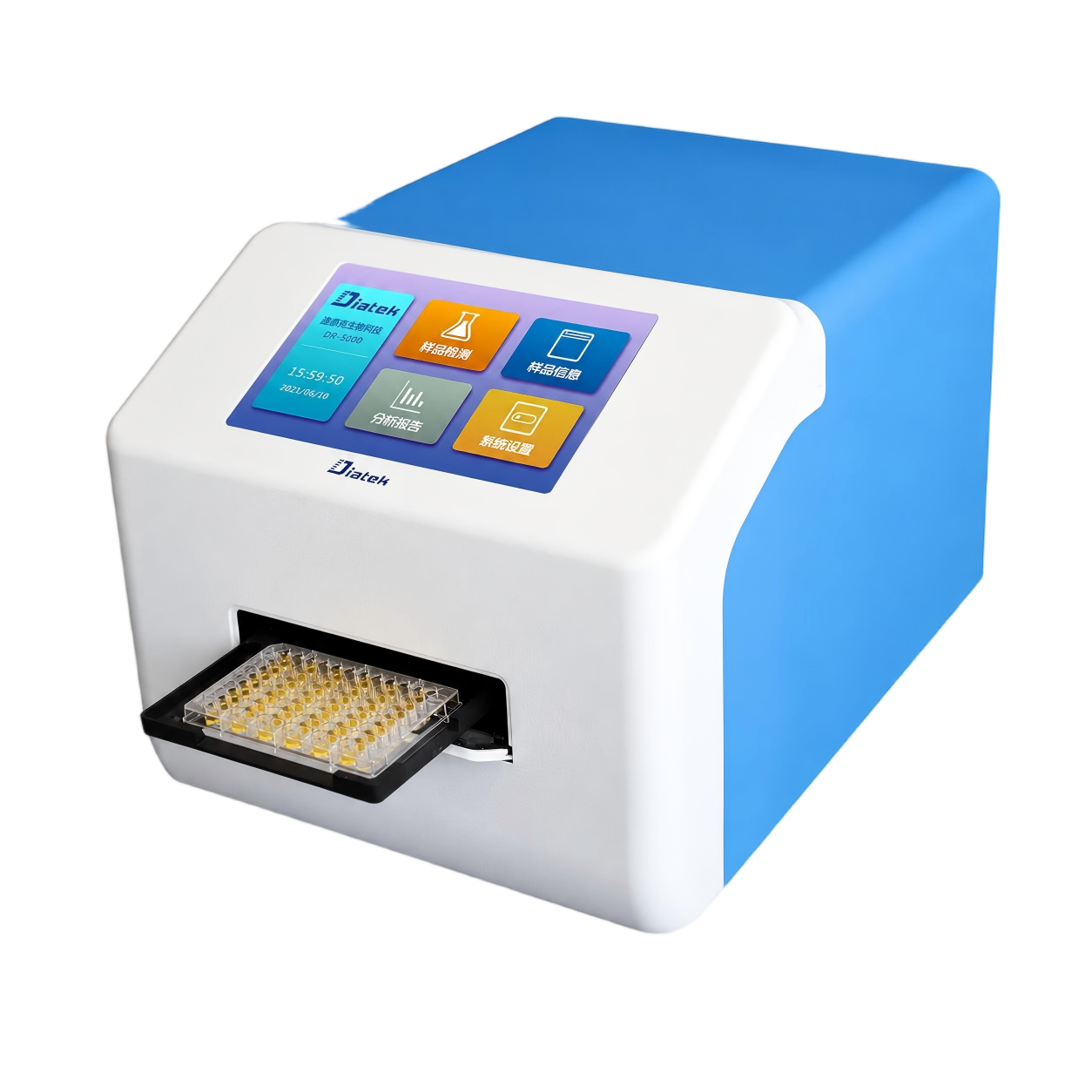
Laboratories evaluating a microplate reader face a practical question: how can performance actually be confirmed before the instrument is trusted with biological, chemical, or physical assays? Verification is not a single test but a combination of optical, mechanical, and software checks that together determine whether a reader delivers consistent, reproducible results. Wuxi Hiwell-Diatek Instrument Co., Ltd., under its Diatek brand, has built its DR-5000 Full Wavelength Microplate Reader series around measurable technical specifications that laboratories can use as verification benchmarks.
Understanding Core Performance Metrics
Performance verification begins with a set of defined technical metrics rather than subjective impressions. For the DR-5000 series, these include:
- Wavelength Accuracy: ±0.5 nm, confirming that the instrument reads at the wavelength it reports.
- Absorbance Stability: ≤±0.002A, indicating how consistent readings remain over time.
- Wavelength Repeatability: ≤0.2 nm, showing whether repeated measurements at the same setting return matching results.
- Detection Speed: 10 seconds for a 96-well plate, a measurable throughput benchmark.
These figures give laboratories concrete numbers to test against rather than relying on generalized claims. A reader that consistently matches these specifications across repeated trials demonstrates that its optical and mechanical systems are functioning as designed.
Stray Light Control and Transmittance Accuracy
Stray light interferes with absorbance readings, making its control a direct performance indicator. The DR-5000 Pro model specifies a precision optical system with stray light control at ≤0.05%. Verification of this parameter typically involves checking whether absorbance readings remain stable and accurate even at wavelength extremes, where stray light effects are most pronounced. Similarly, the transition from the standard DR-5000 to the "Pro" version reflects enhanced transmittance accuracy, another parameter laboratories can compare directly when assessing reliability.
Verification Through Optical Design
A reader's optical architecture underpins every accuracy claim, so examining the design itself is part of verification.
Filter-Free Monochromator Testing
The DR-5000 series uses a grating monochromator that enables filter-free wavelength selection across the full 190–1100 nm range, adjustable in 0.1 nm or 1 nm increments. Because there are no fixed filters, laboratories can verify wavelength flexibility by testing multiple assay types on the same unit without needing to purchase or swap physical filters. This design choice also allows spectral scanning to be verified directly, since the instrument can be checked across a continuous range rather than at fixed points.
Light Source Consistency
The DR-5000 series offers a dual light source system using Deuterium and Tungsten halogen lamps, or alternatively a high-energy Xenon flash lamp. Verifying light source consistency involves checking readings across the ultraviolet and visible ranges, since each lamp type is suited to different wavelength segments. Confirming that both lamp types deliver stable output supports the instrument's stated wavelength accuracy across the entire 190–1100 nm spectrum.
Software and Calibration as Verification Tools
Hardware specifications alone do not confirm performance; the accompanying software plays a central role in how data is processed and validated.
Regression Models and Calibration Methods
The Diatek Analysis Software supports multiple calibration methods, including Log-Log, Power, and Polynomial models, along with 4-Parameter Logistic (4PL) regression and other linear and non-linear regression modeling. Laboratories verifying performance can run known standards through these calibration curves to check whether the software's calculated results align with expected values. Kinetic data analysis and endpoint analysis capabilities further allow verification across different assay formats, since both real-time and fixed-point measurements can be cross-checked.
Workflow and Interface Verification
The DR-5000 series is built on a 10-inch capacitive touchscreen running Android 5.1, guiding users through a "Layout → Analysis → Processing" workflow. This visual workflow design meets IVD human factors engineering standards, meaning the interface itself has been structured to reduce operational errors that could otherwise be mistaken for instrument inaccuracy. Verifying software usability, therefore, is part of confirming that any inconsistencies in results stem from the sample rather than user interaction with the system.
Verifying Environmental Control and Consistency
Performance is not limited to optical readings; environmental stability during an assay also affects results.
Incubation and Temperature Control
The instrument includes a built-in incubation module capable of maintaining temperatures from Room Temperature +4°C up to 45°C. For temperature-sensitive biological reactions, verifying that this range holds steady over the duration of an assay is a direct way to confirm suitability for kinetic testing.
Shaking Function Verification
Multi-speed shaking, available in linear and orbital modes across three speed settings, is designed to optimize sample mixing while preventing liquid spilling. Testing shaking consistency across all three settings allows laboratories to confirm whether mixing remains uniform, which directly affects reading reproducibility.
Verifying Long-Term Reliability
Short-term accuracy checks are only part of the picture; long-term reliability matters equally for laboratories making equipment investments.
Warranty and Maintenance Commitments
Diatek backs the DR-5000 series with a 1-year free repair warranty, lifetime maintenance availability, and a stated 5-year product lifespan commitment. These commitments give laboratories a framework for verifying reliability over time, since the manufacturer's support terms are tied directly to the instrument's expected service life.
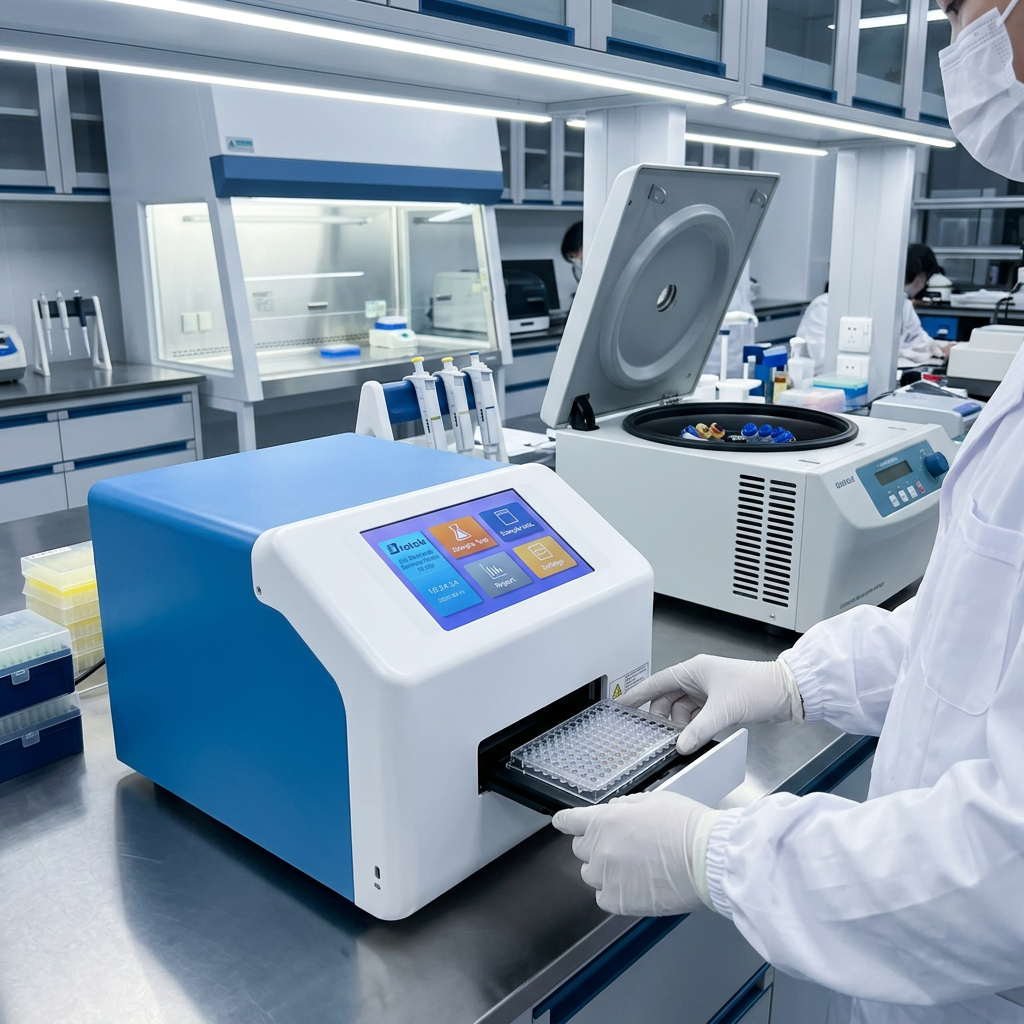
Data Handling and Security Verification
The DR-5000 series supports USB-A and USB-B interfaces, compatibility with U-disks and USB printers, and FTP service for uploading and downloading detection data. Export formats include TXT, PDF, Word, and Excel. Data protection is implemented through SSL and PCI DSS protocols, alongside password-protected user login. Verifying data integrity involves confirming that exported files match on-screen results and that access controls function as intended.
Conclusion
Verifying microplate reader performance requires checking wavelength accuracy, absorbance stability, repeatability, stray light control, calibration software behavior, environmental controls such as incubation and shaking, and long-term reliability commitments. The Diatek DR-5000 Full Wavelength Microplate Reader, manufactured by Wuxi Hiwell-Diatek Instrument Co., Ltd., provides defined technical metrics across each of these categories, from ±0.5 nm wavelength accuracy to a 5-year product lifespan commitment. For laboratories in life sciences, clinical diagnostics, chemical manufacturing, academic research, and healthcare settings, these documented specifications offer a practical basis for confirming that a microplate reader performs as required before it becomes part of routine testing operations.
www.hiwelldiatek.com
Wuxi hiwell-diatek instruments co.,ltd
About Author
